
Metellina
Chamberlin & Ivie, 1941
Autumn Spider
Species Guides
3- Metellina curtisi
- Metellina mimetoides
- Metellina segmentata(Autumn spider)
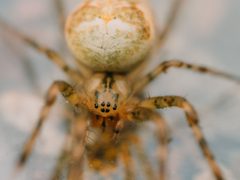
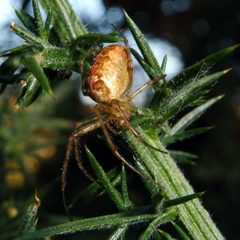
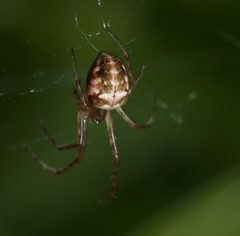
Metellina is a of orb-weaving spiders in the Tetragnathidae, distributed primarily across Eurasia with two in North America. The genus includes sixteen species as of 2025, with M. segmentata being the most abundant orb-weaving spider in Germany and introduced to Canada. Metellina spiders construct webs low in vegetation and are commonly known as Autumn Spiders. Some researchers have proposed placing this genus in a distinct family, Metidae.
Pronunciation
How to pronounce Metellina: /me.tɛˈliː.na/
These audio files are automatically generated. While they are not always 100% accurate, they are a good starting point.
Identification
Most similar to the related Meta. Distinguished by flat epigynal plate with -facing copulatory openings, canoe-shaped tapetum in secondary , and single macroseta on palpal patella.
Images
Appearance
longer than wide, usually without . Secondary possess a canoe-shaped tapetum. lateral eyes located on a single tubercle. Epigynal plate flat with posterior-facing copulatory openings. ducts originate near area of spermathecae with mass of accessory glands near copulatory ducts. Palpal patella bears one macroseta.
Habitat
Web dwellers that construct webs low in vegetation. Includes both epigean (woodland) and hypogean (cave) ; M. merianae occurs in caves while M. mengei inhabits woodland. Web inclination affects prey capture success.
Distribution
Primarily Eurasia. Two found in North America; M. segmentata introduced to Canada. African species include M. barreti, M. gertschi, M. longipalpis, M. merianopsis, M. minima, M. villiersi, and M. haddadi from South Africa.
Seasonality
Active during autumn; commonly known as Autumn Spider.
Host Associations
- Megaetaira madida - Alters web architecture of M. merianae
Behavior
Males of M. segmentata compete for access to mates by guarding orb webs of mature females. Male contests determined by relative body size and prior residency; larger males (>10% size advantage) nearly always win, while prior residents win when size asymmetries are smaller. Contest duration decreases exponentially with increasing size asymmetry. Males adjust fighting effort based on female . Males perform leg-twitching vibrations on female webs that mimic struggling prey, causing females to adopt predatory posture rather than cannibalistic posture during courtship, thereby reducing sexual risk.
Ecological Role
Orb-web ; M. mengei shows no significant edge effect on prey capture quantity in woodland , suggesting minimal impact from habitat fragmentation.
Human Relevance
M. segmentata is the most abundant orb-weaving spider in Germany and has been introduced to Canada.
Similar Taxa
Sources and further reading
- BugGuide
- Wikipedia
- GBIF taxonomy match
- iNaturalist taxon
- NCBI Taxonomy
- Catalogue of Life
- Male exploitation of female predatory behaviour reduces sexual cannibalism in male autumn spiders, Metellina segmentata
- A comparison of morphology and web geometry between hypogean and epigean species of Metellina orb spiders (family Tetragnathidae)
- A comparison of morphology and web geometry between hypogean and epigean species of Metellina orb spiders (family Tetragnathidae)
- No edge effect on quantity of prey captured in the forest-dwelling tetragnathid orb spider Metellina mengei
- A Synopsis of African Metellina (Aranei, Tetragnathidae, Metainae) with Description of a New Species from South Africa
- Figure 1 from: Hesselberg T, Simonsen D (2019) A comparison of morphology and web geometry between hypogean and epigean species of Metellina orb spiders (family Tetragnathidae). Subterranean Biology 31: 53-65. https://doi.org/10.3897/subtbiol.31.36222
- Figure 1 from: Hesselberg T, Simonsen D (2019) A comparison of morphology and web geometry between hypogean and epigean species of Metellina orb spiders (family Tetragnathidae). Subterranean Biology 32: 1-13. https://doi.org/10.3897/subtbiol.32.36222
- Web architecture alteration of the orb web weaving spiderMetellina merianae(Araneae, Tetragnathidae) induced by the parasitoidMegaetaira madida(Ichneumonidae,Polysphinctagroup)
- Spiders of the generaAraniella, Zygiella, ZillaandMangora(Araneae, Araneidae) from Israel, with notes onMetellinaspecies from Lebanon
- Fighting in Males of the Autumn Spider, Metellina segmentata: Effects of Relative Body Size, Prior Residency and Female Value on Contest Outcome and Duration
- Figure 2 from: Hesselberg T, Simonsen D (2019) A comparison of morphology and web geometry between hypogean and epigean species of Metellina orb spiders (family Tetragnathidae). Subterranean Biology 32: 1-13. https://doi.org/10.3897/subtbiol.32.36222
- Figure 2 from: Hesselberg T, Simonsen D (2019) A comparison of morphology and web geometry between hypogean and epigean species of Metellina orb spiders (family Tetragnathidae). Subterranean Biology 31: 53-65. https://doi.org/10.3897/subtbiol.31.36222