
Metellina segmentata
(Clerck, 1757)
Autumn spider, Eurasian Armoured Long-jawed Spider, Meta segmentata
Metellina segmentata is an orb-weaving spider in the Tetragnathidae, commonly known as the Autumn spider due to its late-season activity. The exhibits pronounced : males possess longer legs and a broader prosoma, while females are markedly heavier with a larger opisthosoma adapted for production. Adults mature from August to October, with males competing aggressively for access to female webs through ritualized contests influenced by relative body size, prior residency, and female reproductive value. The species builds characteristic orb webs with a radial frame supporting spiral sticky silk, typically positioned 0.5–2 meters above ground in edge .

Pronunciation
How to pronounce Metellina segmentata: /mɛˈtɛlɪnə sɛɡmɛnˈtɑːtə/
These audio files are automatically generated. While they are not always 100% accurate, they are a good starting point.
Identification
Distinguished from primarily by season of maturity: present August–October versus April–July for M. mengei. M. merianae differs in markings. Identification from M. mengei requires examination of genitalia for certainty. Body size decreases latitudinally, with northern British smaller than southern ones. Woodland specimens average smaller than those from open clearings. Web structure diagnostic for Tetragnathidae: orb web with open hub lacking central threads.
Images
Appearance
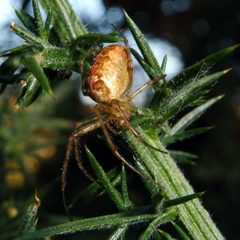
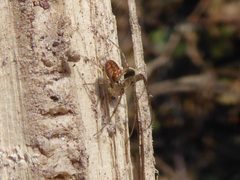
Small to medium-sized orb-weaver with distinct . Males measure 4–6 mm in body length with characteristically long legs and broad prosoma; females measure 4–8 mm with disproportionately heavy, rounded opisthosoma. displays variable coloration including yellow, red, and orange with black markings; surface pale cream with red and pink shades. bears black fork-like central marking. Female underside shows black strip extending to epigyne. Both sexes possess powerful ; females have notably large epigynes. Coloration and markings vary considerably among individuals.
Habitat
Occupies low vegetation and structures from ground level to approximately 2 meters height. Prefers edge at woodland margins, gardens, and open clearings adjacent to woods. Found in both mature woodland and more open disturbed areas, with body size varying between these habitats. Web placement typically in low bushy vegetation, between tree branches, or on leaves. Larger individuals occupy higher-quality sites with superior lighting and wind conditions; smaller individuals relegated to lower-quality areas such as window corners and dense bushes.
Distribution
Native to the Palaearctic region, with core distribution in Europe where it is common and widespread, especially abundant in the United Kingdom. Range extends through Turkey, Israel, Caucasus, Russia (European to South Siberia), Kazakhstan, Iran, China, and Japan. Introduced to Canada with established . Collected specimens documented from Oxford, England (51.74°N, –1.30°W).
Seasonality
with strict seasonal . overwinter, hatching around mid-June. Juveniles progress through four instars, maturing in approximately two months. present from August to October (late summer through autumn), with some sources extending this to mid-August through December. Peak adult activity coincides with late-season flowering and prey abundance in edge .
Diet
Prey captured in orb webs consists of flying insects, primarily Diptera (flies) and Lepidoptera (). Prey wrapped in silk and consumed immediately or preserved for several days. Some individuals observed to store wrapped prey. Specific prey spectrum varies with and season.
Life Cycle
cycle. deposited in spherical white cocoons on twigs or bark, until mid-June hatch. Juveniles undergo four instars over approximately two months, reaching maturity by late summer. live one to two years post-maturation. Female correlates strongly with body size: 2 mm width produces ~80 eggs, 3 mm width produces ~160 eggs. Male size also influences female fecundity, with larger males associated with higher egg production in mates.
Behavior
Builds orb webs with radial frame supporting spiral of sticky silk, positioned relatively low above ground. Spider typically occupies web center but retreats to edge, maintaining contact through signaling thread. Males practice intensive mate-guarding, occupying female webs and defending against rivals. Contests between males involve ritualized displays and physical combat, with outcomes determined by relative body size (larger male wins when >10% larger), prior residency, and female reproductive value. Contest duration decreases exponentially with increasing size asymmetry, indicating mutual assessment. Males delay copulation until female captures and bites prey, exploiting female predatory to reduce sexual risk. Some males present captured prey or even rival male corpses to females as . Sexual cannibalism of males by females has been documented.
Ecological Role
of flying insects; contributes to regulation of dipteran and lepidopteran in late-season edge . Webs provide microhabitat for kleptoparasitic . Serves as prey for larger predators and some vertebrates. Male-male competition and female choice dynamics represent well-studied examples of and contest in spiders.
Human Relevance
Non-venomous to humans; no documented bites despite in gardens and human-populated areas. Occasionally referenced in older literature by synonym Meta segmentata. Subject of extensive behavioral research on , contest , and mating strategies in spiders. sequenced as part of biodiversity initiatives.
Similar Taxa
- Metellina mengeiOverlapping European distribution; distinguished by earlier season (April–July versus August–October) and requires genital examination for certain identification
- Metellina merianaeThird British ; differs in markings and
More Details
Male-Male Competition Dynamics
Research demonstrates that male contest involves sophisticated assessment strategies. When size asymmetry exceeds 10%, larger males almost invariably defeat opponents. For smaller asymmetries, prior residency determines outcome. Contest duration reflects both size asymmetry and resource value, with males fighting longer over larger, more fecund females. This represents one of the first documented cases of assessment strategies in orb-web-building spiders.
Anti-Predation Mating Tactics
Males have evolved specific to reduce sexual , including delayed copulation until females are occupied with prey handling. Some males kill rival males and present the wrapped corpse to females, or present captured prey items, potentially reducing female aggression during mating approaches.
Sexual Size Dimorphism Evolution
Positive correlation between and clutch size drives selection for larger females. Larger females possess more powerful legs and to support heavier loads. Male preference for larger females intensifies selection, creating feedback loop increasing dimorphism across .
Sources and further reading
- BugGuide
- Wikipedia
- GBIF taxonomy match
- iNaturalist taxon
- NCBI Taxonomy
- Catalogue of Life
- Psychidae | Beetles In The Bush
- Coleoptera | Beetles In The Bush | Page 3
- Cantharidae | Beetles In The Bush
- Male exploitation of female predatory behaviour reduces sexual cannibalism in male autumn spiders, Metellina segmentata
- Fighting in Males of the Autumn Spider, Metellina segmentata: Effects of Relative Body Size, Prior Residency and Female Value on Contest Outcome and Duration
- The genome sequence of the Autumn Spider, Metellina segmentata (Clerck, 1757).