
Tetragnatha
Latreille, 1804
Stretch Spiders, Long-jawed Orb Weavers
Species Guides
11- Tetragnatha caudata(tailed long-jawed orbweaver)
- Tetragnatha dearmata
- Tetragnatha elongata(Elongate Stilt Spider)
- Tetragnatha extensa(Common Stretch Spider)
- Tetragnatha guatemalensis(Guatemalan long-jawed spider)
- Tetragnatha laboriosa(Silver Long-jawed Orbweaver)
- Tetragnatha nitens(Nitens long-jawed spider)
- Tetragnatha pallescens(Long-jawed orb weaver)
- Tetragnatha straminea(long-jawed orb weaver)
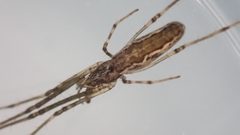
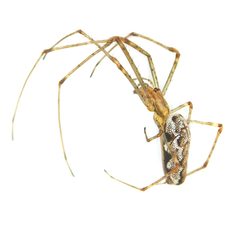
Tetragnatha is a large of long-jawed orb-weaving spiders with hundreds of distributed worldwide, though most occur in tropical and subtropical regions. These spiders are characterized by their elongated bodies, extremely long legs, and notably elongated (jaws) with well-developed teeth. They construct horizontal orb webs, often near water, and many species can run across water surfaces. The genus exhibits remarkable variation in ability, with some species being excellent dispersers capable of colonizing islands, while others appear to have secondarily lost this capacity. Hawaiian Tetragnatha species have undergone adaptive radiation, with some lineages evolving (running) and abandoning web-building entirely.
Pronunciation
How to pronounce Tetragnatha: //ˌtɛtrəɡˈneɪθə//
These audio files are automatically generated. While they are not always 100% accurate, they are a good starting point.
Identification
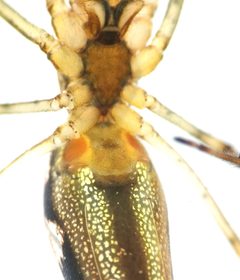
Distinguished from other orb-weaving (Araneidae) by their horizontal web orientation, extremely elongated body and legs, and long . -level identification requires microscopic examination of genitalia—females have genital openings at the end of the procurved epigastric furrow with unsclerotized genital plates; males possess a separate movable paracymbium with coiled embolus and conductor. spacing and jaw length relative to length also aid identification. Distinguished from other Tetragnathidae by the combination of elongated cylindrical , long chelicerae with distinct tooth rows, and typical horizontal orb-web construction.
Images
Habitat
Occupies tall herb and tree layers, particularly in vegetation near or above streams, ponds, and slow-flowing water in sunlit areas. Meadow-dwelling occur in grasses and fields. Requires humid ; without access to moisture, spiders suffer dehydration. Some species have evolved habits on the Hawaiian islands, living on vegetation without building webs.
Distribution
Worldwide distribution including Greenland, with highest diversity in tropics and subtropics. Fifteen occur in North America. Notable disjunct include the Hawaiian archipelago, where adaptive radiation has occurred. Caribbean populations result from multiple overwater events from mid-Eocene to late-Miocene rather than ancient vicariance.
Seasonality
activity peaks in summer. In T. praedonia, newly hatched spiderlings emerge repeatedly from June through September, indicating multivoltinism with multiple per year.
Diet
Primarily small flying insects, especially Diptera such as and gnats smaller than 3 mm. Larger prey including Lepidoptera, craneflies, and are captured when available. T. laboriosa and related show documented prey preferences for aquatic and semi-aquatic insects.
Life Cycle
Multivoltine with repeated of spiderlings through the active season. In T. praedonia, developmental time from emergence to is 57–59 days for males and 47–51 days for females. Females lay in silken egg sacs that may be adhered to twigs or suspended on web periphery; appearance varies by . Spiderlings disperse after their first molt outside the egg sac.
Behavior
Constructs horizontal or near-horizontal orb webs with open hub and 30–40 viscid spirals; webs are short-lived and taken down daily or more frequently, with silk material digested and recycled. When at rest, stretches front legs forward and other legs backward to align with grass blades or stems, rendering it nearly invisible—hence "stretch spider" . When disturbed, dashes from web to hug vegetation and merge with substrate. Capable of on water surfaces at high speed using alternating diagonal rhythm of legs I and II while dragging legs III and IV behind. Some Hawaiian have evolved , abandoning web-building entirely and actively hunting on vegetation. T. guatemalensis exhibits social behavior, building communal webs spanning acres. During mating, both sexes grasp each other's jaws; males use cheliceral spurs to receive female fangs.
Ecological Role
of small flying insects, particularly aquatic emergent insects such as , gnats, and mayflies. Helps regulate of nuisance insects near water bodies. Serves as prey for various and predators. Hawaiian occupy predatory similar to those filled by other spider elsewhere.
Human Relevance
Generally beneficial due to on , mosquitoes, and other nuisance insects. No significant medical importance; bites to humans are rare and not considered dangerous. Communal webs of T. guatemalensis occasionally attract public attention when exceptionally large occur.
Similar Taxa
- Araneidae (typical orb-weavers)Construct vertical rather than horizontal orb webs; have shorter, more robust bodies and legs; lack the extremely elongated and stretching camouflage posture.
- Linyphiidae (sheetweb weavers)Build flat or dome-shaped sheet webs rather than orbs; have shorter legs and more compact bodies; lack the distinctive jaw elongation.
- Pachygnatha (another tetragnathid genus)Also long-jawed orb-weavers but with shorter, stouter bodies and different genitalia structure; web architecture differs.
- Dolomedes (fishing spiders)Also associated with water and have long legs, but are hunters that do not build webs for prey capture; have different arrangement and body proportions.
Sources and further reading
- BugGuide
- Wikipedia
- GBIF taxonomy match
- iNaturalist taxon
- NCBI Taxonomy
- Catalogue of Life
- Spider Researcher Rosemary Gillespie to Present UC Davis Seminar | Bug Squad
- Bug Eric: Spider Sunday: Longjawed Orb Weavers
- Bug Eric: One Night, One House, Seventeen Spider Species
- Bug Eric: July 2012
- Life history of Tetragnatha praedonia (Araneae: Tetragnathidae)
- PREDATORY BEHAVIOR OF TETRAGNATHA PRAEDONIA (ARANEAE: TETRAGNATHIDAE)
- Global biogeography of Tetragnatha spiders reveals multiple colonization of the Caribbean
- Life History, Habits, and Prey Preferences of Tetragnatha laboriosa (Araneae: Tetragnathidae)
- New data on long-jawed spiders (Araneae, Tetragnathidae, Tetragnatha) from China.