
Dolomedes
Latreille, 1804
fishing spiders, raft spiders, dock spiders, wharf spiders
Species Guides
8- Dolomedes albineus(white-banded fishing spider)
- Dolomedes gertschi(New Mexico Fishing Spider)
- Dolomedes okefinokensis(Okefenokee Fishing Spider)
- Dolomedes scriptus(striped fishing spider)
- Dolomedes striatus
- Dolomedes tenebrosus(Dark Fishing Spider)
- Dolomedes triton(Six-spotted Fishing Spider)
- Dolomedes vittatus(Banded Fishing Spider)
Dolomedes is a of large spiders in the Dolomedidae, comprising over 100 worldwide. Most species are semiaquatic, hunting on water surfaces by detecting vibrations with specialized leg hairs. They exhibit remarkable locomotion abilities including on water, diving while breathing trapped air, and passive sailing using wind. The genus shows diverse preferences, with most species associated with freshwater habitats while some occupy terrestrial or arboreal .
Pronunciation
How to pronounce Dolomedes: //ˌdɒləˈmiːdiːz//
These audio files are automatically generated. While they are not always 100% accurate, they are a good starting point.
Identification
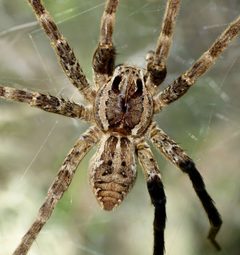
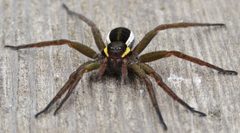
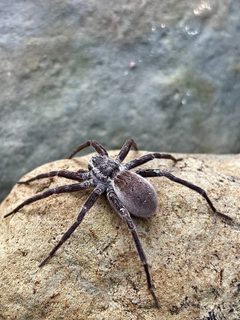
Distinguished from similar-looking wolf spiders (Lycosidae) by arrangement: Dolomedes has eight eyes in two rows with smaller eyes, versus wolf spiders' three rows. Aquatic adaptations provide additional differentiation: dense hydrophobic body hairs create silvery air film when submerged. Many display pale lateral stripes on the body. Large size with females of some species reaching 26 mm body length and 80 mm leg span.
Images
Habitat
Predominantly semiaquatic: found at edges of pools, streams, lakes, ponds, and bogs. Specific varies by : forest streams (D. aquaticus), bog pools (D. fimbriatus), fens (D. plantarius), small lakes and ponds (D. triton). Some species occupy non-aquatic habitats: D. tenebrosus occurs in wooded settings far from water; D. albineus is arboreal in cypress swamps and riparian forests.
Distribution
Worldwide distribution with highest in Asia, particularly Southeast Asia from China and Japan to New Guinea. Second highest diversity in tropical Africa. North America: nine including D. triton, D. tenebrosus, D. albineus. Europe: two species (D. fimbriatus, D. plantarius). New Zealand: four species. Madagascar: at least five species in humid forests. South America: four species.
Diet
Primarily aquatic and terrestrial insects detected through surface vibrations. Larger capture small fish (including goldfish, sticklebacks, and bass), tadpoles, and frogs. Opportunistic ambush ; some species mainly consume water striders.
Life Cycle
Females carry spherical sacs in jaws and until near hatching, then construct nursery webs in vegetation or other structures and guard egg sac and spiderlings. Spiderlings disperse after first . Some exhibit ballooning for . Males may outnumber females 3:1 in some species. Mating in D. tenebrosus results in obligate male death.
Behavior
Hunts by waiting at water's edge with front legs extended to detect prey vibrations through (sensitive leg hairs). Pursues prey across water surface or dives beneath using trapped air for breathing. hunting when avian are inactive. Multiple locomotion modes on water: passive sailing (raising front legs to catch wind), rowing (using leg dimples as oars), and galloping (rapid leg slicing at speeds up to 3 feet/second). Defensive diving when threatened by predators such as spider wasps.
Ecological Role
of aquatic insects and small vertebrates in freshwater . Prey for birds, snakes, (on juveniles), and parasitic (Pompilidae, including Anoplius depressipes which can hunt spiders underwater). Contributes to nutrient transfer between aquatic and terrestrial .
Human Relevance
Generally harmless to humans despite large size; venom not medically significant. Occasionally encountered near human dwellings on docks, wharves, and buildings near water. Subject of scientific interest for biomimicry of water surface locomotion and vibration detection.
Similar Taxa
- Lycosidae (wolf spiders)Similar large, robust body form and hunting without webs; distinguished by arrangement in three rows versus Dolomedes' two rows, and lack of aquatic adaptations
- Pisauridae (nursery web spiders)Same historically; some reclassified to Dolomedidae; share -carrying and nursery web
Sources and further reading
- BugGuide
- Wikipedia
- GBIF taxonomy match
- iNaturalist taxon
- NCBI Taxonomy
- Catalogue of Life
- UC Davis Chemical Ecologist Walter Leal Says We're Like Bolas Spiders: Here's Why! | Bug Squad
- An arboreal fishing spider | Beetles In The Bush
- Bug Eric: Spider Sunday: Six-spotted Fishing Spider
- Bug Eric: Ballooning Spiders
- Bug Eric: One Night, One House, Seventeen Spider Species
- Bug Eric: Spider Sunday: Whitebanded Fishing Spider
- Behavior of Dolomedes tenebrosus
- Behavior of Dolomedes tenebrosus
- Figure 17: Estimated habitat preferences of the five Dolomedes species as summarized from Table 2.
- ‘Sailing’ behaviour in the fishing spider, Dolomedes triton (Walckenaer)
- Table 2: Habitat classification for each locality in Madagascar where Dolomedes specimens were collected and recorded; see Taxonomy for coordinates.
- New species of Dolomedes (Araneae: Dolomedidae) from Kerala, India with insights on Indian records of the genus.