
Dolomedes albineus
Hentz, 1845
white-banded fishing spider, whitebanded fishing spider
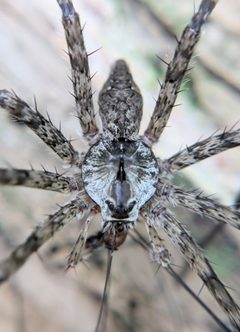
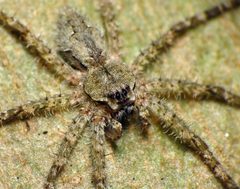
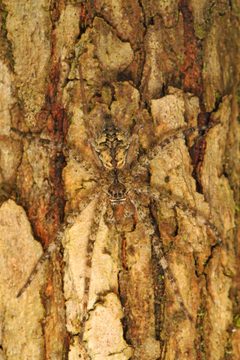
Dolomedes albineus is a large nursery web spider native to the southeastern and central United States. Mature females reach approximately 23 mm in body length, males about 18 mm. The is named for the distinctive white band immediately below the and above the , though coloration is highly variable—ranging from mottled gray to mossy green with darker markings. Unlike some fishing spiders, D. albineus is strongly associated with aquatic , particularly cypress swamps and river edges, where it hunts from perches on vegetation or pilings. Females carry sacs in their jaws before constructing nursery webs and guarding the emerging spiderlings.
Pronunciation
How to pronounce Dolomedes albineus: //ˌdɒləˈmiːdiːz ælˈbɪniəs//
These audio files are automatically generated. While they are not always 100% accurate, they are a good starting point.
Identification
Distinguished from other Dolomedes by the white band below the (absent in D. tenebrosus and D. triton). D. tenebrosus has interrupted white borders on 'W'-shaped abdominal markings and is frequently found far from water in wooded settings. D. triton has two rows of white spots on and is more widespread but scarce in the Midwest. D. albineus is larger than most sympatric fishing spiders and shows stronger association with aquatic than D. tenebrosus.
Images
Appearance
Large, robust spider with variable coloration. Mature females ~23 mm body length, males ~18 mm. Diagnostic white band present immediately below and above (jaws), though sometimes entire is white with central black spot. Body color ranges from mottled gray (blending with lichen-spotted bark) to mossy green with darker markings. patterned with variable markings. Legs long, adapted for sensing water surface vibrations.
Habitat
Edges of aquatic , especially cypress swamps, river backwaters, and floating docks. Frequently perches on emergent vegetation, pilings, or tree trunks at water's edge. Less commonly found in arboreal situations away from water compared to D. tenebrosus.
Distribution
Southeastern United States from Florida north to Appalachian Mountains of North Carolina, and west through Mississippi River basin to Kentucky and southern Missouri. Core range centered on coastal plain and lower Mississippi valley.
Seasonality
active primarily in spring and summer. One observation notes congregation of adults in tree holes and crevices, possibly for mating. Females guard nursery webs until spiderlings complete first .
Diet
Active hunting small fish, tadpoles, frogs, and aquatic . Also takes terrestrial and aerial insects that fall onto water surface or approach within striking range on shore. Detects prey through surface wave vibrations using specialized hairs on legs.
Life Cycle
Females carry spherical sac in jaws and until just before hatching, then construct nursery web amid foliage or bridge beams and suspend egg sac inside. Female guards egg sac and emerging spiderlings; spiderlings disperse after first outside egg sac. Female resumes hunting after parental duties conclude.
Behavior
Ambush that waits motionless on perches at water's edge. Capable of on water surface using water-repellent hairs; can dive and swim using air bubble trapped on for underwater hunting. Shows remarkable motion detection—reacts to visual stimuli by sidling to new positions rather than bolting. Males initiate courtship by generating rhythmic surface waves with legs or by following female draglines with rapid leg-tapping upon approach.
Ecological Role
Top in freshwater edge . Controls of small aquatic vertebrates and insects. Serves as prey for spider wasps including Anoplius depressipes.
Human Relevance
Not dangerously venomous to humans; venom used for subduing prey. Occasionally encountered by humans near water bodies; may cause alarm due to large size. Documented from Waccamaw National Wildlife and similar protected areas.
Similar Taxa
- Dolomedes tenebrosusSimilar size and arboreal habits, but has interrupted white borders on 'W'-shaped abdominal markings and is frequently found far from water; lacks diagnostic white band below
- Dolomedes tritonHas two rows of white spots on rather than single white band below ; more widespread but scarce in Midwest; prefers quiet water of ponds and lakes
More Details
Taxonomic note
listed as Dolomedidae in some sources (including Catalogue of Life and iNaturalist ) but Pisauridae in GBIF and most modern treatments; Pisauridae is currently accepted.
Research opportunities
, habits, and poorly documented; researcher James Carico noted possible 'mating swarm' behavior of congregating in tree holes and crevices in 1973, but this remains unconfirmed and would be unusual for arachnids.
Sources and further reading
- BugGuide
- Wikipedia
- GBIF taxonomy match
- iNaturalist taxon
- Catalogue of Life
- Bug Eric: Spider Sunday: Whitebanded Fishing Spider
- Limacodidae | Beetles In The Bush
- August | 2022 | Beetles In The Bush
- entomology | Beetles In The Bush | Page 5
- Bug Eric: Spider Sunday: Six-spotted Fishing Spider
- An arboreal fishing spider | Beetles In The Bush