
Dolomedes triton
(Walckenaer, 1837)
Six-spotted Fishing Spider
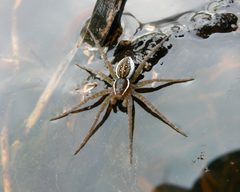
A large semi-aquatic fishing spider native to North America, named for the mythological Greek god Triton. Mature females reach 17–20 mm body length, males 9–13 mm. Distinguished by two rows of white spots on the , though spot count varies and does not always total six. Hunts primarily from floating vegetation at water's edge, detecting prey through water surface waves with remarkable . Exhibits sophisticated locomotion including rowing, sailing, and galloping across water surfaces.
Pronunciation
How to pronounce Dolomedes triton: //ˌdɒləˈmiːdiːz ˈtraɪtɒn//
These audio files are automatically generated. While they are not always 100% accurate, they are a good starting point.
Identification
Large body size with extensive leg span making spiders appear even larger. Two rows of white spots on , though number varies and may not equal six. Mature females 17–20 mm, males 9–13 mm. Color and pattern highly variable between individuals. Distinguished from similar Dolomedes by spot pattern and association; D. albineus has white band under and above , D. tenebrosus has interrupted white borders behind W-shaped abdominal markings and occurs in wooded settings often far from water.
Images
Habitat
Quiet freshwater environments including ponds, lakes, and river backwaters. Rests on emergent vegetation or floating objects in horizontal plane, maintaining contact with water surface using first two pairs of legs. Positions at distances from shore proportional to width of vegetation zone. positively correlated with aquatic vegetation presence, negatively correlated with wind-generated wave amplitude.
Distribution
Widespread in North America, present from Canada through the United States; records from Alberta, Canada and throughout USA. Present in Cuba and Caribbean. Scarce in Midwest and Rocky Mountains.
Seasonality
Active primarily during warmer months. In central Alberta, semivoltine with two periods; juveniles grow rapidly May–August, virtually no growth September–April. Spiderling ballooning peaks at 5 days after hatch, declining thereafter.
Diet
Prey captured using water surface wave detection; 68% responsiveness to surface waves, 48% to air-borne vibrations at distances under 10 cm, exclusively surface waves beyond 10 cm. Visual prey capture rare (14% success). Prey includes terrestrial and aerial insects blown onto water surface or falling from vegetation; capable of capturing aquatic vertebrates including small fish, tadpoles, and frogs up to four to five times spider's own weight, though such large prey rarely targeted and success rate under 10%.
Life Cycle
Semivoltine in central Alberta with two periods; main overwintering stages instars 3–5 and 9–11. Variable number of stages: 10–15 in males, 9–15 in females. After second overwintering, large juveniles moult once or twice to reach reproductive stage. Both overwintering phases facultative; at high temperatures (24–25°C) and long-day conditions can develop directly to adults. Mated females create spherical sac carried in jaws and until just before hatching, then construct nursery web suspending egg sac inside, guarding egg sac and spiderlings until first , after which spiderlings disperse.
Behavior
Rests motionless in ambush posture on vegetation, detecting prey through water surface waves using and metatarsal lyriform organs; turns toward wave source with mean error angle of 9.3°. Pursues prey underwater rarely; dives primarily to escape , especially spider wasp Anoplius depressipes, using fine body hairs to trap air layer against breathing holes. Three distinct surface locomotion modes: rowing (using leg dimples as oars, leisurely speed), sailing (raising legs to catch wind, speed correlates with wind velocity up to 0.3 m/s, passive with little speed control), and galloping (slicing water rapidly with leg tips, body elevated, speeds up to 3 feet per second, unsustainable). Male courtship involves generating rhythmic surface waves with legs or following female dragline with rapid leg-tapping; leg-touching identity verification dance precedes mating.
Ecological Role
in freshwater edge ; contributes to regulation of aquatic and terrestrial insect . Spiderling ballooning contributes to of new habitats including temporary water bodies.
Human Relevance
Occasionally encountered near human settlements with suitable water bodies. Not dangerously venomous to humans; venom used for prey capture. Subject of behavioral and sensory research due to sophisticated wave detection and surface locomotion abilities.
Similar Taxa
- Dolomedes albineusWhitebanded Fishing Spider has white band under and above rather than abdominal spots; primarily southeastern US in cypress swamps; often on tree trunks and pilings rather than floating vegetation.
- Dolomedes tenebrosusDark Fishing Spider has interrupted white borders behind W-shaped abdominal markings; frequently found far from water in wooded settings, hibernates under bark; more arboreal use.
Sources and further reading
- BugGuide
- GBIF taxonomy match
- iNaturalist taxon
- NCBI Taxonomy
- Catalogue of Life
- Bug Eric: Spider Sunday: Six-spotted Fishing Spider
- Bug Eric: Ballooning Spiders
- Bug Eric: Fun With Austin Butterfly Forum
- An arboreal fishing spider | Beetles In The Bush
- Bug Eric: Spider Sunday: Whitebanded Fishing Spider
- ‘Sailing’ behaviour in the fishing spider, Dolomedes triton (Walckenaer)
- Sensory ecology of a semi-aquatic spider (Dolomedes triton)
- Sensory ecology of a semi-aquatic spider (Dolomedes triton)
- The diving and surface-walking behaviour of Dolomedes triton sexpunctatus (Araneida: Pisauridae)
- The vertebrate-catching behaviour of the fishing spider Dolomedes triton (Araneae, Pisauridae)
- Precopulatory sexual cannibalism in fishing spiders (Dolomedes triton): a role for behavioral syndromes
- Abiotic conditions rather than resource availability cues determine aerial dispersal behaviour in spiderlings of Dolomedes triton (Araneae: Pisauridae)
- The Role of Body Size in Mating Interactions of the Sexually Cannibalistic Fishing SpiderDolomedes triton
- Phenology and life-cycle regulation of the fishing spiderDolomedestritonWalckenaer (Araneae, Pisauridae) in central Alberta