
Gerromorpha
semiaquatic bugs, shore-inhabiting bugs, water striders, water measurers, velvet water bugs, water treaders, riffle bugs
Infraorder Guides
4- Gerroidea(Water Striders and Ripple Bugs)
- Hebroidea(Velvet Water Bugs)
- Hydrometridae(marsh treaders)
- Mesoveliidae(Water Treaders)
is an infraorder of true bugs (Hemiptera: Heteroptera) comprising approximately eight in four superfamilies. Members are commonly called semiaquatic or shore-inhabiting , though many are specifically adapted to exploit the water surface film. The group includes well-known such as Gerridae (water striders), Hydrometridae (water measurers), Hebridae (velvet bugs), and Veliidae (riffle bugs). Gerromorphans are distributed globally and are frequently used as bioindicators of aquatic quality.
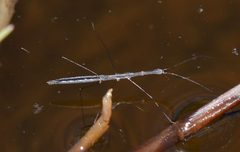
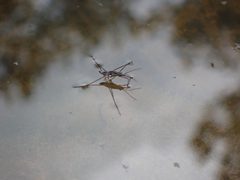
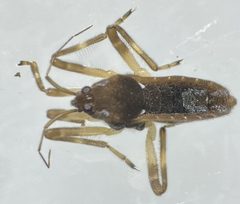
Pronunciation
How to pronounce Gerromorpha: //dʒɛ.ɹəˈmɔːɹ.fə//
These audio files are automatically generated. While they are not always 100% accurate, they are a good starting point.
Identification
Distinguished from Nepomorpha (true water bugs) by that are visible and not concealed in grooves beneath the , generally more slender body form, and predominant association with water surface film rather than submerged . Within , are distinguished by leg proportions (Gerridae with very long middle legs), body shape (Hydrometridae with elongated and body), and habitat preference (Hebridae in moist marginal vegetation, Veliidae in flowing water habitats).
Images
Habitat
Primarily associated with freshwater aquatic systems including lentic waters (lakes, ponds) and lotic waters (streams, rivers). Specific microhabitats vary by : Gerridae on open water surfaces, Veliidae in riffles and along stream margins, Hydrometridae in quiet waters or wet margins, Hebridae in moist terrestrial vegetation near water, and Mesoveliidae in emergent vegetation. Some occupy brackish coastal . Altitudinal range extends from lowlands to high-Andean lakes above 3,000 m.
Distribution
distribution with records from all continents except Antarctica. Documented from Colombia (Cundinamarca department, 1,585–3,700 m), Colorado USA, Kerala India, Romania, Mongolia, Canary Islands, eastern Amazon streams, and southern Brazil. Diversity is highest in tropical regions, particularly Neotropical aquatic .
Diet
Predatory; feeds on small and insects trapped on or near the water surface. Specific prey items include terrestrial insects that fall onto water, emerging aquatic insects, and other small arthropods.
Life Cycle
Hemimetabolous development with , nymph, and stages. Eggs are typically laid on submerged or emergent vegetation or other substrates at or near the water surface. Nymphs resemble adults in form and occupy similar , progressing through five instars before reaching adulthood.
Behavior
Locomotion on water surface enabled by hydrofuge leg setae that resist wetting and exploit surface tension; some can move rapidly (up to 1 m/s in Gerridae). Mating and territorial well-documented in Gerridae, involving complex surface wave communication. Some species exhibit wing with (fully winged) and brachypterous or (reduced or absent wing) forms, often correlated with permanence.
Ecological Role
in aquatic and semiaquatic , regulating of small . Important prey for fish, birds, and other aquatic predators. Widely used as bioindicators of water quality and integrity; composition and diversity reflect habitat structure, water chemistry, and disturbance regimes. Documented sensitivity to mining impacts and pipeline construction in Amazonian streams.
Human Relevance
Similar Taxa
- NepomorphaAlso aquatic Heteroptera, but distinguished by concealed (hidden in grooves beneath ), generally more robust body form, and primarily submerged or bottom-dwelling habits rather than surface-dwelling. Ochteroidea within Nepomorpha also occupy shore , creating potential confusion.
More Details
Systematics
Eight in four superfamilies: Mesovelioidea (Mesoveliidae, Madeoveliidae), Hebroidea (Hebridae, Macroveliidae), Hydrometroidea (Hydrometridae, Paraphrynoveliidae), and Gerroidea (Gerridae, Veliidae, ). Phylogenetic relationships indicate Mesovelioidea and Hebroidea represent basal lineages, with Hydrometroidea and Gerroidea forming a more derived clade.
Conservation relevance
Documented sensitivity to degradation makes valuable for conservation planning. Studies in the eastern Amazon demonstrate negative impacts of mining pipelines on diversity, while work in Colombia establishes baseline data for high-altitude lake .
Sources and further reading
- BugGuide
- Wikipedia
- iNaturalist taxon
- NCBI Taxonomy
- The Heteropterans (Gerromorpha and Nepomorpha) of Andean lakes from Colombia
- New Reports of Semi-Aquatic Bugs (Hemiptera: Heteroptera: Gerromorpha)
- An illustrated checklist of Nepomorpha and Gerromorpha (Hemiptera) of Colorado
- La hemipterofauna acuática epicontinental (nepomorpha y gerromorpha) de las Islas Canarias (España): faunística, biogeografía y novedades sinecológicas = The epicontinental water bugs (nepomorpha & gerromorpha) from Canary Islands (Spain): Faunistic data, biogeography and sinecology novelties
- NEW RECORS OF AQUATIC AND SEMI-AQUATIC BUGS (HETEROPTERA: NEPOMORPHA, GERROMORPHA) FROM MONGOLIA
- Review of the family Veliidae in Romania (Hemiptera: Heteroptera: Gerromorpha)
- Effect of the mining pipeline on habitat quality and the diversity of semiaquatic bug communities (Heteroptera: Gerromorpha) in streams of the eastern Amazon.
- New records of semi-aquatic bugs (Hemiptera, Heteroptera, Gerromorpha) from the South Region of Brazil.