
Hebridae
Amyot & Serville, 1843
Velvet Water Bugs
Genus Guides
3- Hebrus(velvet water bugs)
- Lipogomphus
- Merragata(velvet water bugs)
, known as velvet water bugs, is a small of semiaquatic Heteroptera within the infraorder Gerromorpha. The family comprises approximately 220 in 9 and 2 , distributed worldwide. Members are characterized by their small size, plump body form, and dense covering of setae that gives them a velvety appearance. They inhabit humid terrestrial and marginal freshwater , including mossy areas, pond margins, and stream banks with abundant vegetation.
Pronunciation
How to pronounce Hebridae: //ˈhɛbrɪdiː//
These audio files are automatically generated. While they are not always 100% accurate, they are a good starting point.
Identification
Distinguished from other Gerromorpha by combination of extremely small size, plump body form, and dense velvety . Hebrids walk or run on water surfaces rather than skating or sculling like Gerridae and most Veliidae. They lack the elongated body and long middle legs characteristic of water striders (Gerridae), and differ from Hydrometridae (water measurers) in body shape and movement pattern. Identification to and requires examination of genitalia and wing structure.
Images
Appearance
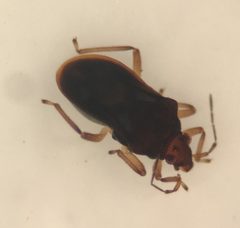
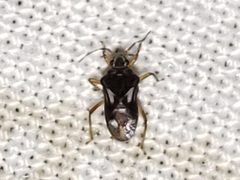
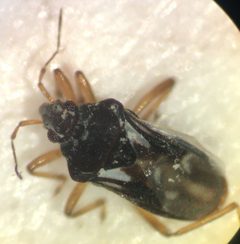
Small insects measuring 1.3–3.7 mm in body length. Plump, compact body shape with brownish to black coloration. Body surface densely covered with fine setae, producing a velvety texture. Wing variable; some are (short-winged) while others are fully winged. Overall appearance resembles tiny veliids (small water striders) but with a more robust, rounded body profile.
Habitat
Humid terrestrial environments and marginal freshwater . Found among moss, at muddy margins of small streams, on emergent rocks, and in ponds with abundant vegetation. Specific microhabitats include coastal mangrove forests, stream banks, and vegetated pond margins. In Thailand, Hebrus nereis has been collected from muddy margins of small streams and emergent rocks in mangrove forests.
Distribution
Worldwide distribution. Documented from: South Thailand (mangrove forests of the Gulf of Thailand and Andaman Sea); Argentina (central region); Australia (with and ); West-Palaearctic region including Morocco, Bulgaria, Israel, Romania, Iran, Oman, Greece, Lithuania, Cyprus; Kazakhstan (Taldybulak River); and Scandinavia (Denmark, Norway, Sweden).
Diet
Predatory, feeding on small arthropods.
Behavior
Semiaquatic locomotion characterized by or running across water surfaces rather than skating. Movement is slower and more deliberate than that of water striders. Activity patterns in specific microhabitats include foraging among vegetation and on moist substrates at water margins.
Similar Taxa
- VeliidaeSimilar small size and preference, but veliids typically have more elongated bodies and exhibit skating locomotion on water surfaces, whereas hebrids walk or run.
- GerridaeBoth are Gerromorpha, but gerrids (water striders) are larger with elongated bodies and long middle legs adapted for skating, while hebrids are smaller, plumper, and move by .
- HydrometridaeShare semiaquatic habits and small size, but hydrometrids (water measurers) have extremely elongated bodies and characteristic measuring gait, contrasting with the compact, velvety form of hebrids.
More Details
Taxonomic composition
The contains approximately 220 in 2 and 9 . Notable genera include Hebrus (the largest genus), Lipogomphus, Merragata, and Austrohebrus ( to Australia). The Australian fauna shows high with one-third of gerromorphan genera and over 80% of species being endemic.
Phylogenetic position
belongs to the superfamily Hebroidea within the infraorder Gerromorpha. Phylogenetic analyses based on morphological characters support their placement as a distinct lineage within semiaquatic bugs, though relationships with some veliid and gerrid remain unresolved.
Sources and further reading
- BugGuide
- GBIF taxonomy match
- iNaturalist taxon
- NCBI Taxonomy
- Catalogue of Life
- New data on Corixidae and Hebridae (Heteroptera) of Kazakhstan
- A new species of Hebrus (Hemiptera: Heteroptera: Hebridae) from Argentina
- Hebridae, Gelastocoridae, and Mesoveliidae (Hemiptera: Heteroptera) from mangrove areas in Thailand
- Review of West-Palaearctic Hebridae with description of a new species and redescription of Hebrus fulvinervis (Hemiptera: Heteroptera)
- Mesoveliidae, Hebridae, and Hydrometridae of Australia (Hemiptera : Heteroptera : Gerromorpha), with a reanalysis of the phylogeny of semiaquatic bugs