
Saldidae
Amyot & Serville, 1843
Shore bugs
Subfamily Guides
2- Chiloxanthinae(shore bugs)
- Saldinae
is a of true bugs (Hemiptera: Heteroptera) commonly known as shore bugs. are small (2–8 mm), oval-shaped insects associated with shoreline . The family comprises approximately 350 described in 39 and 2 (Chiloxanthinae and Saldinae), with highest diversity in the Nearctic and Palearctic regions. Members are and scavengers, and many species tolerate submergence during high tides. Winter survival occurs through or adult .
Pronunciation
How to pronounce Saldidae: /ˈsældaɪdiː/
These audio files are automatically generated. While they are not always 100% accurate, they are a good starting point.
Identification
Distinguished from other shore-associated Heteroptera by the combination of small oval body, compact build, and shoreline preference. Distinguished from Gerridae (water striders) by shorter legs not adapted for skimming and more compact body. Distinguished from Veliidae (small water striders) by larger size and different leg proportions. Distinguished from Mesoveliidae by body shape and habitat specificity. -level identification requires examination of male genitalia (parameres, parandria) and detailed external .
Images
Appearance
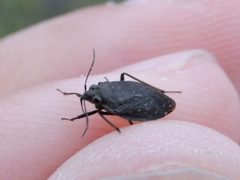
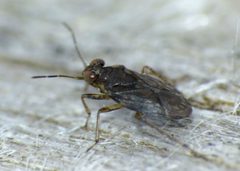
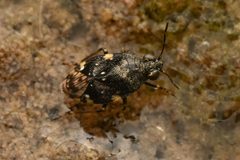
Small, oval-shaped true bugs measuring 2–8 mm in length. Body typically compact with relatively short . present with distinct and membranous apex. Coloration variable, often cryptic (brown, black, or mottled) matching shoreline substrates. Some exhibit metallic reflections. Legs relatively short and stout; hind legs modified for jumping in some . Wings fully developed, allowing .
Habitat
Primarily shoreline and : margins of freshwater bodies (lakes, ponds, streams), estuaries, sea coasts, and intertidal zones. Many occupy the supralittoral zone, with some tolerant of periodic submergence during high tides. Associated with marginal vegetation, , and debris along water edges. Some species occur in alkaline flats and other specialized shoreline environments.
Distribution
Worldwide distribution with approximately 350 described . Highest in Nearctic and Palearctic realms. Documented from all major zoogeographic regions: Palearctic (Europe, Asia, including China with 50+ species), Nearctic (North America), Neotropical (Central and South America), Afrotropical, Oriental, Australasian (including New Zealand with ), and Pacific islands (Samoa). Specific records include: China (50 species in 13 genera), New Zealand (endemic genera Kiwisaldula and Zemacrosaldula), Eastern Tropical Pacific (Panamic Province from Sea of Cortez to Ecuador).
Seasonality
Activity patterns vary by latitude and . and nymphs active during warmer months in temperate regions. Some exhibit winter as or adults. In intertidal habitats, activity patterns may be tide-dependent.
Diet
and scavengers. Specific prey items not well documented in available sources; feeding habits inferred from -level characterization.
Life Cycle
Hemimetabolous development with , nymph, and stages. Winter passed through egg or adult . Nymphs occur alongside adults in suitable shoreline . Specific developmental details and nymphal instar counts not documented in available sources.
Behavior
Can flee disturbance by leaping or taking . Some tolerate submergence during high tides, with and nymphs surviving periodic inundation. Activity likely influenced by tidal cycles in intertidal and temperature/season in inland habitats.
Ecological Role
and scavengers in shoreline and littoral . Contribute to nutrient cycling in marginal aquatic . Serve as prey for larger and vertebrates in shoreline . Some are indicators of specific shoreline habitat conditions.
Human Relevance
Occasionally encountered by entomologists and naturalists in shoreline . Some may serve as indicators of water quality or shoreline habitat integrity. No significant economic importance documented; neither major pests nor beneficial species in human contexts.
Similar Taxa
- GerridaeWater striders share shoreline but have extremely long, slender legs adapted for skimming on water surface and more elongate body form
- VeliidaeSmall water striders overlap in but are generally smaller with different body proportions and leg structure
- MesoveliidaeWater treaders occur in similar but differ in body shape and habitat specificity; some are euryhaline and occasionally invade marine habitats
More Details
Taxonomic diversity
comprises 39 in 2 (Chiloxanthinae and Saldinae). World catalog documents 30 genera and 307 -group (298 species, 9 ) in 3 tribes. Significant regional radiations include genera in New Zealand (Kiwisaldula, Zemacrosaldula).
Salt tolerance
Many occupy intertidal zones and demonstrate physiological to saltwater submergence. Species such as Saldula pallipes can survive high-tide submergence, representing to dynamic shoreline environments.
Collection note
A field observation from Salt Plain National Wildlife , Oklahoma, documents Pentacora signoreti () occurring on alkaline flats, where its small size and cryptic appearance led to initial misidentification as a tiger ().
Sources and further reading
- BugGuide
- Wikipedia
- GBIF taxonomy match
- iNaturalist taxon
- NCBI Taxonomy
- Catalogue of Life
- Mantispidae | Beetles In The Bush
- July | 2024 | Beetles In The Bush
- Taxonomic review of Saldula (Hemiptera: Heteroptera: Saldidae) from China
- Kiwisaldula (Hemiptera: Heteroptera: Saldidae) from the South Island of New Zealand: new species and identification key
- Synopsis of the shore bugs of China (Hemiptera: Heteroptera: Leptopodomorpha: Saldidae)
- World Saldidae: Supplement (1987–2018) to the catalog and bibliography of the Leptopodomorpha (Heteroptera)
- Records of Salda sahlbergi Reuter from the Urals and Taimyr (Heteroptera: Saldidae)
- A New Species of Omania from Samoa, with Notes on Its Biology (Heteroptera: Saldidae)
- (Gelastocoridae, Gerridae, Mesoveliidae, Saldidae, Veliidae)
- Distribution of the Wilbur Springs Shore Bug (Hemiptera: Saldidae): A Product of Abiotic Tolerances and Biotic Constraints
- Zemacrosaldula, a new genus of Saldidae (Hemiptera: Heteroptera) from New Zealand: taxonomy, geographic distribution, and biology
- Distribution of the Wilbur Springs Shore Bug (Hemiptera: Saldidae) 1 : Predicting Occurrence Using Water Chemistry Parameters
- Complete mitochondrial genome of Saldoida armata Horváth, 1911 (Heteroptera: Saldidae) and phylogenetic analysis.