
Dolomedes scriptus
Hentz, 1845
striped fishing spider
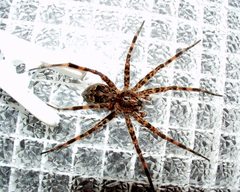
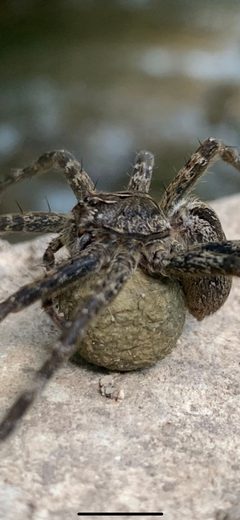
Dolomedes scriptus, the striped fishing spider, is a large semi-aquatic hunting spider native to North America. Females can exceed 6 cm in legspan. The is distinguished by pale brown coloration with lighter stripes on the legs and a longitudinal stripe along each side of the body. It is closely related to D. tenebrosus and shares the 's characteristic ability to hunt on and near water surfaces.
Pronunciation
How to pronounce Dolomedes scriptus: //ˌdoʊləˈmiːdiːz ˈskrɪptəs//
These audio files are automatically generated. While they are not always 100% accurate, they are a good starting point.
Identification
Distinguished from the closely related D. tenebrosus (dark fishing spider) by color pattern: D. scriptus shows pale brown with lighter stripes on legs and lateral body stripes, while D. tenebrosus is darker with 'W'-shaped abdominal markings and interrupted white borders behind them. D. scriptus lacks the six abdominal spots characteristic of D. triton. Large size and semi-aquatic help separate from most other spider ; arrangement (two large eyes with smaller eyes in three rows) confirms family Pisauridae.
Images
Appearance
Large spider with pale brown base coloration. Legs bear lighter-colored stripes. Each side of the body has a distinct longitudinal stripe running its length. Females reach over 6 cm in legspan, making them among the largest spiders in eastern North America. Males are smaller. The overall build is robust with long, laterally extended legs typical of the .
Habitat
Associated with aquatic and semi-aquatic environments including ponds, lakes, rivers, and streams. Also found in wooded settings near water. Has been observed on tree trunks and building exteriors at night. Requires access to water surfaces for hunting.
Distribution
United States and Canada. Documented from Ontario and Manitoba in Canada. Occurs across North America with presence in eastern and central regions.
Behavior
Nocturnally active hunter. Has been documented on building exteriors and tree trunks at night. As a Dolomedes , likely capable of surface locomotion on water using surface tension, though specific for D. scriptus are not detailed in available sources.
Ecological Role
Apex in freshwater edge . Likely contributes to regulation of aquatic and terrestrial insect and small aquatic vertebrates.
Human Relevance
Large size and presence on buildings can cause alarm, but not dangerously venomous to humans. May be encountered during nighttime inspection of building exteriors near water bodies.
Similar Taxa
- Dolomedes tenebrosusSimilar size and ; distinguished by darker coloration and 'W'-shaped abdominal pattern with interrupted white borders rather than lateral body stripes
- Dolomedes tritonSimilar aquatic hunting ; distinguished by two rows of white spots on (typically six, though variable) rather than lateral stripes
More Details
Taxonomic note
placement varies between sources: Catalogue of Life and NCBI list Dolomedidae, while GBIF and traditional classifications use Pisauridae. The Dolomedes is well-established within the nursery web spider group.
Observation frequency
Over 11,000 observations documented on iNaturalist, indicating the is regularly encountered by naturalists despite being primarily .