
Tetragnatha extensa
(Linnaeus, 1758)
Common Stretch Spider
Tetragnatha extensa is a long-jawed orb-weaver spider with a Holarctic distribution. It is characterized by an extremely elongated body and legs, with females reaching up to 11 mm in body length. The constructs horizontal orb webs in damp, vegetated and exhibits a distinctive straight-line defensive posture when alarmed. It is the most common species of Tetragnatha in the United Kingdom and among the most frequently encountered long-jawed orb weavers across its range.
Pronunciation
How to pronounce Tetragnatha extensa: /ˌtɛtrəɡˈneɪθə ɪkˈstɛnsə/
These audio files are automatically generated. While they are not always 100% accurate, they are a good starting point.
Identification
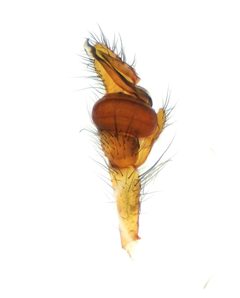
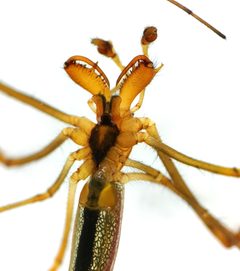
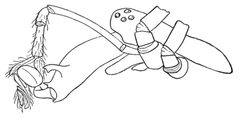
Distinguished from by the microscopic structure of male genitalia (curved tip of conductor) and female spermatheca . General appearance similar to other Tetragnatha , requiring examination of reproductive structures for definitive identification. The straight-line defensive posture—legs extended fore and aft along a stem or leaf midrib—is characteristic of the but not unique to this species.
Images
Habitat
Occupies low-growing vegetation in damp or moist environments. Frequently found in meadows, riparian corridors, coastal vegetation, and areas near water bodies. Has been recorded at tree line in the Rocky Mountains, indicating broad ecological .
Distribution
Holarctic distribution across the Northern Hemisphere. In North America: Alaska to Newfoundland, south to Washington, Colorado, and Pennsylvania. In Europe: widespread including coastal vegetation; throughout the United Kingdom where it is the commonest Tetragnatha ; also recorded from Madeira.
Seasonality
active May through September in the United Kingdom; May through July in Alaska. Overwinters as early-instar spiderlings.
Diet
Feeds on flying insects captured in its web, including mosquitoes, , and .
Life Cycle
Mating involves minimal courtship; male and female lock jaws, possibly to prevent female on the male. sacs are globular, covered with grey tufted silk resembling bird droppings, and pressed against plant stems. stage is early-instar spiderlings.
Behavior
Constructs loosely built, horizontal orb webs. When alarmed, assumes a straight-line posture: sits along a plant stem, grass blade, or leaf with four legs pointing forward and four legs pointing backward, achieving effective camouflage. Capable of on water surface, moving faster on water than on land.
Ecological Role
of small flying insects; contributes to of mosquitoes, , and other aquatic-emergent insects. Serves as prey for larger and possibly small vertebrates.
Human Relevance
agent for nuisance insects such as mosquitoes and midges. No documented negative impacts on humans; non-aggressive and bites are not considered medically significant.
Similar Taxa
- Other Tetragnatha speciesRequire microscopic examination of genitalia for separation; T. extensa distinguished by male conductor shape and female spermatheca structure.
- Tetragnatha viridisEasily distinguished by emerald green coloration; T. extensa lacks this consistent green pigmentation and shows more variable coloration.
- Araneidae (typical orb-weavers)Construct vertical rather than horizontal orb webs; have shorter and more robust body proportions.
More Details
Taxonomic history
First described by Carl Linnaeus in Systema Naturae (1758) as Aranea extensa, marking one of the earliest binomial names in zoological .
Population status
Among the most abundant spiders in suitable within its range; particularly common in the United Kingdom where it dominates Tetragnatha .