
Tetragnatha viridis
Walckenaer, 1841
Green Long-jawed Orbweaver
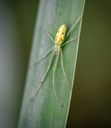
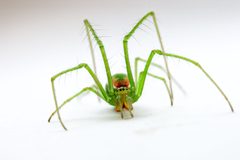
Tetragnatha viridis is a of long-jawed orb-weaver spider in the Tetragnathidae, distinguished by its striking emerald green coloration. It is found in the eastern United States and adjacent southern Canada, with recent records documenting its presence in Quebec, Canada. Like other members of its , it constructs horizontal orb webs and possesses characteristically elongated and slender body proportions.
Pronunciation
How to pronounce Tetragnatha viridis: //ˌtɛtræɡˈneɪθə ˈvɪrɪdɪs//
These audio files are automatically generated. While they are not always 100% accurate, they are a good starting point.
Identification
Tetragnatha viridis is the only emerald green in the Tetragnatha in North America, making it readily distinguishable from all other long-jawed orb-weavers in the region. Other Tetragnatha species are typically straw-colored, brown, or yellowish. Definitive species-level identification within the genus usually requires examination of genitalia, relative spacing, and the ratio of jaw length to length.
Images
Habitat
Found in meadows, fields, and riparian corridors. Like other Tetragnatha , it occupies near water or in grassy areas where horizontal orb webs can be constructed. Specific microhabitat preferences for T. viridis are not well documented, but the species has been collected from very different habitat types at separate locations in Quebec.
Distribution
Eastern United States and adjacent southern Canada. Documented from Quebec, Canada (first records in 2010 from Contrecoeur and Terrebonne), Vermont, and elsewhere in the eastern U.S. The ' full range within the United States is not precisely defined in available literature.
Seasonality
Active during summer months. In Quebec, specimens have been collected in June and September. General activity period likely spans late spring through fall, consistent with other temperate Tetragnatha .
Behavior
Constructs horizontal orb webs, typical of the Tetragnatha. When disturbed, individuals may dash from the web to cling to vegetation, using their slender bodies and leg posture to blend with grass stems or twigs. Mating involves both sexes grasping each other's jaws; males may possess spurs on the to receive female fangs. of conspecifics varies; some Tetragnatha build webs in close proximity, though T. viridis specifically has not been documented as colonial.
Ecological Role
of flying insects; horizontal webs are particularly effective at intercepting emergent aquatic insects such as , gnats, and mayflies. Contributes to insect in riparian and meadow .
Human Relevance
No documented direct economic or medical significance. As a of , mosquitoes, and other flying insects, it may provide incidental benefit to humans in riparian areas.
Similar Taxa
- Other Tetragnatha speciesShare elongated body form, long , and horizontal web construction, but differ in coloration (typically straw, brown, or yellow rather than emerald green)
- Araneidae (typical orb-weavers)Construct vertical rather than horizontal orb webs; lack the extremely elongated and slender body proportions of Tetragnathidae
More Details
Taxonomic history
First described by Walckenaer in 1841. The was first documented in Quebec, Canada in 2010, representing a northward range extension or previously overlooked .
Field identification reliability
The emerald green coloration is considered diagnostic for this in eastern North America; no other regional Tetragnatha species exhibits this color, making field identification unusually straightforward for a where species-level determination typically requires microscopic examination.
Sources and further reading
- BugGuide
- Wikipedia
- GBIF taxonomy match
- iNaturalist taxon
- NCBI Taxonomy
- Catalogue of Life
- Spider Researcher Rosemary Gillespie to Present UC Davis Seminar | Bug Squad
- Bug Eric: Spider Sunday: Longjawed Orb Weavers
- Bug Eric: July 2012
- Green Light: New ID Test Ready for Invasive Mealybug Pest
- Here We Go Again: Another Invasive Pest in Florida Citrus
- Bug Eric: One Night, One House, Seventeen Spider Species
- Premières mentions des araignées (Araneae) Phidippus audax Hentz, 1845 (Salticidae) et Tetragnatha viridis Walckenaer, 1841 (Tetragnathidae) au Québec