
Tetragnatha elongata
Walckenaer, 1841
Elongate Stilt Spider
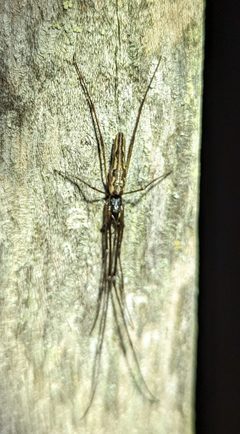
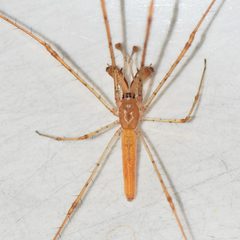
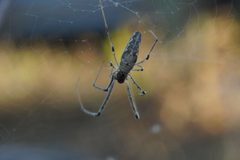
Tetragnatha elongata is a riparian spider in the Tetragnathidae, commonly known as the elongate stilt spider. It constructs small orb webs oriented horizontally or parallel to water surfaces near shorelines. When displaced onto water, it exhibits sophisticated orientation including concentric circling before traveling directly toward the nearest land. The is notable for its ability to walk on water using alternating leg movements while dragging its legs, and can employ silk extrusion to catch wind and be blown to shore.
Pronunciation
How to pronounce Tetragnatha elongata: //ˌtɛtrəɡˈnæθə iːˈlɒŋɡətə//
These audio files are automatically generated. While they are not always 100% accurate, they are a good starting point.
Identification
Long, slender body and legs characteristic of the Tetragnatha. Builds horizontal or near-horizontal orb webs, distinguishing it from most Araneidae orb weavers that construct vertical webs. Specific identification to level requires examination of genitalia, spacing, and relative jaw length to length.
Images
Habitat
Riparian adjacent to standing water and flowing fresh water. Constructs webs parallel to water surfaces.
Distribution
North and Central America, including the Caribbean (Cuba, Jamaica). GBIF records extend from Canada to Argentina.
Diet
Emerging aquatic insects including , gnats, and mayflies.
Behavior
web-building. When displaced onto water: performs orientation circles (10-20 cm diameter, 1-8 circles) before choosing direct path toward nearest shoreline; walks on water using alternating movements of first three leg pairs while dragging pair behind; can extrude silk to catch wind and be blown to shore (silking); travels approximately 10 times faster on water (38.9 cm/s) than on land (3.6 cm/s); adopts elongation posture (stick-like) when threatened to camouflage against vegetation.
Ecological Role
Important component of aquatic ; preys upon emerging aquatic insects, contributing to aquatic connectivity.
Similar Taxa
- Tetragnatha guatemalensisAlso builds communal webs, but T. elongata does not form the extensive communal webs characteristic of T. guatemalensis
- Tetragnatha viridisBoth in same , but T. viridis is distinctly emerald green and easily distinguished by coloration
- Araneidae (typical orb weavers)Construct vertical webs rather than the horizontal webs of T. elongata
Sources and further reading
- BugGuide
- Wikipedia
- GBIF taxonomy match
- iNaturalist taxon
- NCBI Taxonomy
- Catalogue of Life
- Good Bug, Bad Weed | Bug Squad
- Spider Researcher Rosemary Gillespie to Present UC Davis Seminar | Bug Squad
- Bug Eric: Spider Sunday: Longjawed Orb Weavers
- Bug Eric: One Night, One House, Seventeen Spider Species
- The role of prey availability in aggregative behaviour of the orb weaving spider Tetragnatha elongata
- Orientation behavior of riparian long‐jawed orb weavers (Tetragnatha elongata) after displacement over water