
Tetragnatha guatemalensis
O. Pickard-Cambridge, 1889
Guatemalan long-jawed spider
Tetragnatha guatemalensis is a long-jawed orb weaver spider notable for its exceptional social among typically solitary arachnids. Under favorable conditions, particularly during mass of , this constructs extensive communal webs that can span acres. The species demonstrates remarkable of conspecifics, with thousands of individuals cooperating to build shared silk structures. This social web-building represents the extreme end of a gradient of tolerance seen across the Tetragnatha.
Pronunciation
How to pronounce Tetragnatha guatemalensis: //ˌtɛtrəˈɡnæθə ˌɡwɑːtəˌmɑːˈlɛnsɪs//
These audio files are automatically generated. While they are not always 100% accurate, they are a good starting point.
Identification
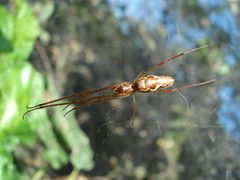
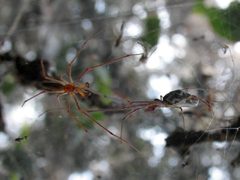
Distinguishable from other Tetragnatha by its propensity for communal web construction under certain conditions; most build solitary webs. Species-level identification requires examination of genitalia, spacing, and relative jaw length to length. As with all tetragnathids, possesses elongated and fangs, long slender body, and long legs.
Images
Habitat
Meadows, fields, and riparian corridors; often found near water where emergent aquatic insects provide abundant prey. Communal webs typically occur in situations with mass emergences of or other small aquatic insects.
Distribution
North America, Central America, Cuba, Jamaica, Brazil, and Paraguay.
Diet
Feeds on small flying insects, particularly , gnats, and mayflies. Communal webs are associated with mass events of these prey.
Behavior
Exhibits social rare among spiders, constructing communal webs involving thousands of individuals when prey abundance is high. This cooperative web-building represents an extreme expression of the general of conspecifics seen in the . Individuals typically occupy the hub of their webs in meadow , or sit on web perimeters near water, aligning their bodies with substrate to camouflage as broken vegetation.
Ecological Role
of emergent aquatic insects; communal webs may significantly reduce local of and mosquitoes.
Human Relevance
Communal webs can be conspicuous and extensive, occasionally attracting public attention. The 2007 Lake Tawakoni State Park web in Texas, covering acres, was constructed by this .
Similar Taxa
- Tetragnatha viridisBoth are long-jawed orb weavers with elongated bodies, but T. viridis is emerald green and solitary, never forming communal webs.
- Other Tetragnatha speciesMost build solitary horizontal orb webs and lack the extreme social web-building ; require genitalia examination for definitive separation.
Sources and further reading
- BugGuide
- Wikipedia
- GBIF taxonomy match
- iNaturalist taxon
- NCBI Taxonomy
- Catalogue of Life
- Bembicid Holdings | Entomology Research Museum
- Spider Researcher Rosemary Gillespie to Present UC Davis Seminar | Bug Squad
- Bug Eric: Spider Sunday: Longjawed Orb Weavers
- Bug Eric: July 2012
- Bug Eric: One Night, One House, Seventeen Spider Species