
Tetragnatha dearmata
Thorell, 1873
Tetragnatha dearmata is a of long-jawed orb weaver spider in the Tetragnathidae. The species was described by Thorell in 1873 and has a transcontinental distribution spanning North America and Eurasia. Like other members of the Tetragnatha, it possesses characteristically elongated and a slender body form adapted for camouflage in vegetation. Specific details of its and remain poorly documented in the available literature.
Pronunciation
How to pronounce Tetragnatha dearmata: /ˌtɛtrəɡˈnæθə ˌdiːɑːrˈmɑːtə/
These audio files are automatically generated. While they are not always 100% accurate, they are a good starting point.
Identification
Distinguished from other Tetragnatha by genitalia , relative spacing, and the proportional length of jaws to . Reliable identification to species level requires microscopic examination of external genitalia. Separated from orb weavers in Araneidae by horizontal web orientation and elongated body form. Distinguished from other long-jawed orb weavers in Tetragnatha only through detailed morphological analysis.
Images
Appearance
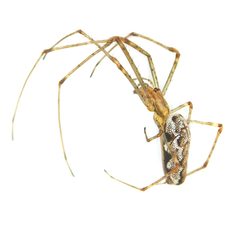
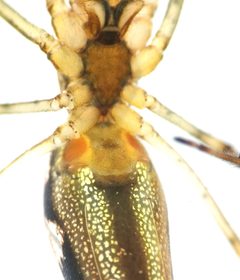
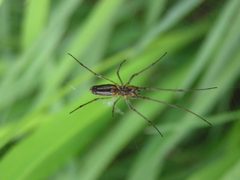
Body elongated and slender with exceptionally long (jaws) and fangs, characteristic of the Tetragnatha. Long, thin legs held close to the body at rest. Coloration typically straw-colored or pale, aiding camouflage against grass stems and vegetation. Body length likely falls within the 5–16 mm range typical for mature Tetragnatha, though specific measurements for this are not documented in the provided sources.
Habitat
Found in meadows, fields, and riparian corridors. Likely occupies vegetation near water bodies as well as grassland , based on patterns observed in . Webs constructed in horizontal or near-horizontal planes, typically anchored to grass stems, twigs, or emergent vegetation.
Distribution
North America (including Alberta and British Columbia, Canada; United States), Europe, Caucasus, and Russia (extending from Europe to the Russian Far East). Specific presence confirmed in Flanders, Belgium.
Seasonality
Active during summer months, consistent with the seasonal pattern of Tetragnathidae. Mature individuals may be encountered from spring through fall depending on geographic location.
Behavior
Constructs orb webs in horizontal or near-horizontal orientation. When disturbed, dashes from the web to hug nearby vegetation, pressing body close to stems to enhance camouflage. Tolerant of conspecifics; may build webs in close proximity to others of the same .
Ecological Role
of small flying insects. Likely contributes to of , gnats, mosquitoes, and other emergent aquatic insects when inhabiting riparian zones.
Similar Taxa
- Tetragnatha viridisBoth are emerald green long-jawed orb weavers, but T. viridis is restricted to the eastern United States and adjacent southern Canada and is reportedly unmistakable due to its distinctive coloration.
- Tetragnatha guatemalensisBoth build horizontal orb webs, but T. guatemalensis is essentially social and capable of constructing communal webs spanning acres, a not documented for T. dearmata.
- Araneidae (typical orb weavers)Both construct orb webs, but Araneidae typically orient webs vertically and lack the elongated and slender body form characteristic of Tetragnathidae.
More Details
Taxonomic note
Identification of Tetragnatha to the species level is described as an inexact science requiring examination of genitalia, spacing, and jaw proportions relative to length. The specific epithet 'dearmata' may relate to reduced or modified armature, though this interpretation is speculative without direct examination of the original description.