
Tetragnatha nitens
(Audouin, 1826)
Nitens long-jawed spider
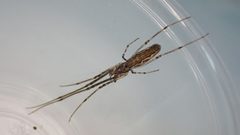
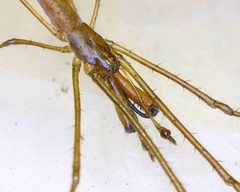
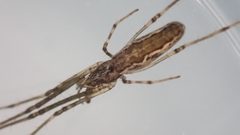
Tetragnatha nitens is a long-jawed orb weaver spider with a cosmotropical distribution spanning tropical and subtropical Asia, where it is native, and numerous introduced regions including the Americas, Macaronesia, Mediterranean Europe, Africa, Madagascar, Pacific islands, and New Zealand. The constructs horizontal orb webs in vegetation and has demonstrated ecological adaptability across diverse biomes including Fynbos, Grassland, Savanna, and Thicket. Listed as Least Concern due to its wide geographic range and presence in multiple protected areas.
Pronunciation
How to pronounce Tetragnatha nitens: //ˌtɛtrəˈɡnæθə ˈnaɪtɛnz//
These audio files are automatically generated. While they are not always 100% accurate, they are a good starting point.
Identification
Identification to level requires examination of genitalia and precise measurements of jaw length relative to length, plus relative spacing—features not reliably assessed from field observations alone. The specific epithet 'nitens' refers to a shining appearance, though this trait alone is insufficient for definitive identification.
Images
Habitat
Constructs orb webs in vegetation. Recorded from diverse biomes including Fynbos, Grassland, Indian Ocean Coastal Belt, Savanna, and Thicket. In South Africa, occurs from sea level to 1399 m elevation. Specimens have been sampled from trees adjacent to water bodies during daytime.
Distribution
Native to tropical and subtropical Asia; introduced and established in the Americas, Macaronesia (Madeira, Canary Islands), Mediterranean Europe, Egypt, Saint Helena, South Africa, Madagascar, Pacific islands, and New Zealand. In South Africa, known from six provinces including five protected areas. Recently recorded from Tamil Nadu, South India.
Life Cycle
Females deposit in silken egg sacs; sac placement and attachment style varies among Tetragnatha , with some adhered to substrates and others suspended at web periphery.
Behavior
Constructs orb webs in horizontal or near-horizontal orientation, distinguishing this from vertically-oriented Araneidae orb weavers. Tolerates proximity with individual webs built in close proximity to others.
Ecological Role
of flying insects; webs positioned to intercept aquatic insect (, gnats, mayflies) emerging from water.
Human Relevance
No documented direct impacts; presence in human-modified environments and protected areas suggests adaptability.
Similar Taxa
- Tetragnatha viridisEasy to distinguish—T. viridis is emerald green with no similar in eastern North America, whereas T. nitens lacks this distinctive coloration.
- Tetragnatha guatemalensisT. guatemalensis exhibits essentially social with communal webs spanning acres; T. nitens builds individual webs with only for proximity.
- Araneidae (typical orb weavers)Tetragnathidae construct horizontal orb webs versus the vertical webs of most Araneidae; also distinguished by elongated bodies and exceptionally long .
More Details
Etymology
The specific epithet 'nitens' is Latin for 'shining' or 'brilliant'.
Taxonomic history
Originally described from Egypt; revised by Okuma and Dippenaar-Schoeman in 1988.
Conservation status
IUCN Least Concern; no significant threats identified despite wide distribution including multiple protected areas in South Africa (Roodeplaatdam Nature Reserve, Addo Elephant National Park).
Sources and further reading
- BugGuide
- Wikipedia
- GBIF taxonomy match
- iNaturalist taxon
- NCBI Taxonomy
- Catalogue of Life
- Spider Researcher Rosemary Gillespie to Present UC Davis Seminar | Bug Squad
- Bug Eric: Spider Sunday: Longjawed Orb Weavers
- citizen science | Blog - Part 4
- Bug Eric: One Night, One House, Seventeen Spider Species
- Distributional notes on the long-jawed spider Tetragnatha nitens (Audouin, 1826) (Araneae, Tetragnathidae) from India