
Tetragnatha pallescens
F.O. Pickard-Cambridge, 1903
Long-jawed orb weaver
Tetragnatha pallescens is a of long-jawed orb-weaving spider in the Tetragnathidae. It occurs across North America, Central America, and the Caribbean. Like other members of its , it possesses elongated and constructs horizontal orb webs, often in riparian or meadow .
Pronunciation
How to pronounce Tetragnatha pallescens: /ˌtɛtrægˈnæθə pəˈlɛsɛnz/
These audio files are automatically generated. While they are not always 100% accurate, they are a good starting point.
Identification
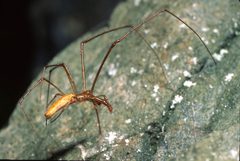
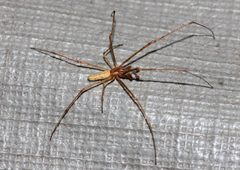
-level identification of Tetragnatha pallescens requires examination of genitalia. The Tetragnatha is distinguished from other orb-weaving by elongated bodies, long legs, and exceptionally long (jaws) and fangs. Within the genus, spacing patterns and relative jaw length compared to length are used for species differentiation. T. pallescens is described as pale in coloration, consistent with its specific epithet.
Images
Habitat
Based on -level patterns, Tetragnatha occupy two primary : meadows and fields, or riparian corridors near water. Water-associated species typically build webs over or adjacent to aquatic environments, where they capture emerging aquatic insects.
Distribution
Documented from North America, Central America, and the Caribbean. Specific regional records include the Canadian provinces of Alberta, Manitoba, and Saskatchewan.
Behavior
Horizontal web orientation distinguishes Tetragnatha from the vertically oriented webs of most Araneidae orb weavers. When disturbed, individuals rapidly retreat from webs to cling to vegetation, using their elongated bodies and legs pressed together to resemble broken grass stems. Some Tetragnatha demonstrate for proximity, with webs occasionally built in close .
Ecological Role
As an orb-weaving , likely contributes to regulation of flying insect , particularly aquatic emergent insects such as , gnats, and mayflies in riparian settings.
Similar Taxa
- Tetragnatha viridisBoth are North American Tetragnatha , but T. viridis is readily distinguished by its emerald green coloration, whereas T. pallescens is pale.
- Araneidae (typical orb weavers)Both construct orb webs, but Araneidae build vertically oriented webs and lack the elongated and slender body form characteristic of Tetragnathidae.
More Details
Taxonomic note
The specific epithet 'pallescens' (Latin: becoming pale) refers to the pale coloration of this .