
Pachygnatha
Sundevall, 1823
thickjawed orbweavers, long-jawed orb-weavers
Species Guides
6Pachygnatha is a of long-jawed orb-weaving spiders in the Tetragnathidae, containing approximately 44 distributed across Eurasia, Africa, and North America. are secondarily webless, with only spiders constructing orb webs. The genus is notable for its large and ground-dwelling habits in moist microhabitats. Several species have been documented as significant of agricultural pests and soil-dwelling , including aphids and ticks.
Pronunciation
How to pronounce Pachygnatha: /ˌpækɪˈɡneɪθə/
These audio files are automatically generated. While they are not always 100% accurate, they are a good starting point.
Identification
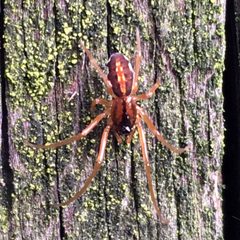
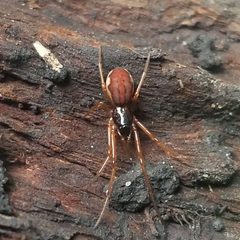
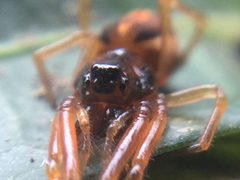
Members of Pachygnatha can be distinguished from other Tetragnathidae by their notably large : females consistently bear three teeth on the margin, while males have modified, expanded chelicerae sometimes bearing a spur on the outside above the base of the fang. The are closely grouped, with eyes separated by their own diameter. The is subspherical and slightly flattened, displaying a folium bordered by dark marks with adjacent silver spots; the folium typically has lobes, and paired white spots are often present. The legs are thin and lack macrosetae.
Images
Habitat
are typically found close to the ground in leaf litter, hollow plant stems, under stones, dead wood, or leaves. They are more numerous in damp areas. African species occur mainly in the lower litter layer, with some found at high altitudes in equatorial regions where water is available.
Distribution
Eurasia, Africa, and North America. Specific records include the United Kingdom, Far East Russia (Khabarovsk region), China, Burundi and the Albertine Rift, Cameroon to Malawi in equatorial Africa, and North America.
Diet
. Pachygnatha degeeri has been documented consuming aphids at disproportionately high rates, with individuals containing significantly greater concentrations of proteins than other spider . Pachygnatha listeri has been observed preying on Ixodes ricinus nymphs, representing the first record of a Tetragnathidae spider consuming tick nymphs.
Life Cycle
Only spiders construct orb webs; are secondarily webless.
Behavior
spiders are ground-dwelling and do not build capture webs. spiders construct orb webs. in damp areas show higher abundance. One species, Pachygnatha leleupi, is the most common species in the lower litter layer throughout equatorial Africa.
Ecological Role
Important component of soil . P. degeeri functions as a significant early-season agent in agricultural systems, limiting during the establishment phase and providing time for predators and to establish. P. listeri contributes to regulation of populations in soil . The appears to be an important element of afromontane spider fauna.
Human Relevance
Pachygnatha zappa was named in honor of musician Frank Zappa. Some have potential as agents in , particularly for suppression in winter wheat systems.
Sources and further reading
- BugGuide
- Wikipedia
- GBIF taxonomy match
- iNaturalist taxon
- NCBI Taxonomy
- Catalogue of Life
- Pachygnatha listeri - Entomology Today
- What Eats Ticks? Study Puts an Old Technique to New Use
- Bug Eric: December 2011
- Bug Eric: Spider Sunday: Spiders and Celebrities
- Redescription and a new synonym of the spider Pachygnatha amurensis Strand, 1907 (Araneae, Tetragnathidae, Tetragnathinae)
- On the genus Pachygnatha (Araneae, Tetragnathidae) in the Albertine Rift of Burundi, with the description of three new species
- Monoclonal antibodies reveal the potential of the tetragnathid spider Pachygnatha degeeri (Araneae: Tetragnathidae) as an aphid predator
- Two new species of the long-jawed orb-weaving spider genus Pachygnatha Sundevall, 1823 (Araneae, Tetragnathidae) from southern China