
Ixodes
Latreille, 1795
hard-bodied ticks, blacklegged ticks, deer ticks
Species Guides
7- Ixodes affinis
- Ixodes banksi
- Ixodes dentatus
- Ixodes kingi(Rotund Tick)
- Ixodes marxi(Squirrel Tick)
- Ixodes pacificus(Western black-legged tick)
- Ixodes scapularis(deer tick)
Ixodes is a of hard-bodied ticks ( Ixodidae) comprising approximately 274 with a near- distribution. It is the sole representative of the Prostriata clade, distinguished from Metastriata by an anal groove that loops to the . Many species serve as important , transmitting including Borrelia burgdorferi (), microti (), and Anaplasma phagocytophilum (anaplasmosis). Some species, notably Ixodes holocyclus, inject that can cause .
Pronunciation
How to pronounce Ixodes: //ɪkˈsoʊ.diːz//
These audio files are automatically generated. While they are not always 100% accurate, they are a good starting point.
Identification
Distinguished from other Ixodidae by the position of the anal groove (loops anterior to ), versus position in Metastriata such as Amblyomma. Eyeless condition separates from many other genera. Long, slender mouthparts in females versus short mouthparts in males. Molecular identification often required for -level determination, especially for engorged larvae.
Images
Appearance
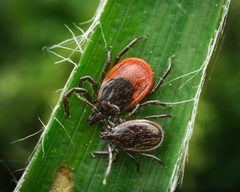
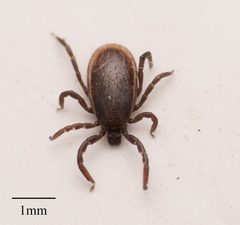
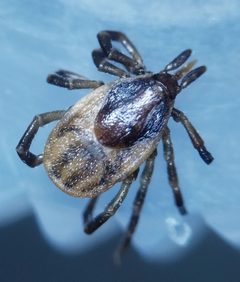
Small to medium-sized ticks with pyriform (pear-shaped) or ovate body profile. Eyeless. Mouthparts in both sexes; long and slender in females, short in males. Males possess sclerotised adanal plates. Anal groove curves anterior to the , the diagnostic feature of Prostriata.
Habitat
Occupies diverse including deciduous and coniferous forests, grasslands, shrublands, and coastal areas. Associated with forest-floor leaf litter, vegetation edges, and animal nesting sites. Some occur in extreme environments including Antarctic penguin rookeries.
Distribution
Near-; present in all major biogeographic realms including North America, Europe, Asia, Africa, South America, Australia, and Antarctica. Key Ixodes scapularis occurs in eastern United States; Ixodes pacificus in western United States; Ixodes ricinus in Europe; Ixodes persulcatus in Asia.
Seasonality
Activity varies by and climate. In temperate regions, active spring through fall; nymphs peak in late spring and summer; larvae active summer and early fall. Activity extends year-round in warmer climates or during mild winter periods. Peak transmission risk in northeastern United States occurs May through August.
Diet
Obligate ; feeds exclusively on vertebrate blood. Larvae, nymphs, and each require blood meals for development and . include mammals (especially rodents, deer), birds (including passerines and seabirds), and reptiles.
Host Associations
- Rodentia - primary White-footed mice (Peromyscus leucopus) and other small mammals serve as for Borrelia burgdorferi and preferred hosts for stages
- Cervidae - White-tailed deer (Odocoileus virginianus) are important for stages but less significant for acquisition
- Passeriformes - Songbirds serve as for stages and may transport ticks long distances; documented hosts include American robin, Carolina wren, white-throated sparrow
- Sphenisciformes - Antarctic associated with penguin rookeries and seabirds
Life Cycle
Three- typical: larva feeds on host, detaches and to nymph; nymph feeds on second host, detaches and molts to ; adult feeds on third host, mates, and female deposits . Development from egg to adult typically requires 2-3 years in temperate climates. Each stage dies if unable to locate a host within months (duration varies by humidity and temperature).
Behavior
Questing : climbs vegetation and extends forelegs to detect and grasp passing , responding to carbon dioxide, heat, movement, and vibrations. Attaches to host skin using and secretes cement-like substance for firm attachment. Feeds for 3-7 days depending on stage. Aggregates at edges () between forest and open areas.
Ecological Role
for transmission of multiple zoonotic between wildlife and humans. Maintains enzootic cycles of Borrelia burgdorferi, microti, and other agents in natural of rodents and birds. Serves as food source for limited including some birds and ants.
Human Relevance
Major public health concern as of (most common vector-borne illness in United States), , anaplasmosis, hard (Borrelia miyamotoi), and Powassan virus. Ixodes holocyclus causes via . Bites require prompt removal (within 24 hours) to reduce transmission risk. Prevention through repellents, protective clothing, and tick checks.
Similar Taxa
- AmblyommaBoth are Ixodidae with similar body plan; distinguished by anal groove position in Amblyomma versus in Ixodes
- DermacentorSimilar size range and ; Dermacentor have and patterns, and anal groove
- HaemaphysalisOverlapping geographic range and ; Haemaphysalis has laterally compressed basis capituli and different spiracular plate shape
More Details
Disease ecology
Transmission varies by and feeding duration. Borrelia burgdorferi transmission typically requires 24-48 hours of attachment. Coinfection with multiple pathogens (B. burgdorferi, B. microti, A. phagocytophilum) is common in areas.
Climate sensitivity
sensitive to desiccation; survival depends on humidity and availability. Mild, moist winters favor survival; drought reduces populations. Climate change associated with range expansion northward and to higher elevations.
Taxonomic complexity
Contains up to 24 recognized subgenera with ongoing revision; classification and phylogenetic relationships remain active research areas. Three fossil known from Cretaceous to Eocene amber deposits.
Sources and further reading
- BugGuide
- Wikipedia
- GBIF taxonomy match
- iNaturalist taxon
- NCBI Taxonomy
- Catalogue of Life
- Just in the tick of time: American dog tick, Dermacentor variabilis, and Black-legged tick, Ixodes scapularis — Bug of the Week
- Destination Potomac, Maryland – Spring arrives and with it, ticks: Lone star tick, Amblyomma americanum, and Blacklegged ticks, Ixodes spp. — Bug of the Week
- CDC Study Shares County Maps of 7 Diseases Spread by Blacklegged Ticks
- A Tick that Feeds on Birds May Increase the Range of Lyme Disease
- New Study Reveals Emerging Cases of Babesiosis in the Mid-Atlantic Region
- Mapping Lyme: CDC Reveals Distribution of Lyme Disease-Causing Bacteria by County
- Efficacy of Purified Borrelial Lipoproteins (PBL) as an oral formulation in reducing transmission of Lyme spirochetes from reservoir hosts to Ixodes scapularis ticks.