
Haemaphysalis
C.L. Koch, 1844
Species Guides
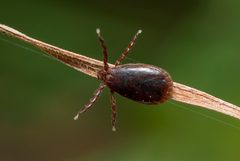
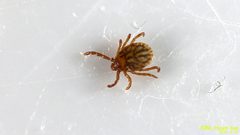
2- Haemaphysalis leporispalustris(rabbit tick)
- Haemaphysalis longicornis(Asian longhorned tick)
Haemaphysalis is the second largest of hard ticks ( Ixodidae), comprising approximately 170 distributed across all continents except Antarctica. The genus is distinguished by morphological features including lateral salience on palpal article II and eyeless with short mouthparts. Most species parasitize birds and mammals, with highest diversity concentrated in the Oriental and Afrotropical regions. The Asian longhorned (H. longicornis) has emerged as a significant in North America since 2017.

Pronunciation
How to pronounce Haemaphysalis: /ˌhiːməfəˈseɪlɪs/
These audio files are automatically generated. While they are not always 100% accurate, they are a good starting point.
Identification
Best distinguished from other ixodid by the pronounced lateral projection on palpal article II extending beyond the basis capitulum margin. Eyeless condition separates Haemaphysalis from many other hard genera. -level identification requires examination of capitular and festoon characteristics.
Images
Habitat
Occurs across diverse terrestrial including forests, shrublands, and grasslands. Temperate conditions with moderate temperature, humidity, and precipitation support optimal . Forested or shrubby vegetation provides preferred questing substrates. Specific habitat associations vary by .
Distribution
Found on all continents except Antarctica. Approximately 80% of occur in Asia and Africa, with greatest diversity in the Oriental and Afrotropical zoogeographical regions. Lower in Europe and the Americas. The H. longicornis has established in eastern North America.
Diet
Ectoparasitic blood-feeders on vertebrate . primarily parasitize birds and mammals; host associations vary among species.
Host Associations
- Birds - primary Many parasitize avian
- Mammals - primary Many parasitize mammalian including livestock and wildlife
Life Cycle
Hard ticks with typical ixodid : , larva, nymph, . H. longicornis exhibits parthenogenetic (females produce viable offspring without mating), a trait rare among ticks that facilitates rapid establishment by single females.
Behavior
Questing on vegetation for acquisition. H. longicornis nymphs and frequently cluster on tall grass while questing, dispersing rapidly when disturbed by potential hosts. Parthenogenetic in H. longicornis enables establishment from single introduced females.
Ecological Role
that may influence through blood loss and transmission. Serve as for various agents affecting wildlife, livestock, and humans. Severe can cause anemia and mortality in heavily parasitized animals.
Human Relevance
Several are medically and veterinary important as . H. longicornis is an emerging threat in North America, capable of transmitting Theileria orientalis to cattle and experimentally transmitting rickettsii. Potential to carry Anaplasma, , Ehrlichia, and Heartland virus, though vector competence varies by . No confirmed human disease transmission in North America to date.
Similar Taxa
- IxodesLargest ixodid ; distinguished from Haemaphysalis by absence of lateral salience on palpal article II and typically longer mouthparts
- DermacentorDiffers in possessing and lacking the distinctive palpal of Haemaphysalis
- AmblyommaDiffers in possessing and scutal patterns; palpal structure distinct from Haemaphysalis
More Details
Taxonomic Complexity
Contains 170 distributed across 8 subgenera (Aboimisalis, Aborphysalis, Allophysalis, Haemaphysalis, Herpetobia, Kaiseriana, Ornithophysalis, Segalia), though phylogenetic relationships remain unresolved with most subgenera being polyphyletic. Former subgenera Alloceraea and Sharifiella elevated to generic rank.
Invasive Potential
H. longicornis represents the first established in the United States in approximately 80 years. Climate modeling indicates potential for establishment across large swaths of eastern North America and the coastal Pacific Northwest. Parthenogenetic significantly enhances invasive capacity.
Sources and further reading
- BugGuide
- Wikipedia
- GBIF taxonomy match
- iNaturalist taxon
- NCBI Taxonomy
- Catalogue of Life
- Be On the Lookout: There's a New Tick in Town
- Potential Range for Asian Longhorned Tick Covers Much of Eastern U.S.
- Lab Study Shows Asian Longhorned Tick Can Spread Rocky Mountain Spotted Fever
- Invasive Tick Persists in New Jersey
- Commonly Used Acaricides Found Effective on Invasive Tick
- New Study Points to Management Strategies for Invasive Tick on Cattle Farms