
Haemaphysalis longicornis
Neumann, 1901
Asian longhorned tick, longhorned tick, bush tick, cattle tick, Asian tick
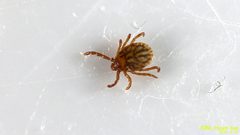
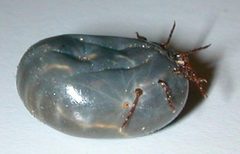
Haemaphysalis longicornis is an three- native to temperate East Asia that has established in Australia, New Zealand, the Pacific Islands, and the United States. First detected in New Jersey in 2017, it has since spread to at least 19 U.S. states. The exhibits facultative , with all-female populations documented in northern Japan, Russia, and the U.S. It is a significant veterinary pest of livestock, particularly cattle, and has been shown to transmit multiple to animals. While associated with various human tick-borne in its native range, human pathogen transmission has not been confirmed in North America.

Pronunciation
How to pronounce Haemaphysalis longicornis: //ˌhɛ.mə.fɪˈsæ.lɪs ˌlɒŋ.ɪˈkɔːr.nɪs//
These audio files are automatically generated. While they are not always 100% accurate, they are a good starting point.
Identification
Accurate identification requires microscopic examination of minute morphological features, particularly capitulum and characteristics. The cannot be reliably distinguished from other Haemaphysalis ticks by gross alone. Molecular confirmation via amplification of the cox1 gene or other is recommended for definitive identification, particularly in newly invaded regions.
Images
Habitat
Thrives in temperate conditions with moderate temperature, humidity, and precipitation. Associated with forested or shrubby vegetation that provides suitable questing substrate. In agricultural settings, highest densities occur within 20 meters of livestock housing; abundance declines significantly beyond 30 meters from shelters. Suitable includes pastures, woodland edges, and areas with tall grass where ticks quest in clusters.
Distribution
Native to temperate East and Central Asia including China, Korea, Japan, and the Russian Far East. established in Australia, New Zealand, Fiji, and other Pacific islands. In North America, first confirmed detection in Hunterdon County, New Jersey in November 2017; subsequently detected in at least 19 eastern and midwestern U.S. states including Virginia, West Virginia, North Carolina, South Carolina, Pennsylvania, New York, Arkansas, Maryland, Connecticut, Ohio, Maine, Tennessee, and Oklahoma. Climate modeling indicates potential for establishment across much of eastern North America and the coastal Pacific Northwest.
Seasonality
Exhibits a seasonal feeding and reproductive cycle typical of temperate hard ticks. Activity patterns influenced by temperature and humidity, with warm, humid conditions favoring increased activity and growth. Unfed ticks can survive close to one year depending on temperature and humidity, with nymphs and females showing the longest survival.
Diet
Obligate blood-feeding . Larvae, nymphs, and all require blood meals to develop and reproduce. Documented include cattle, horses, sheep, pigs, chickens, dogs, cats, humans, deer, bear, foxes, hares, ferrets, rats, other small mammals, and various bird .
Host Associations
- cattle - primary Major veterinary concern; can cause severe , blood loss, and anemia
- sheep - Site of first U.S. detection
- horses -
- pigs -
- chickens -
- dogs - Companion animal
- cats -
- humans - incidental Bites documented but human transmission not confirmed in U.S.
- white-tailed deer - wildlife
- bear - wildlife
- foxes - wildlife
- hares - wildlife
- ferrets -
- rats -
- birds - ; potential Believed to facilitate long-distance to new areas
Life Cycle
Three- with four developmental stages: , larva, nymph, and . Each active stage requires a separate blood meal from a host before molting to the next stage. Females lay eggs after engorgement. Unfed ticks can survive extended periods without feeding—up to nearly one year for nymphs and adult females under favorable temperature and humidity conditions.
Behavior
Quests in clusters on tall grass and vegetation. Clusters commonly disperse explosively when disturbed by contact with a animal, human, or monitoring equipment. Reproduces parthenogenetically in many , allowing single females to establish new populations without mating. Disperses to new areas primarily through host movement, particularly bird .
Ecological Role
of veterinary and human . Transmits Theileria orientalis to cattle, causing with impacts including anemia, decreased milk production, and reduced wool quality. Laboratory studies demonstrate competence for transmitting rickettsii ( agent) and other rickettsial, viral, and bacterial pathogens, though field transmission to humans in North America remains unconfirmed.
Human Relevance
Significant threat to livestock industry through direct blood loss and transmission, particularly Theileria orientalis in cattle. Potential public health concern due to demonstrated competence for multiple human in laboratory and native-range studies; CDC-recommended repellents and permethrin-treated clothing are effective for personal protection. Management on farms involves integrated approaches including closed herds, acaricides, and vegetation management.
Similar Taxa
- Haemaphysalis concinnaOverlapping geographic range in Asia; microscopic examination required for differentiation
- Haemaphysalis megaspinosa with similar ; attachment height on differs but requires detailed study to distinguish
- Haemaphysalis punctataAnother Haemaphysalis ; both require microscopic or molecular identification
- Amblyomma americanumNative U.S. with similar range and ; differs in and lacks
- Dermacentor variabilisNative U.S. of rickettsii; H. longicornis has shown similar laboratory transmission
Misconceptions
Despite common references, this has not been confirmed to transmit (Borrelia burgdorferi); laboratory studies have shown it cannot transmit this . While associated with many human pathogens in its native range, transmission of human agents has not been documented in North American .
More Details
Parthenogenesis
in northern Japan, Russia, China, and the U.S. reproduce primarily through . occurs in southern Japan, southern Korea, and southern parts of the former Soviet Union. An aneuploid race capable of both reproductive modes exists in China. The absence of males in U.S. field collections suggests parthenogenesis dominates in the range.
Acaricide susceptibility
Laboratory studies demonstrate susceptibility to multiple EPA-registered acaricides including permethrin sprays and pour-on , with 100% mortality within 24 hours at label rates. However, resistance risk exists due to parthenogenetic , which could allow rapid selection and spread of .
Climate suitability modeling
Climate envelope models based on native-range data predict suitable across much of eastern North America from the Gulf Coast to southern Canada, plus the coastal Pacific Northwest. Optimal conditions include temperate climates with moderate temperature, humidity, and precipitation supporting forested or shrubby vegetation.
Management strategies
Field studies on Tennessee cattle farms indicate that combining closed herds (no outside animal introduction), monthly brush cutting, and on-animal acaricide application can reduce by over 90%. Vegetation management alone shows limited efficacy; integrated approaches are recommended.
Sources and further reading
- BugGuide
- Wikipedia
- GBIF taxonomy match
- iNaturalist taxon
- NCBI Taxonomy
- Catalogue of Life
- Lab Study Shows Asian Longhorned Tick Can Spread Rocky Mountain Spotted Fever
- Potential Range for Asian Longhorned Tick Covers Much of Eastern U.S.
- Different Tick, Same Repellents: CDC Study Shows How to Avoid Asian Longhorned Tick
- Be On the Lookout: There's a New Tick in Town
- Commonly Used Acaricides Found Effective on Invasive Tick
- New Study Points to Management Strategies for Invasive Tick on Cattle Farms
- Functional Morphology of the Reproduction in Haemaphysalis longicornis
- Transferrin affects food intake and reproduction in the hard tick Haemaphysalis longicornis
- Asian longhorned tick, Haemaphysalis longicornis Neumann (Arachnida: Acari: Ixodidae)
- Heights of attachment to host in Haemaphysalis megaspinosa Saito and H. longicornis Neumann (Metastigmata : Ixodidae)
- Preliminary prediction of the potential distribution and consequences of Haemaphysalis longicornis using a simple rule-based climate envelope model
- First Report of Haemaphysalis longicornis (Neumann) in Oklahoma, USA
- Identification and knockdown effect of disulfide isomerase in the Haemaphysalis longicornis (Acari: Ixodidae)
- First Hemispheric Report of Invasive Tick Species Haemaphysalis Punctata Canestrini Et Fanzago, 1878, First State Report of Haemaphysalis Longicornis Neumann, and Range Expansion of Native Tick Species in Rhode Island, USA
- Distribution, seasonal occurrence and biological characteristics of Haemaphysalis longicornis, a vector of bovine piroplasmosis in Japan.
- Distribution characteristics and influencing factors of Haemaphysalis longicornis around goat sheds in Jinan city, East China
- Haemaphysalis longicornis and Carvacrol as Acaricide: Efficacy and Mechanism of Action
- Molecular cloning and transcriptional and functional analysis of glycogen synthase kinase-3β inHaemaphysalis longicornis(Acari, Ixodidae)