
Amblyomma americanum
Linnaeus, 1758
Lone Star Tick, Northeastern Water Tick, Turkey Tick, Cricker Tick
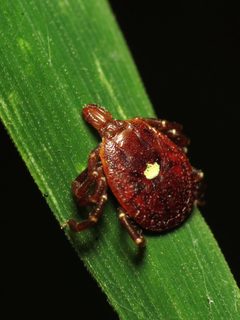
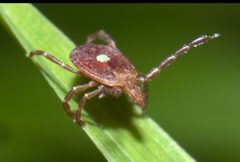
Amblyomma americanum is a three- hard native to eastern North America, notable for its aggressive host-seeking and expanding geographic range. females are distinguished by a silvery-white star-shaped spot on the , while males display white streaks or spots at the shield margins. The is the primary of Ehrlichia chaffeensis and Ehrlichia ewingii, and its bite can induce alpha-gal —a delayed allergic reaction to mammalian meat. Unlike many ticks, A. americanum exhibits active horizontal movement rather than passive questing, traveling up to 9 meters in 24 hours in field conditions.
Pronunciation
How to pronounce Amblyomma americanum: /ˌæm.bliˈɒm.ə ə.ˌmɛr.ɪˈkeɪ.nəm/
These audio files are automatically generated. While they are not always 100% accurate, they are a good starting point.
Identification
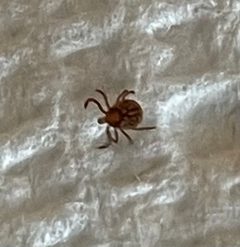
females are readily identified by the single white or off-white star-shaped spot centered on the portion of the . Adult males lack this central spot, instead showing scattered white streaks or spots at the scutum margins. The has notably long mouthparts compared to some other common . Larvae and nymphs lack the distinctive star marking and require microscopic examination for definitive identification.
Images
Habitat
Wooded areas with dense underbrush and leaf litter, particularly second-growth forests. Strongly associated with white-tailed deer . Also occupies ecotonal zones between forest and grassland, and areas with thick vegetation such as briars and understory plants. In Missouri Ozark forests, nymphs and are more abundant in valleys and on north-facing slopes than on ridges or south-facing slopes.
Distribution
Native to eastern and southeastern United States; historical range extended from Iowa, Illinois, Ohio, West Virginia, Maryland, Delaware, and New Jersey southward. Range has expanded northward since the mid-20th century into Minnesota, Wisconsin, Michigan, Pennsylvania, New York, New England states, and southern Ontario, Canada. Western expansion has also occurred. Present in Mexico. Predicted to continue expanding under climate change scenarios.
Seasonality
Active during warmer months; activity increases when temperatures rise above freezing threshold. In temperate regions, questing activity begins in late winter to early spring and extends through autumn. Activity suppressed below 7°F (-14°C), with leaf litter and snow providing insulation for survival.
Diet
Obligate blood-feeding ; requires blood meal at each active life stage. -seeking driven by detection of carbon dioxide, heat, vibration, and chemical cues via Haller's organ on forelegs.
Host Associations
- White-tailed deer - primary Primary for ticks; key driver of abundance and distribution
- Wild turkeys - for stagesCommon for larvae and nymphs in some Midwestern states; source of 'turkey '
- Humans - incidental Bites aggressively at all life stages; frequently reported biting humans in southeastern and south-central US
- Domestic livestock - Cattle, horses, goats; significant pest in agricultural settings
- Dogs - Companion animal
- Small mammals and birds - for stagesLarvae and nymphs feed on birds, small rodents, and other small mammals
- Feral nilgai antelope - Documented in Texas coastal plains
Life Cycle
Three- with complete : , larva, nymph, . Each active stage feeds on a different host individual. Eggs laid on ground in leaf litter or mulch; larvae hatch and quest for host, feed 1–3 days, drop off and to nymph. Nymph quests, feeds 5–10 days, drops off and molts to adult. Adult quests; male takes repeated small blood meals and mates repeatedly on host; female feeds 8–20 days, engorges fully, drops off, converts blood meal to eggs (up to 5,000–20,000), lays eggs, and dies. Total spans 6–18 months or longer, with delaying development in response to seasonal conditions.
Behavior
Exhibits active hunting rather than passive questing alone. Capable of horizontal movement: travels up to 9 meters (mean 3.2 m) in 24 hours in field conditions, and up to 36 meters (mean 70.4 m) in laboratory conditions. Detectable in environment for up to 14 days after release. Prefers on ground to climbing vertical structures. Questing posture involves climbing vegetation and extending forelegs to detect passing . Can survive extended periods off-host without feeding by extracting moisture from humid air.
Ecological Role
of multiple human and animal including Ehrlichia chaffeensis (human monocytic ), Ehrlichia ewingii (human and canine granulocytic ehrlichiosis), Francisella tularensis (), amblyommii, Coxiella burnetii, and Heartland virus. Implicated in Southern -Associated Rash Illness (STARI), possibly associated with Borrelia lonestari. Bite induces alpha-gal , altering human dietary . Serves as food source for and potentially other .
Human Relevance
Major public health and veterinary concern due to aggressive biting and transmission. Bites are painless and often unnoticed; ticks may remain attached up to seven days. Primary of in the United States. Bite can trigger alpha-gal , causing delayed anaphylactic reactions to mammalian meat (beef, pork, lamb) and products containing galactose-alpha-1,3-galactose. Allergic reactions typically occur 3–6 hours after consumption and may include hives, gastrointestinal , or life-threatening anaphylaxis. Not a competent vector of (Borrelia burgdorferi); saliva appears to destroy this .
Similar Taxa
- Ixodes scapularis (blacklegged tick)Similar size and ; distinguished by lack of star spot, shorter mouthparts, and black legs. Primary of , which A. americanum does not transmit.
- Dermacentor variabilis (American dog tick)Overlapping range and ; distinguished by with whitish markings on dark background but lacking central star, and shorter mouthparts. of .
- Amblyomma maculatum (Gulf Coast tick)Congeneric with similar ; distinguished by distribution (primarily southern coastal plains) and associations. of parkeri rickettsiosis.
Misconceptions
Long presumed capable of transmitting ; comprehensive review of over 60 studies and 52,000 ticks confirms A. americanum is not a competent of Borrelia burgdorferi. The name 'lone star ' refers to the scutal spot, not Texas. STARI (Southern Tick-Associated Rash Illness) produces Lyme-like rash but is clinically distinct and less severe.
Sources and further reading
- BugGuide
- Wikipedia
- GBIF taxonomy match
- iNaturalist taxon
- NCBI Taxonomy
- Catalogue of Life
- A warming world: range expansions of lone star ticks, Amblyomma americanum, and the alpha-gal they carry — Bug of the Week
- Lone Star Tick: Why Land Management (Not Just Climate Change) is Driving Boom
- Lone Star Ticks: Not Guilty in Spread of Lyme Disease
- Natural Compound Deters Lone Star Tick Larvae
- Landscape Terrain Provides New Angle for Measuring Tick Abundance
- An Up-Close Look at the Tiny Sensory Pits That Ticks Use to Smell
- Characterization of Glycine Rich Proteins in Amblyomma americanum
- Lone Star Tick Amblyomma americanum (Linnaeus) (Acari: Ixodidae)
- Spatial and temporal activity patterns of Amblyomma americanum
- Mapping the distribution of Amblyomma americanum in Georgia, USA
- Some Ecological Aspects of Lone Star Tick Amblyomma Americanum (L.) Distribution in Louisiana.
- Effects of two commercial neem-based insecticides on Amblyomma americanum: Repellency, mortality, and reproduction
- Drivers of behavior in two tick species, Amblyomma americanum and Amblyomma maculatum (Acari: Ixodidae), in a laboratory setting
- Dermal secretion physiology in Metastriata ticks; thermoregulation in the lone star tick Amblyomma americanum
- The microbiota of Amblyomma americanum reflects known westward expansion
- Sexual and regional differences in the microbiome and functional metagenome of the lone star tick, Amblyomma americanum