
Dermacentor variabilis
Say, 1821
American dog tick, wood tick
, commonly known as the or wood , is a hard tick native to eastern North America. It is a medically significant , capable of transmitting rickettsii (), Francisella tularensis (), and the responsible for . Unlike many tick species, D. variabilis exhibits a behavioral in larvae that synchronizes questing activity with spring conditions. Recent taxonomic revision split the former western into a separate species, Dermacentor similis.

Pronunciation
How to pronounce Dermacentor variabilis: //ˌdɜːrməˈsɛntɔr ˌvɛəriˈæbɪlɪs//
These audio files are automatically generated. While they are not always 100% accurate, they are a good starting point.
Identification
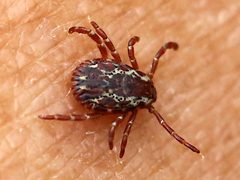
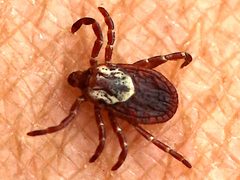
are relatively large hard ticks with patterns. Males and females exhibit in Haller's organ , with females showing distinct structural differences. Spiracular plates have a extension that is longer and narrower compared to the western sister D. similis. Larvae have six legs; nymphs and adults have eight legs.
Images
Habitat
Found in highly wooded, shrubby, and long-grass areas. Favors between forest and meadow, grassy meadows, field-woodland borders, and vegetation along stream banks. show attraction to heat stimuli associated with road edge .
Distribution
Eastern North America, from Nova Scotia and Massachusetts southward through the eastern United States. Range extends west to approximately the Rocky Mountains; formerly considered western D. variabilis have been reclassified as D. similis. Established populations documented in southern Manitoba and undergoing range expansion in the northern Maritimes of Canada.
Seasonality
Activity varies by latitude: April–August in northernmost range (Nova Scotia, Massachusetts) with peak May–June; April–September/October in coastal Virginia with peaks in May and July; late April–September in Ohio with peaks May–June and August–September; late March–August in Georgia with multiple peaks; April–July in Florida where activity is limited by high summer temperatures and low winter humidity.
Diet
Obligate blood-feeding . Requires blood meal at every life stage (larva, nymph, ) for development and .
Life Cycle
Complete four-stage : , six-legged larva, eight-legged nymph, and . Unlike most , D. variabilis exhibits a behavioral in larvae after egg , allowing unfed larvae to overwinter and synchronize questing with spring onset. Life cycle may take 2–3 years in cooler climates. Virgin females capable of parthenogenetic , producing viable offspring without mating.
Behavior
Exhibits "questing" : climbs vegetation and waves forelegs to detect passing using Haller's organ, a sensory pit on forelegs that detects carbon dioxide, ammonia, , humidity, and infrared radiation (body heat). Larval behavioral represents an adaptive strategy for northern range .
Ecological Role
for multiple human and animal . Serves as bridge between wildlife and human/domestic animal .
Human Relevance
Primary of ( rickettsii), with transmission possible within 30 minutes to 4 hours of attachment—significantly faster than previously believed. Also transmits (Francisella tularensis) and can induce via . Not a competent vector for (Borrelia burgdorferi). Control methods include modification (grass cutting), permethrin-treated clothing, and prompt removal with fine-point tweezers or removal hooks.
Similar Taxa
- Dermacentor similisFormerly considered western of D. variabilis; distinguished by spiracular plate (narrower, shorter extension) and genetic differentiation; west of Rocky Mountains
- Dermacentor andersoniOverlapping range in western Canada; lacks the behavioral observed in D. variabilis larvae under identical environmental conditions
- Ixodes scapularisSmaller blacklegged ; primary ; lacks patterns of Dermacentor
- Rhipicephalus sanguineusBrown dog tick; more distribution; lacks the distinctive patterning
Sources and further reading
- BugGuide
- Wikipedia
- GBIF taxonomy match
- iNaturalist taxon
- NCBI Taxonomy
- Catalogue of Life
- Ticks Can Do More Than 'Tick You Off' | Bug Squad
- Just in the tick of time: American dog tick, Dermacentor variabilis, and Black-legged tick, Ixodes scapularis — Bug of the Week
- Study Shows American Dog Ticks in Western U.S. Are a Separate Species
- Don’t Get Too Attached: New Research on Grace Period for Tick-Borne Spotted Fevers
- An Up-Close Look at the Tiny Sensory Pits That Ticks Use to Smell
- New CDC Tick Study Adds to Promise of Permethrin-Treated Clothing
- The Distribution of Dermacentor variabilis
- Parthenogenetic Reproduction by Dermacentor variabilis (Acarina: Ixodidae)
- Interspecific differences in the questing behaviour of Dermacentor andersoni and Dermacentor variabilis (Acari: Ixodidae) larvae
- The Distribution in Oregon of Ixodes Pacificus, Dermacentor Andersoni, and Dermacentor Occidentalis with a Note on Dermacentor Variabilis (Acarina: Ixodidae)
- ECOLOGY OF THE AMERICAN DOG TICK, DERMACENTOR VARIABILIS IN SOUTHWESTERN NOVA SCOTIA
- Optimal sampling and spatial distribution of Ixodes pacificus, Dermacentor occidentalis and Dermacentor variabilis ticks (Acari: Ixodidae)
- American Dog Tick, Dermacentor variabilis (Say) (Arachnida: Ixodida: Ixodidae)
- STUDIES IN TICK TAXONOMY AND HOST-PARASITE RELATIONS: OVIPOSITIONAL ABILITY, IMMUNO-DIFFUSION AND FREE AMINO ACID PATTERNS IN RHIPICEPHALUS SANGUINEUS (LA TREILLE) AND DERMACENTOR VARIABILIS (SAY)
- County-level surveillance for the American dog tick (Dermacentor variabilis) and Rickettsia species in Kentucky.
- A Field Study Examining the Attraction of Adult Dermacentor variabilis to Heat Stimuli Associated with Road Edge Habitats.
- The genome of the American dog tick (Dermacentor variabilis).
- Spatial and temporal analyses of Dermacentor variabilis (Say) (Acari: Ixodidae) in central and eastern Canada.
- Genetic diversity and phylogeographic relationships of Dermacentor variabilis (Acari: Ixodidae) within an established population in southern Manitoba (Canada), and the prevalence of Rickettsia montanensis and Francisella-like endosymbionts.
- Identification and characterization of a Relish-type NF-κB, DvRelish, in Dermacentor variabilis in response to Rickettsia rickettsii infection.
- Establishment and range expansion of Dermacentor variabilis in the northern Maritimes of Canada: Community participatory science documents establishment of an invasive tick species.
- Powassan Virus Lineage I in Field-Collected Dermacentor variabilis Ticks, New York, USA.
- Infestation patterns of Ixodes scapularis and Dermacentor variabilis on dogs and cats across Canada.