
Dermacentor andersoni
Stiles, 1908
Rocky Mountain wood tick
Dermacentor andersoni, the , is a three- hard found in the Rocky Mountain region of western North America. It is a medically significant , primarily transmitting virus, with secondary potential for and . Unlike larvae and nymphs, which feed on small mammals, will feed on humans. The exhibits in coloration and size, with engorged females reaching nearly three times their unfed size.
Pronunciation
How to pronounce Dermacentor andersoni: /ˌdɜːrməˈsɛntɔː ændərˈsoʊnaɪ/
These audio files are automatically generated. While they are not always 100% accurate, they are a good starting point.
Identification
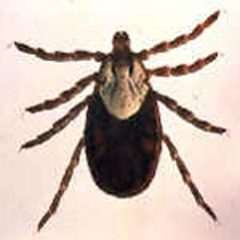
Distinguished from by having 100–200 goblets on spiracular plates (visible microscopically). Females differ from by geographic range—D. andersoni occurs west of the Missouri River, while D. variabilis dominates east of it. Females have a distinct silver-gray shield that darkens when feeding, whereas males lack this shield and show gray-white spotting. The 11 festoons on the lower dorsal margin aid in -level identification. Engorged females are notably larger than males.
Images
Appearance
are brown to reddish-brown, flat, and pear-shaped, measuring 2.0–5.3 mm unfed. Females display a distinct silver-gray ornamentation that darkens to gray when engorged. Males are spotted gray and white without a distinctive shield marking. The body has 11 festoons on the lower dorsal portion. Females are larger than males and can increase body size by nearly three-fold when fully engorged. The shows considerable individual variation in . Respiratory spiracular plates contain 100–200 goblets, a diagnostic feature visible only under light microscopy.
Habitat
Found in Rocky Mountain regions from 1,300 to 5,000 feet elevation. Occurs in wooded and brushy areas with tall grass, rocks, logs, and fallen leaves. Associated with between forest and meadow, grassy meadows, borders of fields and woodlands, and vegetation along stream banks. In Oregon, established occur in central, eastern, and southern counties with suitable mammal .
Distribution
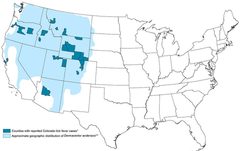
Northwestern United States and southwestern Canada along the Rocky Mountains. In the United States: documented in Oregon (Baker, Crook, Deschutes, Grant, Harney, Jefferson, Klamath, Lake, Malheur, Union, Wallowa counties), and generally throughout the Rocky Mountain states. Absent from western Oregon and coastal regions. In Canada: southern Saskatchewan and adjacent provinces. Range is largely with , with a zone of sympatry in southern Saskatchewan.
Seasonality
deposited from beginning of May through June. Larvae hatch in early summer and begin questing immediately. active during warmer months. In cooler climates, the complete spans 1–3 years depending on temperature, humidity, and availability. Ticks may be active on warm winter days in some regions.
Diet
Obligate blood-feeding . Larvae and nymphs feed on small mammalian including rodents, rabbits, ground squirrels, and chipmunks. feed on larger mammals including deer, elk, coyotes, bears, cattle, horses, dogs, and humans. Each life stage takes a single blood meal from a mammalian host. Adult females feed continuously for 5–15 days; males feed for shorter periods and copulate with multiple partially-fed females.
Host Associations
- Humans - only; larvae and nymphs do not feed on humans
- Dogs - stage
- Horses - stage
- Cattle - stage; also involved in Anaplasma marginale transmission cycle
- White-tailed deer - stage
- Elk - stage
- Coyotes - stage
- Bears - stage
- Rabbits - Larval and nymphal stages
- Ground squirrels - Larval and nymphal stages; important for acquisition
- Chipmunks - Larval and nymphal stages; important for acquisition
- Rodents - Larval and nymphal stages; primary for stages
Life Cycle
Three- with complete : , larva, nymph, . Eggs (2,500–4,000 per female) deposited on moist vegetation over 10–33 days. Larvae hatch in early summer, quest for small mammal hosts using carbon dioxide, light, temperature, and humidity cues, and feed 2–6 days before dropping to . Nymphs enter dormancy until host-stimulated, then feed similarly to larvae. Adults quest for larger mammals; females feed 5–15 days, males for shorter periods. Males copulate with several partially-fed females on the host. Engorged females drop to oviposit; both sexes die shortly after . Total duration: 1–3 years depending on environmental conditions.
Behavior
Larvae exhibit immediate questing upon hatching without the behavioral observed in under identical conditions. Questing involves climbing vegetation and extending forelegs to detect and grasp passing , responding to carbon dioxide, heat, movement, and vibration. Larvae attach to hosts using the first pair of legs, climb upward, and attach with gnathosoma to neck or shoulder regions. Nymphs remain for extended periods unless stimulated by host presence. attach and feed continuously for multiple days.
Ecological Role
of multiple human and animal . Primary vector of virus. Secondary vector for ( rickettsii) and (Francisella tularensis). Vector of Anaplasma marginale, causative agent of bovine anaplasmosis. Can produce via in saliva. Serves as bridge vector between wild mammal and domestic animals or humans.
Human Relevance
Significant medical and veterinary concern. bites pose risk of , , and transmission. can occur, particularly in children. Prevention relies on avoiding , wearing protective clothing (long pants, light colors, tucked pant legs), applying repellents, and prompt inspection and removal. Removal within 24 hours greatly reduces transmission risk. Proper removal requires fine forceps grasping the tick close to skin with slow, steady pull; petroleum jelly or heat methods are ineffective.
Similar Taxa
- Dermacentor variabilis; occurs east of Missouri River where D. andersoni is absent; D. variabilis larvae exhibit behavioral absent in D. andersoni; D. variabilis is more common of
- Dermacentor occidentalisPacific Coast tick; found in coastal California and Oregon; D. andersoni restricted to Rocky Mountain interior regions
More Details
Pathogen Transmission Dynamics
The acquires virus, Anaplasma marginale, and other by feeding on infected small mammals during larval or nymphal stages. allows these pathogens to persist through , making nymphs and infectious to subsequent .
Climate and Distribution
Climate change modeling suggests potential geographic range shifts for this , though specific predictions require further validation. Current distribution is constrained by Rocky Mountain topography and mammal composition.
Sources and further reading
- BugGuide
- Wikipedia
- GBIF taxonomy match
- iNaturalist taxon
- NCBI Taxonomy
- Catalogue of Life
- Ticks Can Do More Than 'Tick You Off' | Bug Squad
- A trio of trouble – Black-legged ticks Ixodes spp., American dog tick Dermacentor variabilis, and lone star tick Amblyomma americanum — Bug of the Week
- Time for ticks: Lone star tick, Amblyomma americanum, Blacklegged ticks, Ixodes spp., and American dog tick, Dermacentor variabilis — Bug of the Week
- A trio of trouble just in time for summer: Blacklegged ticks, Ixodes spp.; American dog tick, Dermacentor variabilis; and lone star tick, Amblyomma americanum — Bug of the Week
- Just in the tick of time: American dog tick, Dermacentor variabilis, and Black-legged tick, Ixodes scapularis — Bug of the Week
- Native to Asia, Found in New Jersey: The Curious Case of an Invasive Tick
- Peer Review #2 of "Climate change influences on the geographic distributional potential of the spotted fever vectors Amblyomma maculatum and Dermacentor andersoni (v0.2)"
- Interspecific differences in the questing behaviour of Dermacentor andersoni and Dermacentor variabilis (Acari: Ixodidae) larvae
- The Distribution in Oregon of Ixodes Pacificus, Dermacentor Andersoni, and Dermacentor Occidentalis with a Note on Dermacentor Variabilis (Acarina: Ixodidae)
- Peer Review #2 of "Climate change influences on the geographic distributional potential of the spotted fever vectors Amblyomma maculatum and Dermacentor andersoni (v0.1)"
- Peer Review #1 of "Climate change influences on the geographic distributional potential of the spotted fever vectors Amblyomma maculatum and Dermacentor andersoni (v0.2)"
- Peer Review #1 of "Climate change influences on the geographic distributional potential of the spotted fever vectors Amblyomma maculatum and Dermacentor andersoni (v0.1)"
- Review of development of colonies of Anaplasma marginale in the gut of Dermacentor andersoni
- Tick-Host Anemia: A Secondary Anemia Induced by Dermacentor andersoni Stiles