
Dermacentor occidentalis
Marx, 1892
Pacific Coast tick
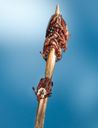
Dermacentor occidentalis, commonly known as the Pacific Coast , is a hard tick in the Ixodidae native to western North America. Unfed measure approximately 4.5 mm in length with a distinctive silvery-gray . This is a known of several human including , Pacific Coast tick fever, and , though it does not transmit . The tick exhibits a three- , feeding on a wide range of mammalian, avian, and reptilian hosts throughout its development.

Pronunciation
How to pronounce Dermacentor occidentalis: //dɛr.məˈsɛn.tɔr ˌɒk.sɪˈdɛn.tə.lɪs//
These audio files are automatically generated. While they are not always 100% accurate, they are a good starting point.
Identification
Dermacentor occidentalis can be distinguished from the western black-legged tick (Ixodes pacificus) by the position of the anal groove: D. occidentalis has the anal groove below the (cup-shaped, opening upward), while I. pacificus has the anal groove above the anus (inverted U-shape, opening downward). This character is diagnostic and visible with magnification. The silvery-gray coloration and patterns help distinguish it from other Dermacentor . () occurs in overlapping ranges but has different coloration patterns and is more common in eastern and central regions.
Images
Habitat
Found in coastal California biome and adjacent regions. Occurs in chaparral, grassland, and woodland-edge . show clumped distributions along trails with aggregated spatial patterns. Vegetation types include tall grass, brush, rocky areas with logs and fallen leaves. Ticks position on vegetation tips to contact passing .
Distribution
Native to western North America. Documented throughout California and in southwestern Oregon (Curry, Coos, Douglas, Lane, Josephine, Jackson, and Klamath counties). Records from Mexico. Distribution closely tied to coastal and near-coastal extending inland in suitable vegetation zones.
Seasonality
active in spring through early summer with peak activity varying by year and location. Nymphal activity patterns vary diurnally in relation to meteorological factors and activity periods. Seasonal activity influenced by temperature and moisture conditions.
Diet
Obligate blood feeder throughout all active life stages. Larvae, nymphs, and each require blood meals for development and .
Host Associations
- Homo sapiens - bite humans
- Neotoma fuscipes - dusky-footed woodrat; stages
- Peromyscus spp. - deer mice; stages
- Sylvilagus spp. - cottontail rabbits; stages
- Lepus spp. - jackrabbits; stages
- Canis latrans - coyote; stages
- Procyon lotor - raccoon; stages
- Mephitis mephitis - striped skunk; stages
- Spilogale putorius - spotted skunk; stages
- Vulpes vulpes - red fox; stages
- Urocyon cinereoargenteus - gray fox; stages
- Odocoileus hemionus - mule deer; stages
- Ovis canadensis - bighorn sheep; stages
- Spermophilus beecheyi - ground squirrel; stages
- Thomomys bottae - pocket gopher; stages
- Scapanus spp. - moles; stages
- Sorex spp. - shrews; stages
- Perognathus spp. - pocket mice; stages
- Dipodomys spp. - kangaroo rats; stages
- Reithrodontomys megalotis - harvest mouse; stages
- Microtus californicus - vole; stages
- Rattus norvegicus - Norway rat; stages
- Mus musculus - house mouse; stages
- Zonotrichia leucophrys - white-crowned sparrow; stages
- Passerella iliaca - fox sparrow; stages
- Pipilo maculatus - spotted towhee; stages
- Melozone crissalis - California towhee; stages
- Toxostoma redivivum - California thrasher; stages
- Aphelocoma californica - scrub jay; stages
- Corvus corax - common raven; stages
- Cyanocitta stelleri - Steller's jay; stages
- Colaptes auratus - northern flicker; stages
- Sphyrapicus spp. - sapsuckers; stages
- Picoides spp. - woodpeckers; stages
- Meleagris gallopavo - wild turkey; stages
- Callipepla californica - California quail; stages
- Zenaida macroura - mourning dove; stages
- Columba livia - rock dove; stages
- Tyto alba - barn owl; stages
- Buteo spp. - hawks; stages
- Accipiter spp. - hawks; stages
- Falco spp. - falcons; stages
- Cathartes aura - turkey vulture; stages
- Pituophis catenifer - gopher snake; stages
- Lampropeltis getula - common kingsnake; stages
- Crotalus spp. - rattlesnakes; stages
- Sceloporus occidentalis - western fence lizard; stages
- Uta stansburiana - side-blotched lizard; stages
- Elgaria multicarinata - alligator lizard; stages
- Phrynosoma blainvillii - horned lizard; stages
- Plestiodon skiltonianus - skink; stages
- Crotaphytus bicinctores - collared lizard; stages
- Sceloporus graciosus - sagebrush lizard; stages
- Urosaurus ornatus - tree lizard; stages
- Cnemidophorus tigris - whiptail; stages
- Gambelia spp. - leopard lizards; stages
- Xantusia spp. - night lizards; stages
- Anniella spp. - legless lizards; stages
- Coluber spp. - racers; stages
- Lampropeltis zonata - mountain kingsnake; stages
- Masticophis flagellum - coachwhip; stages
- Salvadora hexalepis - patch-nosed snake; stages
- Sonora semiannulata - ground snake; stages
- Tantilla spp. - flat-headed snakes; stages
- Thamnophis spp. - garter snakes; stages
- Trimorphodon spp. - lyre snakes; stages
- Hypsiglena torquata - night snake; stages
- Arizona elegans - snake; stages
- Phyllorhynchus decurtatus - leaf-nosed snake; stages
- Rena humilis - western blind snake; stages
- Charina bottae - rubber boa; stages
- Lichanura trivirgata - rosy boa; stages
- Python molurus - Indian python (introduced); stages
Life Cycle
Three- : , larva, nymph, and . Larvae hatch with six legs, feed on host blood, then to eight-legged nymphs. Nymphs feed again and molt to adults. Adults feed, mate, and females lay eggs. Each active stage requires a blood meal and typically feeds on different host individuals. In cooler climates, the life cycle may extend across 2-3 years.
Behavior
Exhibits questing : climbs vegetation and extends forelegs to contact passing . Starved ticks show increased questing activity and metabolic rate compared to recently fed individuals. Ticks sense carbon dioxide and host cues to initiate questing. Can enter state with reduced metabolism when host cues absent. Salivary gland activity increases with starvation, producing cement-like substances for host attachment. host-seeking patterns vary with vegetation type and meteorological conditions. Drop-off rates during sampling affected by , substrate roughness, and distribution pattern.
Ecological Role
Serves as a for multiple between wildlife and humans. Acts as a for endosymbiotic bacteria including Francisella-like endosymbionts (FLE) which may interfere with pathogenic . Microbiome composition varies with geographic location and host association. Male ticks harbor greater bacterial diversity than females. Ticks not infected with spotted fever group Rickettsia show microbiome similarities to canine skin microbiomes, suggesting host influence on microbial .
Human Relevance
Bites humans and is a for ( rickettsii), Pacific Coast fever (Rickettsia philipii strain 364D), (Francisella tularensis), anaplasmosis, and . Does not transmit . Two novel bunyaviruses (Nairovirus and Phlebovirus ) detected in tick with high , though human unconfirmed. Prompt removal within 24 hours reduces transmission risk. Tick testing services available for identification and detection.
Similar Taxa
- Ixodes pacificusOverlapping range in California; distinguished by anal groove position above (inverted U-shape) versus below anus in D. occidentalis; I. pacificus transmits while D. occidentalis does not.
- Dermacentor variabilisCongeneric with similar patterns; D. variabilis more common in eastern and central North America with different geographic distribution; both and .
- Dermacentor andersoniOverlapping distribution in western states; Rocky Mountain wood tick with different preferences and associations.
Misconceptions
Contrary to common belief, ticks do not fly, jump, or fall from trees. They do not embed their in skin; rather, mouthparts are adapted to penetrate and hold fast with cement-like secretions. The does not transmit despite being a common human-biting in California. Burning ticks with matches or applying petroleum jelly are ineffective removal methods and may increase transmission risk.
More Details
Pathogen Prevalence
In San Diego County , philipii str. 364D detected in 2.3% of ticks and R. rhipicephali in 8.2%. Francisella-like endosymbiont present in 70% of ticks in Mendocino County . Two novel bunyaviruses present in 20-91% of ticks depending on collection year.
Microbial Interference
Inverse relationship observed between Francisella-like endosymbiont (FLE) abundance and , suggesting FLE may interfere with spotted fever group Rickettsia establishment in ticks.
Collection Methods
Flagging along trails effective for sampling ; clumped distributions require adequate spatial sampling. Drop-off rates during flagging affected by and substrate characteristics.
Sources and further reading
- BugGuide
- Wikipedia
- GBIF taxonomy match
- iNaturalist taxon
- NCBI Taxonomy
- Catalogue of Life
- Ticks Can Do More Than 'Tick You Off' | Bug Squad
- Those Amazing Ticks: And How Hungry Ticks Work Harder to Find You | Bug Squad
- Want to Learn More about Mosquitoes and Ticks? | Bug Squad
- Good News for the Western Bumble Bee, Bombus occidentalis
- Just in the tick of time: American dog tick, Dermacentor variabilis, and Black-legged tick, Ixodes scapularis — Bug of the Week
- Oh no, engorged tick! Lyme disease? Maybe not: Tick Identification — Bug of the Week
- The Distribution in Oregon of Ixodes Pacificus, Dermacentor Andersoni, and Dermacentor Occidentalis with a Note on Dermacentor Variabilis (Acarina: Ixodidae)
- Optimal sampling and spatial distribution of Ixodes pacificus, Dermacentor occidentalis and Dermacentor variabilis ticks (Acari: Ixodidae)
- Hosts of the Immature Stages of the Pacific Coast Tick Dermacentor occidentalis Neum. (Ixodidae)
- Reproduction in Ticks (Acari: Ixodoidea). 3. Copulation in Dermacentor occidentalis marx and Haemaphysalis leporispalustris (Packard) (Ixodidae)
- Endosymbiont interference and microbial diversity of the Pacific coast tick, Dermacentor occidentalis , in San Diego County, California
- Temporal and Spatial Distribution of Ixodes pacificus and Dermacentor occidentalis (Acari: Ixodidae) and Prevalence of Borrelia burgdorferi in Contra Costa County, California
- Metagenomic-based Surveillance of Pacific Coast tick Dermacentor occidentalis Identifies Two Novel Bunyaviruses and an Emerging Human Ricksettsial Pathogen
- Endosymbiont interference and microbial diversity of the Pacific coast tick, Dermacentor occidentalis , in San Diego County, California
- Diel Activity of Nymphal Dermacentor occidentalis and Ixodes pacificus (Acari: Ixodidae) in Relation to Meteorological Factors and Host Activity Periods
- Diurnal Host Seeking of Adult Pacific Coast Ticks, Dermacentor Occidentalis (Acari: Ixodidae), In Relation to Vegetational Type, Meteorological Factors, and Rickettsial Infection Rates in California, USA
- Dermacentor occidentalis Ticks and Link to Rickettsia lanei Infections, California, USA.