
Dermacentor
C.L. Koch, 1844
Dog Ticks, American Levi tick
Species Guides
5- Dermacentor albipictus(winter tick)
- Dermacentor andersoni(Rocky Mountain wood tick)
- Dermacentor occidentalis(Pacific Coast tick)
- Dermacentor similis(Western Dog Tick)
- Dermacentor variabilis(American dog tick)
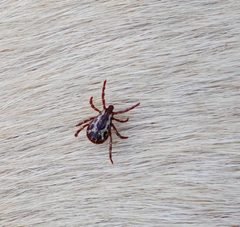
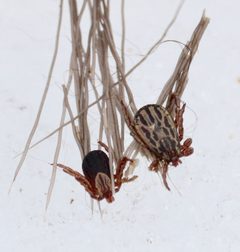
Dermacentor is a of hard ticks ( Ixodidae) with 43 recognized as of 2025. The genus has a distribution, occurring on all continents except Australia, with most species in the Nearctic ecozone. Members are obligate blood-feeding of mammals, including large ungulates, lagomorphs, and humans. Several species are medically significant of human and animal , including the agents of , Q fever, , and .
Pronunciation
How to pronounce Dermacentor: //dɛrˈmæsɛntɔr//
These audio files are automatically generated. While they are not always 100% accurate, they are a good starting point.
Identification
Dermacentor ticks are hard ticks (Ixodidae) with a covering most of the surface in males and the portion in females. The can be distinguished from other ixodid genera by morphological features including the structure of spiracular plates and palps. -level identification requires examination of detailed morphological characters such as the shape and ornamentation of the scutum, festoons, and capitulum. Genetic analysis (e.g., ribosomal markers) can differentiate closely related species such as D. andersoni, D. variabilis, and D. albipictus.
Images
Habitat
Found in diverse terrestrial including grassy meadows, forest edges, brushy areas with tall grass, and riparian vegetation. Ticks are typically found in areas with sufficient vegetation cover to maintain humidity and support . Many occupy between forest and open areas where host animals frequent.
Distribution
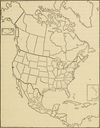
distribution with native on all continents except Australia. Most species occur in the Nearctic ecozone. Specific documented ranges include: North America (widespread, including D. variabilis in eastern states and D. similis west of the Rocky Mountains), Mexico (nine confirmed species), Europe, Asia, and Africa. Notable species distributions include D. andersoni in western North America, D. occidentalis along the Pacific Coast of North America, and D. reticulatus across Europe and Asia.
Seasonality
Activity varies by and climate. In temperate regions, activity typically peaks in spring and early summer (May-June), with some species active into summer. In many areas, ticks remain active on warm winter days. The from to adult may take 2-3 years in cooler climates.
Diet
Obligate . All life stages (larva, nymph, ) feed on blood from vertebrate . Larvae and nymphs typically feed on small mammals; adults feed on larger mammals including deer, cattle, horses, and humans.
Host Associations
- horses - feeding
- deer - feeding
- cattle - feeding
- lagomorphs - stages
- peccaries -
- porcupines -
- tapirs -
- desert bighorn sheep -
- humans - incidental for several
Life Cycle
Holometabolous-like development with : → larva (6 legs) → nymph (8 legs) → (8 legs). After hatching, larvae seek and feed, then to nymphs. Nymphs feed and molt to adults. Adults feed, mate, and females lay eggs (often thousands) on the ground. Some complete all blood meals on a single host; others drop off between stages to seek new hosts. In cooler climates, the complete cycle may require 2-3 years.
Behavior
Exhibits "questing" : climbs vegetation and extends forelegs to grasp passing . Detects hosts through carbon dioxide, heat, movement, and vibrations. Starved ticks show increased questing activity and metabolic rate. Ticks do not fly, jump, or fall from trees. Attachment is facilitated by cement-like secretions from salivary glands and barbed mouthparts. Some inject a that causes .
Ecological Role
of numerous affecting wildlife, domestic animals, and humans. Serve as bridge between wildlife and human . are linked to host mammal abundance, which in turn may be influenced by acorn mast cycles and other environmental factors.
Human Relevance
Major medical and veterinary importance. of ( rickettsii), Q fever (Coxiella burnetii), (Francisella tularensis), anaplasmosis (Anaplasma marginale), equine ( caballi), and virus. Cause through injection. Bites can cause local irritation and secondary . Prevention relies on avoidance, protective clothing, repellents, and prompt removal.
Similar Taxa
- IxodesBoth are hard , but Ixodes lacks the patterns typical of many Dermacentor and has different spiracular plate structure; Ixodes species are primary of in North America
- AmblyommaBoth are hard with similar associations, but Amblyomma typically have longer mouthparts and different geographical distributions; Amblyomma americanum (lone star tick) is a common sympatric species in eastern North America
- RhipicephalusBoth are hard with similar , but Rhipicephalus generally have and different festoon patterns; R. sanguineus (brown dog tick) is a common domestic pest
More Details
Taxonomic revision
Recent integrative taxonomic studies using morphological and genetic data have split some traditionally recognized . Notably, was split into D. variabilis (eastern North America) and D. similis (west of the Rocky Mountains), with significant differences in spiracular plate and genetics.
Vector competency research needs
Following the split of D. variabilis, research is needed to determine whether D. similis has different competency for various compared to its eastern counterpart.
Species diversity
As of 2025, 43 are recognized in the . Notable species include D. variabilis (), D. andersoni (), D. occidentalis (Pacific Coast ), D. albipictus (winter tick), and D. reticulatus ( cow tick).
Sources and further reading
- BugGuide
- Wikipedia
- GBIF taxonomy match
- iNaturalist taxon
- NCBI Taxonomy
- Catalogue of Life
- Ticks Can Do More Than 'Tick You Off' | Bug Squad
- Those Amazing Ticks: And How Hungry Ticks Work Harder to Find You | Bug Squad
- Just in the tick of time: American dog tick, Dermacentor variabilis, and Black-legged tick, Ixodes scapularis — Bug of the Week
- Study Shows American Dog Ticks in Western U.S. Are a Separate Species
- A trio of trouble – Black-legged ticks Ixodes spp., American dog tick Dermacentor variabilis, and lone star tick Amblyomma americanum — Bug of the Week
- Time for ticks: Lone star tick, Amblyomma americanum, Blacklegged ticks, Ixodes spp., and American dog tick, Dermacentor variabilis — Bug of the Week
- Figure 1 from: Guzmán-Cornejo C, Robbins RG, Guglielmone AA, Montiel-Parra G, Rivas G, Pérez TM (2016) The Dermacentor (Acari, Ixodida, Ixodidae) of Mexico: hosts, geographical distribution and new records. ZooKeys 569: 1-22. https://doi.org/10.3897/zookeys.569.7221
- Figure 2 from: Guzmán-Cornejo C, Robbins RG, Guglielmone AA, Montiel-Parra G, Rivas G, Pérez TM (2016) The Dermacentor (Acari, Ixodida, Ixodidae) of Mexico: hosts, geographical distribution and new records. ZooKeys 569: 1-22. https://doi.org/10.3897/zookeys.569.7221
- The Distribution in Oregon of Ixodes Pacificus, Dermacentor Andersoni, and Dermacentor Occidentalis with a Note on Dermacentor Variabilis (Acarina: Ixodidae)
- Figure S2: The localities and potential distribution maps for Dermacentor ticks . (A) Dermacentor marginatus; (B) D. nuttalli; (C) D. silvarum