
Rhipicephalus sanguineus
Latreille, 1806
Brown Dog Tick, Kennel Tick, Pantropical Dog Tick
is a hard distinguished by its ability to complete its entire indoors, a trait unusual among ixodid ticks. It is found worldwide but is most common in warmer climates. The species is a three- tick that feeds on a variety of mammals, with dogs serving as the preferred host in the United States. It is a significant of multiple affecting dogs and humans, including Ehrlichia canis, canis, rickettsii, and Rickettsia conorii.
Pronunciation
How to pronounce Rhipicephalus sanguineus: /ˌrɪpɪˈsɛfələs sæŋˈɡwɪniəs/
These audio files are automatically generated. While they are not always 100% accurate, they are a good starting point.
Identification
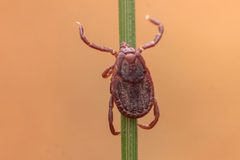
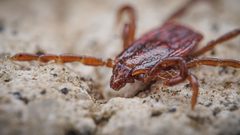
Distinguished from similar ticks by its hexagonal basis capituli, reddish-brown uniform coloration without ornamentation, and elongated body shape. The indoor capability is a behavioral indicator. In the United States, it is the primary establishing sustained indoor in kennels and residences.
Images
Appearance
are 2.28–3.18 mm in length and 1.11–1.68 mm in width. The body is reddish-brown in color and elongated in shape. The basis capituli (the flat surface where mouthparts attach) is hexagonal. The surface lacks ornamentation.
Habitat
Domestic environments including dog kennels, residences, and peri-domiciliary areas. Unlike most hard ticks, it can complete its entire indoors, allowing establishment in colder climates. Outdoor survival is limited by macroclimatic conditions; in temperate regions, persistence depends on the sheltered microclimate provided by dog-associated .
Distribution
distribution worldwide, more common in warmer climates. Present in North America, South America, Europe, Africa, Asia, and Australia. In the United States, established occur throughout the country due to indoor . In the United Kingdom, found only in kennels as of 2010. Distribution is expanding with climate change, with autochthonous cases emerging in Hungary since 2005.
Seasonality
Activity patterns are less constrained by season than outdoor ticks due to indoor capability. In temperate regions, indoor persist year-round. Outdoor activity is limited by temperature and humidity requirements, with optimal conditions for propagation occurring at 20–30°C with high relative humidity.
Diet
Obligate blood-feeding . Larvae feed for 5–15 days, nymphs for 3–13 days, and continue blood-feeding with mating occurring on the .
Host Associations
- Domestic dog (Canis lupus familiaris) - Preferred in the United States; required for development of large Attachment sites include , ears, back, between toes, and axilla
- Humans - Incidental in peri-domestic environmentNot preferred but can be bitten
- Various mammals - Alternative Will feed on wide variety of mammals when available
Life Cycle
Three- with four developmental stages: , larva, nymph, and . The can be completed entirely indoors, which is unusual among Ixodidae. Larvae feed 5–15 days, drop from host, and to nymphs after 1–2 weeks. Nymphs attach to same or different host, feed 3–13 days, drop, and develop into adults after two weeks. Adults attach to host, feed and mate; females drop to lay eggs, with up to 7,000 eggs per female. acquisition can occur at any life stage.
Behavior
Exhibits -seeking adapted to domestic environments. All postembryonic stages can tolerate critical temperature and humidity conditions for defined periods, ensuring enzootic persistence. Capable of establishing dramatic levels in kennels and residences. Becoming an increasingly significant urban pest in association with domestic dogs.
Ecological Role
for transmission of multiple pathogenic agents affecting domestic dogs and humans. include Ehrlichia canis (canine ), canis (canine ), rickettsii ( in humans), Rickettsia conorii (/boutonneuse fever), Anaplasma platys, Coxiella burnetii, Hepatozoon canis, and Mycoplasma haemocanis. The serves as a bridge between wildlife, domestic animal, and human cycles in peri-domestic environments.
Human Relevance
Major veterinary and public health concern. Causes direct harm to dogs through blood loss and irritation. Transmits serious to dogs including and . Transmits and other rickettsial diseases to humans. in homes and kennels can reach pest proportions requiring professional management. Prevention through regular , pet inspection, and environmental control is essential.
Similar Taxa
- Rhipicephalus (Boophilus) microplusSouthern cattle fever ; distinguished by being a one- tick rather than three-host, and by association with cattle rather than dogs
- Dermacentor variabilisAmerican dog tick; distinguished by outdoor , , and inability to complete life cycle indoors
- Amblyomma americanumLone star tick; distinguished by distinct white spot on female and outdoor multi-
- Ixodes pacificusWestern black-legged tick; distinguished by dark coloration, outdoor , and association with transmission
More Details
Acaricide Resistance
The has developed resistance to multiple classes of acaricides, complicating control efforts. Research is ongoing into alternative control methods including desiccant dusts (kaolin/silicate-based products), , and nanoemulsions.
Climate Adaptation
While survival and are directly proportional to relative humidity and inversely proportional to temperature, the has evolved mechanisms that allow temporary survival under critical conditions, facilitating persistence in suboptimal climates through association with sheltered domestic environments.
Sources and further reading
- BugGuide
- Wikipedia
- GBIF taxonomy match
- iNaturalist taxon
- NCBI Taxonomy
- Catalogue of Life
- Ticks Can Do More Than 'Tick You Off' | Bug Squad
- Encyrtid Holdings | Entomology Research Museum
- Cattle Fever Ticks: Outbreaks Driven by Unique Landscape, Exotic Antelope
- New, Fast DNA Method Spots Pesticide-Resistant Ticks
- New Tick Vaccine Looks Promising for Cattle
- Organic Dust Takes a Bite Out of Ticks
- การศึกษาผลของยาฆ่าเห็บบางชนิดที่มีต่อเห็บสุนัข (Rhipicephalus sanguineus latreille)
- Rhipicephalus (Boophilus) microplus e Rhipicephalus sanguineus: uma revisão sobre as perspectivas, distribuição e resistência Rhipicephalus (Boophilus) microplus and Rhipicephalus sanguineus: a review on the prospects, distribution and resistance Rhipicephalus (Boophilus) microplus y Rhipicephalus sanguíneus: una revisión sobre las perspectivas, la distribución y la resistencia
- Zur �kologie eines deutschen Stammes von Rhipicephalus sanguineus (Latreille, 1806) On the Ecology of a German Strain of Rhipicephalus sanguineus (Latreille, 1806)
- Brown Dog Tick, Rhipicephalus sanguineus Latreille (Arachnida: Acari: Ixodidae)
- Ecology and epidemiology of Rocky Mountain spotted fever associated withRhipicephalus sanguineus
- Host location cues of the brown dog tick,Rhipicephalus sanguineus
- Brown Dog Tick Rhipicephalus sanguineus Latreille (Arachnida: Acari: Ixodidae)
- Occurrence of Tick-Borne Pathogens in Rhipicephalus sanguineus Sensu Lato From Domestic Dogs in Kumasi, Ghana.
- Acaricidal and synergistic activity of essential oils, their binary combinations, and nanoemulsions against larvae and unfed adult stages of brown dog tick Rhipicephalus sanguineus (Acari: Ixodidae).