
Rhipicephalus
Koch, 1844
brown ticks, pepper ticks
Species Guides
1- Rhipicephalus sanguineus(Brown Dog Tick)
Rhipicephalus is a of hard ticks (Ixodidae) comprising approximately 90 , commonly known as brown ticks. The genus is but most diverse in tropical Africa. Several species are significant of human and animal , including agents causing , , anaplasmosis, and rickettsial . The subgenus Boophilus, formerly treated as a separate genus, contains economically important cattle fever ticks. Identification is often difficult due to morphological similarity among species and intraspecific variation, particularly in females and stages.
Pronunciation
How to pronounce Rhipicephalus: /ˌrɪpɪˈsɛfələs/
These audio files are automatically generated. While they are not always 100% accurate, they are a good starting point.
Identification
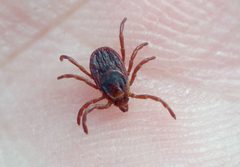
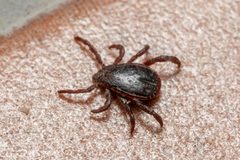
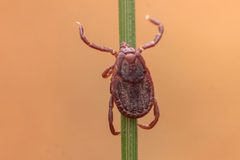
are mostly brown in coloration and generally , lacking color patterns on the . Males are more reliably distinguishable than females or stages. Many lack clear differential morphological features, making identification challenging. The is characterized by a hexagonal basis capituli, referenced in its etymology. Specimens of the subgenus Boophilus differ morphologically from typical Rhipicephalus species.
Images
Distribution
distribution with greatest diversity in tropical Africa. Individual ranges vary; some are restricted to specific regions while others are widespread.
Diet
Ectoparasitic blood-feeders on vertebrate .
Behavior
Females of some produce phenol and p-cresol after six days of feeding; these compounds function as . Some species are one- ticks, completing their entire on a single host individual.
Ecological Role
of significant human and animal including , Theileria, Anaplasma, Ehrlichia, and . Some species cause through injection.
Human Relevance
Major economic, medical, and veterinary importance. Cattle fever ticks (subgenus Boophilus) caused severe livestock losses historically, prompting programs in the United States. Several transmit causing , , , Q fever, and boutonneuse fever. bites can cause allergic reactions and toxic effects. resistance is increasingly problematic in control efforts.
Similar Taxa
- IxodesBoth are of hard ticks (Ixodidae), but Ixodes typically have a rectangular basis capituli and often exhibit more pronounced in coverage.
- DermacentorBoth are hard with veterinary importance, but Dermacentor usually possess scutal patterns and have three- , contrasting with the appearance and one-host tendency in some Rhipicephalus.
- HyalommaBoth are Ixodidae with African diversity centers, but Hyalomma typically have elongated mouthparts and distinct leg ornamentation not seen in Rhipicephalus.
Sources and further reading
- BugGuide
- Wikipedia
- GBIF taxonomy match
- iNaturalist taxon
- NCBI Taxonomy
- Catalogue of Life
- Ticks Can Do More Than 'Tick You Off' | Bug Squad
- engorged female southern cattle tick - (Rhipicephalus (Boophilus) microplus) - Entomology Today
- Rhipicephalus-sanguineus - Entomology Today
- Cattle Fever Ticks: Outbreaks Driven by Unique Landscape, Exotic Antelope
- New, Fast DNA Method Spots Pesticide-Resistant Ticks
- New Tick Vaccine Looks Promising for Cattle
- Rhipicephalus (Boophilus) microplus e Rhipicephalus sanguineus: uma revisão sobre as perspectivas, distribuição e resistência Rhipicephalus (Boophilus) microplus and Rhipicephalus sanguineus: a review on the prospects, distribution and resistance Rhipicephalus (Boophilus) microplus y Rhipicephalus sanguíneus: una revisión sobre las perspectivas, la distribución y la resistencia