
Ixodes pacificus
Cooley & Kohls, 1943
Western black-legged tick, Western blacklegged tick
Ixodes pacificus, the western black-legged tick, is a hard ( Ixodidae) and the principal of (Borrelia burgdorferi) in the western United States. This has a four-stage (, larva, nymph, ) that takes approximately three years to complete under natural conditions. Adults are sexually dimorphic: males have a complete covering the surface and cannot engorge, while females have a partial scutum and can expand significantly when feeding. The species is a known vector for multiple human including Borrelia burgdorferi, Borrelia miyamotoi, Anaplasma phagocytophilum, and others.
Pronunciation
How to pronounce Ixodes pacificus: //ɪkˈsoʊdiːz pəˈsɪfɪkəs//
These audio files are automatically generated. While they are not always 100% accurate, they are a good starting point.
Identification
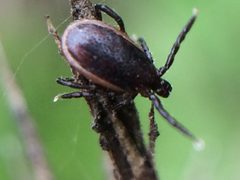
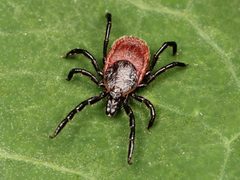
Distinguished from other western ticks by the black-legged appearance and characteristics. Males are easily recognized by the complete scutum; females by the partial scutum and orange coloration of the engorgeable . Differs from Ixodes scapularis (eastern black-legged tick) in geographic range and subtle morphological features requiring microscopic examination. Smaller than Dermacentor (American dog tick, Pacific Coast tick) found in the same range. Nymphs are approximately 2 mm and difficult to distinguish from other Ixodes nymphs without expert examination.
Images
Appearance
males are approximately 2.54 mm when unfed, oval-shaped, and brownish-black in color. The male possesses a hard that completely covers the surface, preventing engorgement. Unfed adult females are approximately 3.18 mm, with a brown-black scutum on the dorsum, an orange , and forward-projecting mouthparts (). When fully engorged, females may reach 9.5 mm or longer. Larvae have six legs; nymphs and adults have eight legs. All life stages have backward-directed projections on the hypostome and secrete cement-like substances from salivary glands to attach to .
Habitat
Nymphs prefer dense woodlands with abundant leaf litter and fir needles, often encountered in contact with logs, branches, and shed leaves. prefer areas with short vegetation including grasslands, woodland edges, brush areas, and trail borders. Both stages require that can maintain , particularly deer for adults and small mammals or lizards for stages. Areas with western fence lizards (Sceloporus occidentalis) are significant habitat components in California.
Distribution
Western North America: primarily California, with records from Oregon, Washington, Utah, Nevada, Arizona, and British Columbia. Most prevalent in northern California. The is the Ixodes in the western United States, paralleling the distribution of Ixodes scapularis in the east.
Seasonality
are most active during winter months, seeking from late fall through spring. Nymphs are primarily active during spring and early summer. Larvae emerge after approximately 53–55 days from . Climate studies indicate that warm early springs predict higher nymph densities the following year, with hot and dry springs associated with earlier peaks in abundance.
Diet
All life stages are obligate hematophages. Larvae and nymphs feed on lizards, small mammals, and birds. feed primarily on medium to large mammals, especially deer. Feeding duration ranges from 4–10 days for larvae, 7–11 days for nymphs, and 10–11 days for adult females. Males take small blood meals or may not feed substantially due to their complete .
Host Associations
- Western fence lizard - Sceloporus occidentalis; common for stages. Lizards are refractory to Borrelia burgdorferi but lizard-fed larvae show enhanced competency for subsequent B. burgdorferi acquisition.
- White-footed mouse - Peromyscus leucopus; important for B. burgdorferi in shared range areas
- Deer - Primary ; important for and range expansion but less important for B. burgdorferi maintenance than small mammals
- Birds - /American robins, dark-eyed juncos, golden-crowned sparrows, lesser goldfinches, oak titmice documented as ; birds can carry B. burgdorferi and B. bissettii and may disperse ticks long distances
Life Cycle
Four-stage : , larva, nymph, . Eggs hatch in 53–55 days. Larvae feed 4–10 days, to nymphs after 37–38 days. Nymphs feed 7–11 days, molt to adults after approximately 30 days. Adult females feed 10–11 days, then enter a pre-oviposition period of 11–16 days before laying 790–1,300 eggs over 33–40 days. Complete cycle takes approximately 3 years under natural conditions; can complete in about 7 months under optimal laboratory conditions with continuous availability. No is required to complete development.
Behavior
Questing : climbs vegetation and extends front legs to detect via CO2, heat, and movement cues. Nymphs seek hosts in leaf litter and on logs/branches; climb vegetation to wait for passing hosts. Attachment involves insertion of barbed and secretion of cement-like substance and anesthetic compounds in saliva, allowing prolonged undetected feeding. Females that are not interrupted may feed for several days to weeks. No evidence of acquired host resistance develops after repeated .
Ecological Role
for multiple zoonotic , most notably Borrelia burgdorferi (). Also vectors B. miyamotoi (hard ), Anaplasma phagocytophilum (anaplasmosis), and potentially others. bloodmeal identity affects vector competency: lizard-fed larvae show upregulated antioxidants and antimicrobial and enhanced B. burgdorferi acquisition in subsequent nymphal feeding compared to mouse-fed larvae. are linked to small mammal abundance, which correlates with oak masting cycles.
Human Relevance
Principal of in the western United States. Nymphs pose the greatest transmission risk due to small size (~2 mm) allowing prolonged undetected attachment; transmission of B. burgdorferi requires approximately 36–48 hours of attachment. Also implicated in transmission of anaplasmosis, , and hard . Public health significance drives extensive surveillance and climate-based predictive modeling for risk assessment.
Similar Taxa
- Ixodes scapularisEastern black-legged tick; morphologically similar but geographically separated (eastern vs. western North America). Both are principal in their respective ranges. Microscopic examination required for definitive separation.
- Dermacentor occidentalisPacific Coast tick; larger size, different pattern, and distinct geographic overlap in western states. Not a but transmits and Pacific Coast tick fever.
- Dermacentor variabilisAmerican dog tick; larger, with markings. Occurs in some overlapping areas but prefers different and is not a significant .
More Details
Vector competency modification
Recent research demonstrates that larval bloodmeal identity significantly alters nymphal competency for B. burgdorferi. Lizard-fed larvae, despite lizards being refractory to , produce nymphs with enhanced B. burgdorferi acquisition capability compared to mouse-fed larvae. This challenges prior assumptions about lizard protective effects in .
Climate prediction models
Studies in northern California demonstrate that warm early spring temperatures predict higher I. pacificus nymph densities one year later, while hot, dry springs correlate with earlier seasonal peaks. Climate change projections suggest potential doubling of nymph numbers with earlier activity peaks over the coming century.
Pathogen surveillance limitations
CDC surveillance indicates that detected distribution is narrower than range, but this likely reflects sampling gaps rather than true absence. Bartonella spp., despite high in rodents and fleas, are rarely detected in I. pacificus, suggesting minimal if any role in Bartonella transmission.
Sources and further reading
- BugGuide
- Wikipedia
- GBIF taxonomy match
- iNaturalist taxon
- NCBI Taxonomy
- Catalogue of Life
- Ticks Can Do More Than 'Tick You Off' | Bug Squad
- It Started Out as a Quiet, End-of-the-Year Hike Near Lake Berryessa... | Bug Squad
- A trio of trouble – Black-legged ticks Ixodes spp., American dog tick Dermacentor variabilis, and lone star tick Amblyomma americanum — Bug of the Week
- Birds Identified as Hosts of Lyme Disease
- Spring Conditions Predict Following Year's Tick Activity in Northern California
- CDC Study Shares County Maps of 7 Diseases Spread by Blacklegged Ticks
- Vertebrate hosts of Ixodes pacificus (Acari: Ixodidae) in California
- Lizard feeding enhances Ixodes pacificus vector competency
- Forum: Reported Distribution of Ixodes scapularis and Ixodes pacificus (Acari: Ixodidae) in the United States
- Infestation Intensities, Attachment Patterns, and the Effect on Host Contest Behavior of the Tick Ixodes pacificus on the Lizard Sceloporus occidentalis
- No evidence of Bartonella infections in host-seeking Ixodes scapularis and Ixodes pacificus ticks in the United States
- Bartonella infections are rare in blood-fed Ixodes scapularis and Ixodes pacificus ticks collected from rodents in the United States
- Ixodes pacificusCooley and Kohls, 1943: Its life-history and occurrence
- Cytokine responses of C3H/HeN mice infested with Ixodes scapularis or Ixodes pacificus nymphs
- County-Scale Distribution ofIxodes scapularisandIxodes pacificus(Acari: Ixodidae) in the Continental United States
- Questing Behavior of Ixodes pacificus (Acari: Ixodidae) in Relation to Meteorological and Seasonal Factors
- Predicting the potential global distribution of Ixodes pacificus under climate change
- No evidence of Bartonella infections in host-seeking Ixodes scapularis and I. pacificus ticks in the United States
- Feeding and Host Preference of Immature Ixodes dammini, I. scapularis, and I. pacificus (Acari: Ixodidae)
- Modeling the Geographic Distribution ofIxodes scapularisandIxodes pacificus(Acari: Ixodidae) in the Contiguous United States
- Host-Seeking Behavior of Adult Ixodes pacificus (Acari: Ixodidae) as Determined by Flagging Vegetation