
Ixodes scapularis
Say, 1821
deer tick, black-legged tick, bear tick, Eastern Black-legged Tick
Ixodes scapularis is a hard-bodied native to the eastern and upper midwestern United States, with expanding in Canada. It is the primary of (Borrelia burgdorferi) in North America and transmits multiple other including microti, Anaplasma phagocytophilum, and Powassan virus. The tick has a two-year with three blood-feeding stages (larva, nymph, ), each requiring a different individual. Climate change is driving northward range expansion and increased human encounters.
Pronunciation
How to pronounce Ixodes scapularis: //ɪkˈsoʊdiːz skəˈpjʊlərɪs//
These audio files are automatically generated. While they are not always 100% accurate, they are a good starting point.
Identification
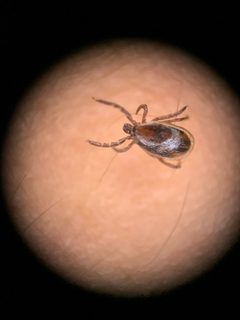
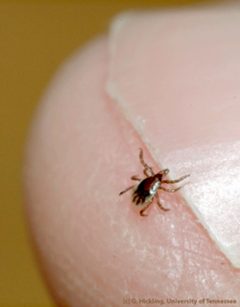
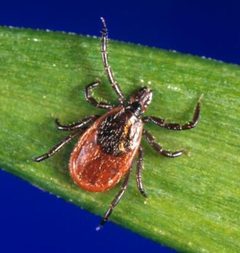
females are 3–4 mm long when unfed, with a dark, covering the portion of the body; the exposed idiosoma is orange to red. Adult males are smaller (2–3 mm) with a rigid scutum covering the entire body, preventing engorgement. Nymphs and adults have eight legs; larvae have six. Unlike ticks in other , Ixodes scapularis lacks . The anal groove forms a horseshoe shape anterior to the anal pore on the surface. Male palps are shorter than female palps. Engorged females become greatly enlarged and grayish. Distinguished from Ixodes pacificus (western black-legged tick) by geographic range; from Dermacentor variabilis (American dog tick) by smaller size, lack of festoons, and dark scutum; from Amblyomma americanum (lone star tick) by absence of a white spot.
Images
Habitat
Wooded and forested with dense leaf litter, particularly areas with high tree stem count, midstory cover, and cover. Found in between forest and meadow, grassy meadows, and vegetation along stream banks. Spends off- periods in leaf litter or soil. abundance correlates with oak mast production with a two-year lag due to small mammal .
Distribution
Eastern and upper midwestern United States, from Florida to Maine and west to Minnesota and Texas; expanding northward into Canada (Ontario, Quebec, Maritime provinces) and westward into central U.S. states. Range expansion attributed to climate warming, increasing deer , and land use changes.
Seasonality
Activity varies by life stage and latitude. Larvae active primarily in summer. Nymphs most active in spring and early summer (peak May–July), presenting highest risk for human transmission. active in fall and early spring; can remain active after hard frosts when daytime temperatures warm sufficiently. In warmer regions, may be active on mild winter days. Two-year typical in northern temperate regions.
Diet
Obligate blood feeder; requires a blood meal from a vertebrate to develop at each life stage. Larvae, nymphs, and each feed on different host individuals, typically of different .
Host Associations
- White-tailed deer - primary for feeding and Odocoileus virginianus; preferred of stage, though deer do not transmit Borrelia to ticks
- White-footed mouse - for stages and acquisitionPeromyscus leucopus; key for Borrelia burgdorferi and other
- Eastern chipmunk - bloodmeal Tamias striatus; bloodmeal source in some (36% of analyzed meals)
- Eastern gray squirrel - bloodmeal Sciurus carolinensis; significant bloodmeal source (26% of analyzed meals)
- Humans - incidental Homo sapiens; nymphs most commonly implicated in human transmission due to small size and summer activity
- Various birds and lizards - for stagesParticularly important for larval and nymphal via migratory birds
Life Cycle
Three- with four stages: , larva, nymph, and . Eggs hatch into six-legged larvae, which feed once and to eight-legged nymphs. Nymphs feed once and molt to adults. Adults feed, mate on host, and females drop off to lay eggs. Each feeding stage takes a blood meal from a different host individual. Two-year cycle: eggs laid spring of year one, larvae feed summer year one, nymphs feed spring-summer year two, adults feed fall-spring and lay eggs. Females lay 1,500–3,000 eggs. Off-host survival periods in leaf litter can extend months.
Behavior
Exhibits questing : climbs vegetation and extends forelegs to detect and grasp passing . Responds to CO₂, heat, movement, and host odors; CO₂ detection occurs even without the Haller's organ, indicating additional sensory structures. speed increases and foreleg waving (questing posture) initiates upon CO₂ exposure above 1% concentration. Host-seeking height varies geographically: northern quest above leaf litter, southern populations remain beneath leaf litter. Can be active after hard frosts when daytime temperatures permit.
Ecological Role
Principal of and other -borne in eastern North America. Serves as bridge between wildlife pathogen (small mammals) and human . Blood feeding influences small mammal . Endosymbiotic relationship with buchneri, which may influence tick and pathogen interactions. in enzootic transmission cycles.
Human Relevance
Major public health threat as of (30,000+ reported U.S. cases annually, estimated 300,000 actual ), , anaplasmosis, and Powassan virus . Nymphal bites most commonly associated with human disease due to small size and summer activity when human exposure is highest. Risk of transmission increases with attachment duration; removal within 24 hours reduces disease risk. Prevention relies on avoidance, protective clothing, repellents, and prompt removal. Photo-based identification services (e.g., TickSpotters) achieve >98% for this .
Similar Taxa
- Ixodes pacificusWestern black-legged tick; morphologically similar but restricted to Pacific Coast states; historically distinguished by geography though some overlap may occur
- Dermacentor variabilisAmerican dog tick; larger size ( 5–15 mm), has festoons (rectangular plates along margin), and more patterning
- Amblyomma americanumLone star tick; females have distinctive white spot on ; more aggressive human biter; different complement including Ehrlichia chaffeensis
More Details
Genomic features
sequenced at approximately 2.1 gigabases, among the largest genomes; - assembly resolved into 15 pseudochromosomes (13 plus X and Y ). Possesses horizontally acquired dae2 genes encoding amidase effectors that limit Borrelia burgdorferi proliferation in the , influencing transmission .
Epigenetic variation
Northern and southern exhibit distinct methylation profiles; northern ticks from Minnesota show reduced global methylation compared to southern Texas populations, potentially contributing to phenotypic plasticity and regional .
Alpha-gal syndrome
Contains alpha-gal ; bites have been associated with induction of red meat allergy (Alpha-Gal ) in sensitive individuals, though this association is more strongly documented for Amblyomma americanum.
Sources and further reading
- BugGuide
- Wikipedia
- GBIF taxonomy match
- iNaturalist taxon
- NCBI Taxonomy
- Catalogue of Life
- It Started Out as a Quiet, End-of-the-Year Hike Near Lake Berryessa... | Bug Squad
- Ticks Can Do More Than 'Tick You Off' | Bug Squad
- Just in the tick of time: American dog tick, Dermacentor variabilis, and Black-legged tick, Ixodes scapularis — Bug of the Week
- A trio of trouble – Black-legged ticks Ixodes spp., American dog tick Dermacentor variabilis, and lone star tick Amblyomma americanum — Bug of the Week
- Crowdsourced Surveillance Program Improves Public Understanding of Tickborne Diseases
- Alpha-gal and the Lone Star Tick, Amblyomma americanum — Bug of the Week
- Contrasting epigenetics of Ixodes scapularis populations
- Biology and Molecular Biology of Ixodes scapularis
- Ecology of Black-Legged Ticks (Ixodes scapularis) at Fort Drum Military Installation, New York
- Lyme Disease and the Effects of Climate Change on the Distributions of Ixodes scapularis in Maine
- The black-legged tick Ixodes scapularis detects CO 2 without the Haller’s organ
- Neurophysiological and Behavioral Responses of Ixodes scapularis to host odors
- Distribution géographique de la tique Ixodes scapularis et taux d’infection en 2017 à Ottawa (Ontario)
- Microbial ecology of Ixodes scapularis from Central Pennsylvania, USA
- Efficacy of Purified Borrelial Lipoproteins (PBL) as an oral formulation in reducing transmission of Lyme spirochetes from reservoir hosts to Ixodes scapularis ticks.
- Efficacy of Simparica and Simparica TRIO for the prevention of Borrelia burgdorferi by Ixodes scapularis.