
Dermacentor similis
Lado, Glon & Klompen, 2021
Western Dog Tick
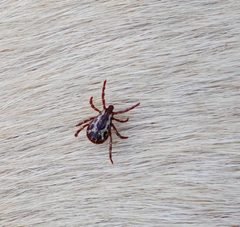
Dermacentor similis is a recently described hard (2021) previously misidentified as western of . Molecular and morphological analyses confirmed it as a distinct species restricted to western North America. Like its eastern counterpart, it is a three- tick with significant medical and veterinary importance, though its specific competence for remains under investigation.
Pronunciation
How to pronounce Dermacentor similis: //ˌdɜːr.məˈsɛn.tɔːr ˈsɪm.ɪ.lɪs//
These audio files are automatically generated. While they are not always 100% accurate, they are a good starting point.
Identification
Dermacentor similis is morphologically distinguished from D. variabilis by the structure of the spiracular plates on the surface. In males, the extension of the spiracular plate is longer and narrower than in D. variabilis. Twelve significant morphological differences have been identified in males and eight in females across 19-20 examined variables. Molecular identification using mitochondrial markers (16S rDNA and COI) is required for definitive separation, as nuclear ITS-2 markers cannot distinguish D. similis from D. variabilis.
Images
Habitat
Suitable correspond to North American Deserts, Mediterranean California, Northwestern Forested Mountains, and Marine West Coast Forests terrestrial ecoregions. Increased ecological suitability is associated with earlier start of frost-free period, fewer below 0°C, less precipitation as snow, greater extreme maximum temperature, greater relative humidity, and climate moisture conditions where precipitation approximately equals potential evapotranspiration.
Distribution
Western North America: confirmed presence in California, Oregon, Washington, and Idaho in the United States, and British Columbia in Canada. High ecological suitability occurs in the Okanagan region of south-central British Columbia, northwestern United States (Washington, Oregon, Idaho), and coastal and inland California regions. Not detected in Alberta or Saskatchewan based on limited survey data.
Diet
Blood-feeding ; feeds on vertebrate
Life Cycle
Three- : larvae, nymphs, and each feed on a separate host individual. After hatching, six-legged larvae seek a host, feed, then to eight-legged nymphs. Nymphs feed on a second host, then molt to adults. Adults feed on a third host before dropping to ground to mate and lay .
Behavior
Questing : climbs vegetation and extends forelegs to detect and grasp passing , responding to odors, heat, movement, and vibrations.
Ecological Role
Potential of multiple including rickettsii (), Anaplasma marginale (bovine anaplasmosis), and Francisella tularensis (). Specific vector competence of D. similis for these pathogens has not been established and requires further study.
Human Relevance
Medical and veterinary significance as a potential of -borne . Prompt removal within 24 hours of attachment reduces disease transmission risk. Prevention measures include wearing light-colored long clothing, tucking pant legs into socks, using repellents, and conducting thorough body checks after outdoor activity in suitable .
Similar Taxa
- Dermacentor variabilisEastern counterpart ; distinguished by spiracular plate and mitochondrial markers. Nuclear ITS-2 markers cannot differentiate the two species.
- Dermacentor andersoniOverlapping western distribution; distinguished from D. similis by ITS-2 amplicon size (approximately 70 longer).
Sources and further reading
- BugGuide
- Wikipedia
- GBIF taxonomy match
- iNaturalist taxon
- NCBI Taxonomy
- Ticks Can Do More Than 'Tick You Off' | Bug Squad
- Study Shows American Dog Ticks in Western U.S. Are a Separate Species
- Bug Eric: A Jumping Spider, Tutelina similis
- Just in the tick of time: American dog tick, Dermacentor variabilis, and Black-legged tick, Ixodes scapularis — Bug of the Week
- A trio of trouble – Black-legged ticks Ixodes spp., American dog tick Dermacentor variabilis, and lone star tick Amblyomma americanum — Bug of the Week
- Time for ticks: Lone star tick, Amblyomma americanum, Blacklegged ticks, Ixodes spp., and American dog tick, Dermacentor variabilis — Bug of the Week
- Integrative Taxonomy ofDermacentor variabilis(Ixodida: Ixodidae) with Description of a New Species,Dermacentor similisn. sp.
- Current and future ecological niche of Dermacentor similis Lado (Acari: Ixodidae) in western North America
- Dermacentor species (Acari: Ixodidae) in western Canada, with detection of Dermacentor similis.