
Dermacentor albipictus
Packard, 1869
winter tick, moose tick
Dermacentor albipictus, commonly known as the winter or moose tick, is a one- hard tick native to North America. It is primarily known as a serious pest of moose (Alces alces), with heavy of up to 150,000 ticks documented on individual animals, often leading to death. The tick also parasitizes other cervids including elk, white-tailed deer, mule deer, and caribou, as well as cattle and horses. Unlike many tick , D. albipictus is not known to transmit to humans, wildlife, or domestic animals. Its spans approximately one year, with all feeding stages occurring on a single host.
Pronunciation
How to pronounce Dermacentor albipictus: /dɛrməˈsɛntɔr ælˈbɪpɪktəs/
These audio files are automatically generated. While they are not always 100% accurate, they are a good starting point.
Identification
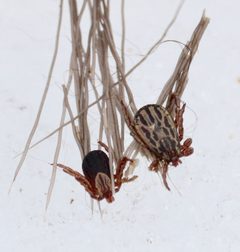
Distinguishable from other Dermacentor by the white shield on females and white markings on males. The one- is distinctive among Dermacentor ticks—most are three-host ticks. () and Dermacentor andersoni (Rocky Mountain wood tick) have different seasonal activity patterns and host associations. Dermacentor albipictus is active primarily in autumn through winter, whereas D. variabilis peaks in spring and summer. Molecular identification may be complicated by deep mitochondrial lineage divergences within that do not indicate distinct species.
Images
Appearance
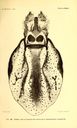
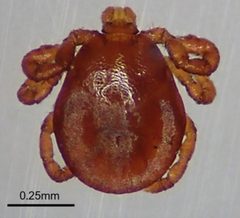
are sexually dimorphic. The adult female is mostly reddish-brown with a white shield () behind the ; engorged females become unusually large, measuring up to 15 mm. The smaller adult male is dark brown with white markings. As a hard (Ixodidae), it possesses a prominent scutum. Larvae and nymphs are considerably smaller and difficult to detect visually.
Habitat
Found in areas with presence of large ungulate , particularly moose. Larvae occur on grassy vegetation up to 1.25 m in height, especially on south-facing slopes. Off-host stages utilize leaf litter and ground-level vegetation. The completes its entire in forested and semi-open across northern North America, including areas north of 60° latitude in Yukon, Canada.
Distribution
Widespread across North America from Alaska and Canada through the United States; documented in Yukon, Alberta, Saskatchewan, Pennsylvania, and northeastern states. GBIF records indicate presence in United States, Guatemala, Mexico, and Hawaii. The shows potential for range expansion with changing climate conditions.
Seasonality
Larval questing peaks in late September to early October; larvae attach to in autumn. All feeding stages (larva, nymph, ) occur on the single host through winter. Engorged females drop off hosts in late winter to early spring (late March to early April documented in Ontario) to lay . Adults mate on the host during late winter. Hosts are free of ticks during summer months.
Host Associations
- Alces alces (moose) - primary most severely affected ; heavy cause anemia, hair loss, emaciation, and death
- Cervus canadensis (elk) - typically low burdens with mild or no ; severe rare
- Odocoileus virginianus (white-tailed deer) - better at and removal than moose; lower levels
- Odocoileus hemionus (mule deer) -
- Rangifer tarandus (caribou) -
- Bos taurus (cattle) - incidental can cause serious losses when cattle graze in moose ; preventable by keeping animals in -free pastures September–May
- Equus caballus (horses) - incidental similar to cattle, vulnerable when grazing in -infested areas
- Sus scrofa (feral swine) - may increase and distribution in some areas
Life Cycle
A one- with approximately one-year . Engorged females drop off hosts in late winter to early spring and lay masses of up to 3,000 eggs in leaf litter. Eggs hatch in late summer or early spring after a pre-oviposition period; laboratory studies indicate 28–32 days incubation at 21°C. Larvae undergo a period of , then ascend vegetation up to 1.25 m and cluster in groups of approximately 1,000 to quest for hosts. Upon host contact, larvae attach and feed, then to nymphs on the same host (approximately 10 days post-attachment documented). Nymphs undergo an extended before molting to in mid-February; this diapause likely delays maturity until warmer weather. Adults feed and mate on the host; males remain on the host for life and die there, while engorged females drop off to oviposit. The diapause mechanism synchronizes development with seasonal conditions.
Behavior
Larvae exhibit questing on vegetation, extending forelegs to detect passing . They respond to host-associated stimuli including odor, heat, movement, and vibration. Larvae cluster on vegetation, which increases encounter rates with hosts. Off-host larvae demonstrate survival capabilities underwater for extended periods (63% survival after 5 weeks for 1-month-old larvae; 23% survival after 7 days for 3-month-old larvae). females show reduced oviposition success after submergence. The extended nymphal represents a key behavioral for seasonal synchronization.
Ecological Role
A significant of large ungulates with documented -level impacts on moose. Heavy cause anemia, hair loss, reduced , and mortality; calf mortality rates of 91% attributed to winter infestation documented in Vermont studies. Reduced moose populations have cascading effects on vegetation —increased abundance of shrubs and balsam fir documented following moose declines on Isle Royale. The tick does not transmit agents, limiting its role as a but not its impact as a parasite. Climate warming correlates with increased tick abundance, with shorter winters associated with higher survival and infestation rates.
Human Relevance
Occasionally bites humans but is not known to transmit . Heavy on livestock (cattle, horses) can cause economic losses for producers. Management strategies include maintaining livestock in fenced, -free pastures or barns from September to May; spring plowing of infested fields to bury engorged females and prevent larval ; and arsenical dips for infested animals (with temperature restrictions in northern regions). The serves as a case study for climate-wildlife- interactions and in wildlife contexts.
Similar Taxa
- Dermacentor variabilis (American dog tick)Three- versus one-host in D. albipictus; active spring through summer versus autumn-winter activity; of and versus no known transmission in D. albipictus; different spiracular plate
- Dermacentor andersoni (Rocky Mountain wood tick)Three- restricted to western North America; of and ; differs in geographic range and
- Amblyomma americanum (Lone Star tick)Three- with different host range; aggressive human biter; transmits , STARI, and other ; active spring through summer; distinct white spot on female
More Details
Climate sensitivity
Warmer and shorter winters correlate with increased survival and higher rates on moose, contributing to declines in the southern half of the eastern moose range.
Genetic variation
Deep mitochondrial lineage divergences (7.1% COI, 4.5% 16S) occur within Alberta , but nuclear markers, endosymbionts, and support single status, highlighting the importance of integrative .
Sex determination
Recent transcriptome analysis identified the first documented case of sex-specific splicing of a doublesex-like gene in chelicerates, suggesting ticks share more insect-like features of sexual differentiation than previously recognized.
Sources and further reading
- BugGuide
- Wikipedia
- GBIF taxonomy match
- iNaturalist taxon
- NCBI Taxonomy
- Catalogue of Life
- Managing External Parasites of Texas Cattle - AgriLife Extension Entomology
- Ticks Can Do More Than 'Tick You Off' | Bug Squad
- Just in the tick of time: American dog tick, Dermacentor variabilis, and Black-legged tick, Ixodes scapularis — Bug of the Week
- Study Shows American Dog Ticks in Western U.S. Are a Separate Species
- A trio of trouble – Black-legged ticks Ixodes spp., American dog tick Dermacentor variabilis, and lone star tick Amblyomma americanum — Bug of the Week
- Time for ticks: Lone star tick, Amblyomma americanum, Blacklegged ticks, Ixodes spp., and American dog tick, Dermacentor variabilis — Bug of the Week
- Reproduction of the winter tick, Dermacentor albipictus, under laboratory conditions
- First records of Dermacentor albipictus larvae collected by flagging in Yukon, Canada
- Survival of off-host Dermacentor albipictus (Acari: Ixodidae) adult females and larvae underwater
- Transcriptome analysis of the winter tick ( Dermacentor albipictus ) reveals sex-specific expression patterns
- Questing behaviour and orientation of larval winter ticks, <i>Dermacentor albipictus</i> (Packard) (Acari: Ixodidae) on vegetation in Central Alberta, Canada
- Prevalence of Winter Ticks (Dermacentor albipictus) in Hunter-Harvested Wild Elk (Cervus canadensis) from Pennsylvania, USA (2017–2018)
- A local Outbreak of the Winter or Moose Tick, Dermacentor albipictus, Pack. (Ixodoidea) in Saskatchewan
- Deep Mitochondrial DNA Lineage Divergences Within Alberta Populations of Dermacentor albipictus (Acari: Ixodidae) Do Not Indicate Distinct Species
- Off-host survival and reproductive success of adult female winter ticks, Dermacentor albipictus in seven habitat types of Central Alberta