
Amblyomma
Koch, 1844
Bont Ticks
Species Guides
6- Amblyomma americanum(Lone Star Tick)
- Amblyomma cajennense(Cayenne tick)
- Amblyomma dissimile(Iguana Tick)
- Amblyomma maculatum(Gulf Coast tick)
- Amblyomma triste
- Amblyomma tuberculatum(gopher tortoise tick)
Amblyomma is the third largest of hard ticks (Ixodidae), comprising medium to large, often ornamented . The genus is the sole member of the Amblyomminae and exhibits its highest in the Americas, where half of all species occur. Many Amblyomma species are medically significant as of human and animal , including , , anaplasmosis, and the agent of alpha-gal . The genus likely originated between South America and Antarctica approximately 48 million years ago, with subsequent diversification and into Australian and South American Gondwana.
Pronunciation
How to pronounce Amblyomma: /æmˈblaɪəmə/
These audio files are automatically generated. While they are not always 100% accurate, they are a good starting point.
Identification
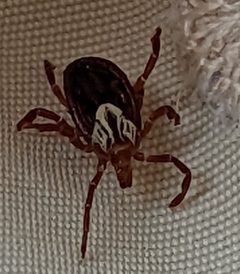
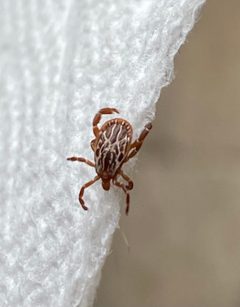
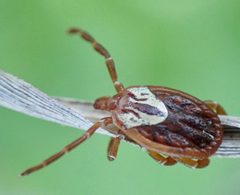
Distinguished from other ixodid by combination of: medium to large size, often , presence of (except Aponomma subgenus), subpentagonal basis capituli, elongate mouthparts, and distinct lateral grooves and festoons. Within the genus, subgenera are largely polyphyletic; only Amblyomma (Amblyomma) and Amblyomma (Walkeriana) are monophyletic. Amblyomma americanum specifically identified by single white spot on female dorsum.
Images
Appearance
Medium to large hard ticks with subcircular to elliptical body shape. Most possess , except those in the subgenus Amblyomma (Aponomma). Basis capituli is subpentagonal with elongate mouthparts. Lateral grooves and festoons are usually distinct. Many species exhibit ornamental patterns on the . Unfed individuals are relatively flat; engorged females may increase body weight up to 200 times after feeding.
Habitat
Primarily occupies torrid zones across all continents, with reaching beyond tropical regions to 40°N and 50°S in the Americas, including alpine zones of the Andes. In temperate North America, found in grassy meadows, field-woodland borders, streamside vegetation, and forest edges. In Missouri Ozark forests, nymphs and more abundant in valleys and on north-facing slopes than on ridges or south-facing slopes.
Distribution
Widespread across Americas, Eurasia, Africa, and Australia. Center of in the Americas, where approximately half of all occur. Amblyomma americanum historically ranged from Iowa, Illinois, Ohio, West Virginia, Maryland, Delaware, and New Jersey southward; range has expanded northward to Minnesota, Wisconsin, Michigan, Pennsylvania, New York, New England, and potentially Maritime Canada. Amblyomma sculptum is a major species in southeastern Brazil, particularly São Paulo State.
Seasonality
Activity governed by temperature; during winter cold. In temperate North America, activity increases as temperatures rise into 70-80°F range in late winter and spring. Peak activity typically May through August, with potential year-round activity on warm winter days. Longer warm seasons associated with climate change extend active period.
Diet
; all active stages feed on blood of vertebrate . Parasitizes wide range of vertebrates except amphibians.
Life Cycle
Behavior
Exhibits questing : climbs vegetation and extends forelegs to encounter passing . Overwinters in leaf litter or soil, where insulation from leaf litter and snow cover enhances survival. Cold limited; exposure to temperatures below 7°F for 2 hours can be lethal to nymphs and . Ticks often attach at skin constrictions such as belt lines or joints where clothing impedes upward movement.
Ecological Role
of vertebrates and of numerous . Transmits agents of Brazilian Spotted Fever, , , anaplasmosis, Southern Associated Rash Illness (STARI), Heartland virus, Bourbon virus, and Theileria equi. Harbors complex bacterial microbiome including potential and zoonotic pathogens (, Anaplasma, Ehrlichia, Coxiella). Serves as bridge between wildlife and human/animal .
Human Relevance
Significant medical and veterinary importance. Bites cause direct injury and transmit multiple . Amblyomma americanum is the primary of alpha-gal , a potentially life-threatening red meat allergy triggered by sensitization to galactose-alpha-1,3-galactose . Climate warming has driven northward range expansion, increasing human exposure risk. Prevention relies on avoidance, inspection, and prompt removal (within 24 hours) to reduce disease transmission risk.
Similar Taxa
- IxodesLargest ixodid ; distinguished by lack of , absence of festoons, and in most . Ixodes scapularis is primary of in eastern North America, which Amblyomma species do not transmit.
- DermacentorIncludes American dog tick (D. variabilis); distinguished by rectangular basis capituli, short mouthparts, and presence of with distinctive color patterns. Dermacentor are primary of in some regions.
- HaemaphysalisSecond largest ixodid ; distinguished by laterally projecting second palpal segment forming 'shoulders' on capitulum, and .
More Details
Phylogenetic History
Following excision of Africaniella (2020) and Cryptocroton (2024), Amblyomma is now monophyletic. Most subgenera remain polyphyletic; only Amblyomma (Amblyomma) and Amblyomma (Walkeriana) are monophyletic. Many remain unresolved.
Climate Change Impact
Documented northward range expansion of A. americanum over seven decades from historical northern limits to New England and potentially Maritime Canada. Predicted to continue or accelerate with greenhouse gas emissions. Lengthening warm seasons extend questing period and increase encounter rates with humans.
Alpha-gal Syndrome Mechanism
Lone star acquires alpha-gal from blood of mammalian (mice, rabbits, cattle, pigs). Subsequent tick bite inoculates alpha-gal into human, triggering IgE-mediated sensitization. Re-exposure through consumption of mammalian meat causes delayed allergic reaction, potentially including anaphylaxis. Not all bites result in sensitization; individual immune responses vary.
Sources and further reading
- BugGuide
- Wikipedia
- GBIF taxonomy match
- iNaturalist taxon
- NCBI Taxonomy
- Catalogue of Life
- A warming world: range expansions of lone star ticks, Amblyomma americanum, and the alpha-gal they carry — Bug of the Week
- A trio of trouble – Black-legged ticks Ixodes spp., American dog tick Dermacentor variabilis, and lone star tick Amblyomma americanum — Bug of the Week
- Alpha-gal and the Lone Star Tick, Amblyomma americanum — Bug of the Week
- Time for ticks: Lone star tick, Amblyomma americanum, Blacklegged ticks, Ixodes spp., and American dog tick, Dermacentor variabilis — Bug of the Week
- A trio of trouble just in time for summer: Blacklegged ticks, Ixodes spp.; American dog tick, Dermacentor variabilis; and lone star tick, Amblyomma americanum — Bug of the Week
- Landscape Terrain Provides New Angle for Measuring Tick Abundance
- Characterization of bacterial microbiome and molecular detection of rickettsiosis in free-living ticks (Amblyomma sculptum Berlese, 1888).