
Amblyomma maculatum
Koch, 1844
Gulf Coast tick
Amblyomma maculatum, commonly known as the Gulf Coast , is a three- hard tick native to the southeastern and south-central United States. The has been expanding its range northward and westward in recent decades, with established now documented as far north as Virginia and west to Oklahoma. primarily parasitize large mammals including cattle, deer, and humans, while stages feed on small mammals and ground-dwelling birds. The species is a of parkeri, the causative agent of American tick bite fever, and has been associated with in rare cases. Heavy on livestock can cause significant economic damage through hide degradation and blood loss.
Pronunciation
How to pronounce Amblyomma maculatum: //ˌæm.bliˈɒm.ə ˌmæk.jʊˈleɪ.təm//
These audio files are automatically generated. While they are not always 100% accurate, they are a good starting point.
Identification
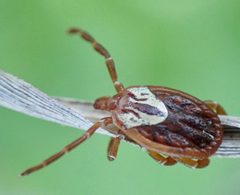
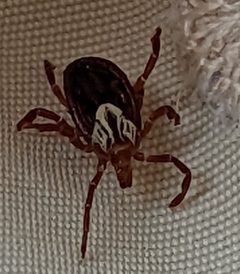
Distinguished from the sympatric lone star (Amblyomma americanum) by the paired spots on the female rather than a single central spot; males lack the festoons with angular projections characteristic of Dermacentor . The scutal pattern separates it from the plain-scutum American dog tick (Dermacentor variabilis). In the western part of its range, it may overlap with Amblyomma triste, which has a more uniformly dark scutum. stages are difficult to distinguish morphologically from other Amblyomma species and require expert examination or molecular identification. Seasonal activity differs from A. americanum, with A. maculatum peaking in late summer and early fall rather than spring.
Images
Appearance
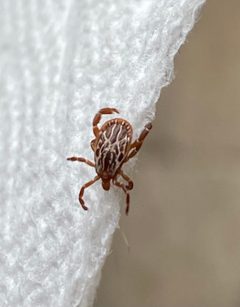
Gulf Coast ticks are relatively large hard ticks with scutums. Females possess a distinctive dark brown to black with white or cream-colored markings, including a pair of spots that give the its specific epithet 'maculatum' (spotted). The scutum covers only the portion of the female body, leaving the idiosoma capable of enormous expansion during blood feeding. Males have a conscutum covering nearly the entire surface with similar ornate patterning. Unfed adults are approximately 4–6 mm in length; fully engorged females may reach 15 mm or more. The mouthparts (capitulum) are long and prominent, extending well anterior to the body. Legs are banded with pale and dark segments.
Habitat
Occurs in coastal plains and prairie , with highest densities in grasslands, pastures, and open woodlands. In the southeastern United States, it inhabits pine savannas, coastal scrub, and agricultural landscapes. In Texas and Oklahoma, it is abundant in tallgrass prairie and post-oak savanna. The shows a strong association with open, sunny rather than dense forest. Within these landscapes, it occupies the herbaceous layer and low shrubs, questing from vegetation 15–45 cm above ground level. Soil moisture requirements appear intermediate; decline in both xeric conditions and areas prone to prolonged flooding.
Distribution
Native range extends along the Atlantic and Gulf coastal plains from Virginia south through the Carolinas, Georgia, Florida, and west along the Gulf Coast through Alabama, Mississippi, Louisiana, and Texas. Western range limit extends through central Oklahoma and eastern Kansas. The has been expanding northward, with recent establishment in Virginia documented. Disjunct occur in parts of the Caribbean and Central America (Mexico, Belize, Honduras, Nicaragua, Rica, Panama). Climate modeling predicts continued northward expansion into the mid-Atlantic and potential westward expansion under warming scenarios. In Colombia, it occurs in Andean regions with potential for Caribbean and Orinoco expansion.
Seasonality
activity peaks in late summer and early fall (July–October in most of the range), with some regional variation. In Texas, peak in August–September. This seasonal pattern contrasts with the spring–summer peak of the lone star . stages (larvae and nymphs) are active primarily in spring and summer, with larvae appearing earlier than nymphs. The exhibits a single per year in most of its range, with overlapping cohorts producing year-round presence of some life stages in southern portions of the distribution. Questing height varies seasonally, with adults climbing higher on vegetation during peak activity periods.
Host Associations
- Cattle (Bos taurus) - primary for attach around ears, , and poll; heavy cause hide damage and 'gotch ear'
- White-tailed deer (Odocoileus virginianus) - primary for Important wildlife supporting
- Cotton rat (Sigmodon hispidus) - preferred for immaturesParticularly favored for larvae and nymphs
- Marsh rice rat (Oryzomys palustris) - for immaturesDocumented in coastal
- Eastern woodrat (Neotoma floridana) - for immaturesGround-dwelling rodent
- Cotton mouse (Peromyscus gossypinus) - for immaturesSmall mammal in southeastern range
- Sylvilagus palustris (marsh rabbit) - for immaturesGround-dwelling lagomorph
- Ground-dwelling birds - for immaturesIncludes Geothlypis trichas, Cardinalis cardinalis, Passerina ciris, Sialia sialis, Thryothorus ludovicianus, Troglodytes aedon, Zonotrichia albicollis
- Humans (Homo sapiens) - incidental for Bites can transmit parkeri
- Domestic dog (Canis lupus familiaris) - for Companion animal
- Fallow deer (Dama dama) - for Documented ungulate
- Domestic pig (Sus scrofa domesticus) - for Livestock
- Coyote (Canis latrans) - for Documented in Oklahoma range expansion
Life Cycle
Three- with each stage requiring a separate blood meal on a different individual host. hatch into six-legged larvae that seek small mammal or bird hosts, feed for 3–5 days, then detach and to eight-legged nymphs. Nymphs quest for hosts similar to larvae, feed for 3–7 days, detach, and molt to . Adults quest on larger mammals, with females taking a single prolonged blood meal (7–10 days or more) before dropping to oviposit. Males may take multiple smaller meals and mate with feeding females. A single is completed in approximately one year under favorable conditions, though individual ticks may live 2–3 years. Females produce 3,000–8,000 eggs in a single oviposition event.
Behavior
Quests from vegetation using foreleg to detect cues (CO₂, heat, vibration). climb higher on vegetation (15–45 cm) than immatures, which remain near ground level. Shows questing activity with peak host-seeking during daylight hours. Host-seeking is driven by and temperature cues. Unlike some , A. maculatum does not exhibit prominent behavior at host trails. In laboratory settings, nymphs show reduced movement compared to A. americanum under similar conditions. Off-host survival is relatively poor compared to sympatric species; adults experience high mortality during prolonged off-host periods, particularly in flooded or extremely dry conditions.
Ecological Role
for parkeri, the agent of American bite fever (a spotted fever rickettsiosis), maintaining this in enzootic cycles involving small mammals and birds. Serves as a bridge vector between wildlife and domestic animals/humans. Heavy on cattle can cause direct economic damage through hide degradation, blood loss, and secondary . The contributes to tick diversity in grassland and savanna and may compete with other tick species for . As a feeder on large mammals, it connects multiple host species in transmission networks.
Human Relevance
Primary of parkeri, causing American bite fever with including fever, headache, myalgia, and eschar formation at bite site. Bites can cause local inflammation and, in rare cases, (documented in alpha-gal knockout mice and suspected in other vertebrates). Economic impact on cattle industry through hide damage and control costs; reduce hide quality and may necessitate acaricide treatments. Occupational hazard for agricultural , wildlife biologists, and outdoor recreationists in areas. Climate change is expected to expand the ' range, increasing human exposure risk in the mid-Atlantic and potentially Midwestern states.
Similar Taxa
- Amblyomma americanum (lone star tick)Overlapping range and use; distinguished by single central scutal spot on females versus paired spots on A. maculatum; also differs in seasonal activity (spring–summer peak vs. late summer–fall)
- Amblyomma tristePotential western range overlap; A. triste has more uniformly dark, less and different associations
- Dermacentor variabilis (American dog tick)Sympatric in eastern range; distinguished by plain brown without patterning and presence of festoons on idiosoma
- Amblyomma cajennense complexOverlapping distribution in Central and South America; requires expert morphological or molecular differentiation
More Details
Microbiome
The A. maculatum microbiome comprises ten core bacterial , with , Francisella, and Candidatus Midichloria as key players. Rickettsia parkeri alters microbiome composition, replacing Francisella and increasing Candidatus Midichloria abundance. These - interactions may influence competence and offer targets for novel control strategies.
Climate change impacts
distribution modeling predicts northward and westward range expansion under climate change scenarios, with suitable increasing in the mid-Atlantic and Midwest by 2070. The species shows higher sensitivity to flooding and desiccation than A. americanum, making its distribution more dependent on soil moisture regimes.
Organic control methods
Field trials in Texas demonstrated that the silicate dust CimeXa achieves 96% reduction in larval and 100% reduction in nymphal A. maculatum when applied to vegetation, offering a potential organic alternative to synthetic acaricides in sensitive .
Sources and further reading
- BugGuide
- Wikipedia
- GBIF taxonomy match
- iNaturalist taxon
- NCBI Taxonomy
- Catalogue of Life
- Managing External Parasites of Texas Cattle - AgriLife Extension Entomology
- Cattle Call: Tick Surveillance Project Offers Model for Monitoring Livestock
- Organic Dust Takes a Bite Out of Ticks
- Entomology 2020: Attendees Share Early Reactions to On-Demand Presentations, Posters
- How a Life-Long Interest in Wildlife Brought One Entomologist to Vector-Borne Disease Ecology
- A warming world: range expansions of lone star ticks, Amblyomma americanum, and the alpha-gal they carry — Bug of the Week
- A New Distribution Record for Amblyomma Maculatum (Acari: Ixodidae)
- Microscopic analysis of Rickettsial co-infection in the Gulf Coast tick, Amblyomma maculatum
- Environmental and host interrelationships and life history of the Gulf Coast tick (Amblyomma maculatum Koch) in southern Georgia
- Peer Review #2 of "Climate change influences on the geographic distributional potential of the spotted fever vectors Amblyomma maculatum and Dermacentor andersoni (v0.2)"
- Peer Review #2 of "Climate change influences on the geographic distributional potential of the spotted fever vectors Amblyomma maculatum and Dermacentor andersoni (v0.1)"
- Peer Review #1 of "Climate change influences on the geographic distributional potential of the spotted fever vectors Amblyomma maculatum and Dermacentor andersoni (v0.2)"
- Drivers of behavior in two tick species, Amblyomma americanum and Amblyomma maculatum (Acari: Ixodidae), in a laboratory setting
- Questing Behavior by Amblyomma maculatum at Semi-Field Conditions in Oklahoma
- Peer Review #1 of "Climate change influences on the geographic distributional potential of the spotted fever vectors Amblyomma maculatum and Dermacentor andersoni (v0.1)"
- Laboratory studies of host-seeking behavior in colonized nymphalAmblyommamaculatumKoch ticks (Acari: Ixodidae)
- Changes in microbial composition, diversity, and functionality in the Amblyomma maculatum microbiome following infection with Rickettsia parkeri
- Unusual paralytic response to Amblyomma maculatum nymphal bite in alpha-gal knockout mice
- A New Distribution Record for the Gulf Coast Tick, Amblyomma Maculatum (Acari: Ixodidae)
- Survival of adult Amblyomma americanum, Amblyomma maculatum, and Dermacentor variabilis (Acari: Ixodidae) in four habitats in southeastern Virginia
- Impact of climate change on the geographical distribution of ticks of public health significance in Colombia: Amblyomma ovale (Ixodida: Ixodidae), the Amblyomma maculatum (Ixodida: Ixodidae) complex and the Amblyomma cajennense (Ixodida: Ixodidae) complex