
Amblyomma cajennense
Fabricius, 1787
Cayenne tick
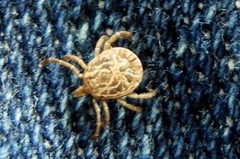
, commonly known as the , is a hard historically considered to range from the southern United States through Central America and the Caribbean to northern Argentina. Molecular studies have revealed this 'species' is actually a complex of multiple cryptic species, with A. cajennense sensu stricto now restricted to the Amazonian region of South America. The is of significant medical and veterinary importance as a of and other rickettsial .
Pronunciation
How to pronounce Amblyomma cajennense: /ˌæm.blɪˈɒm.ə kaˈjɛn.sɛne/
These audio files are automatically generated. While they are not always 100% accurate, they are a good starting point.
Identification
The A. cajennense complex has historically been identified by morphological features, but -level identification within the complex now requires molecular analysis. A. cajennense sensu stricto occurs in the Amazon biome. Other members of the complex are geographically separated: A. mixtum from Texas to western Ecuador, A. patinoi in the Eastern Cordillera of Colombia, A. interandinum in the northern Inter-Andean valley of Peru, A. tonelliae in dry Chaco regions of Argentina/Bolivia/Paraguay, and A. sculptum in humid northern Argentina and adjacent regions.
Images
Habitat
Amazon biome; riparian forest fragments. The broader occupies diverse environments from dry Chaco regions to humid tropical forests, reflecting to wide environmental conditions.
Distribution
A. cajennense sensu stricto: Amazonian region of South America, specifically documented from Rondônia, Brazil. The broader (sensu lato) historically reported from southern United States through Mexico, Central America, Caribbean, and South America to northern Argentina. GBIF records confirm presence in: Argentina, Belize, Bermuda, Bolivia, Brazil, Colombia, Rica, Cuba, Ecuador, El Salvador, French Guiana, Guatemala, Guyana, Honduras, Jamaica, Mexico, Nicaragua, Panama, Paraguay, Peru, Suriname, Trinidad and Tobago, United States, Venezuela.
Diet
Blood-feeding of vertebrate . Documented hosts include mammals (especially horses, dogs), amphibians, reptiles, birds. First recorded instance of on a fish: two A. cajennense were found embedded in an electric eel (Electrophorus varii) specimen collected in Brazil in 1873.
Host Associations
- horses - primary (females collected from)Study specimens from Rio de Janeiro and Minas Gerais, Brazil
- dogs -
- amphibians -
- reptiles -
- birds -
- mammals - general groupespecially those with hooves
- Electrophorus varii - unusual recordfirst known instance of on fish; 1873 museum specimen
Life Cycle
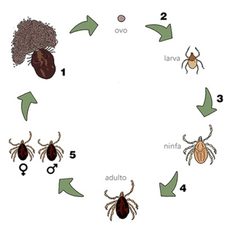
Engorged females oviposit masses in sheltered locations. Eggs are exposed to environmental conditions and vulnerable to desiccation and . Laboratory conditions for egg development: ~93% relative humidity, 26°C, 14h:10h . Bacterial associates identified from eggs may assist in hatching through secretion.
Behavior
Questing : climbs vegetation and extends forelegs to encounter . Saliva exhibits immune-modulatory activity, increasing anti-inflammatory cytokines (IL-6, IL-10), reactive oxygen production, and phagocytic activity in macrophages. Saliva composition changes dynamically throughout the feeding process.
Ecological Role
of rickettsii, the agent of . Primary vector role in the complex now attributed to A. sculptum. harbor associated bacteria (Staphylococcus sciuri predominant) that may provide chemical defense against environmental threats through antifungal, bacteriocin, and bioactive metabolite production.
Human Relevance
Medical significance: of , affecting humans and domestic cattle. Research interest: saliva contains bioactive molecules including Factor X active protein, which has demonstrated anti-cancer properties in laboratory studies. Climate change may expand suitable for some members of the complex while contracting others.
Similar Taxa
- Amblyomma sculptumFormerly considered ; now recognized as distinct occupying humid areas of northern Argentina, Bolivia, Paraguay, and Brazil; primary of rickettsii in those regions
- Amblyomma mixtumFormerly considered ; occurs from Texas to western Ecuador
- Amblyomma patinoiFormerly considered ; occurs in Eastern Cordillera of Colombia
- Amblyomma interandinumFormerly considered ; occurs in northern Inter-Andean valley of Peru
- Amblyomma tonelliaeFormerly considered ; occurs in dry Chaco region from central-northern Argentina to Bolivia and Paraguay
- Amblyomma americanumSimilar (lone star tick) and former broad distribution; distinct white spot on , different geographic range in North America, of different including alpha-gal
Misconceptions
The name '' and broad historical distribution from southern US to Argentina referred to what is now recognized as multiple cryptic . Older literature using 'A. cajennense' may refer to any of several distinct species with different competencies and geographic ranges.
Sources and further reading
- BugGuide
- Wikipedia
- GBIF taxonomy match
- iNaturalist taxon
- NCBI Taxonomy
- Catalogue of Life
- Ticks on an Eel: Museum Specimen is a First of its Kind
- A warming world: range expansions of lone star ticks, Amblyomma americanum, and the alpha-gal they carry — Bug of the Week
- A trio of trouble – Black-legged ticks Ixodes spp., American dog tick Dermacentor variabilis, and lone star tick Amblyomma americanum — Bug of the Week
- Alpha-gal and the Lone Star Tick, Amblyomma americanum — Bug of the Week
- Time for ticks: Lone star tick, Amblyomma americanum, Blacklegged ticks, Ixodes spp., and American dog tick, Dermacentor variabilis — Bug of the Week
- A trio of trouble just in time for summer: Blacklegged ticks, Ixodes spp.; American dog tick, Dermacentor variabilis; and lone star tick, Amblyomma americanum — Bug of the Week
- Bacteria associated with Amblyomma cajennense tick eggs
- Impact of climate change on the geographical distribution of ticks of public health significance in Colombia: Amblyomma ovale (Ixodida: Ixodidae), the Amblyomma maculatum (Ixodida: Ixodidae) complex and the Amblyomma cajennense (Ixodida: Ixodidae) complex
- Amblyomma cajennense Sensu Stricto (Fabricius, 1787) and Amblyomma sculptum (Berlese, 1888) Tick Saliva Elicit Immune-Modulatory Activity in Isolated Murine Macrophages With an Insight Into Proteomic Analysis.