
Amblyomma triste
Koch, 1844
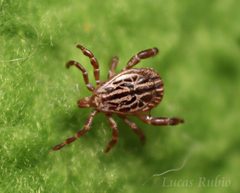
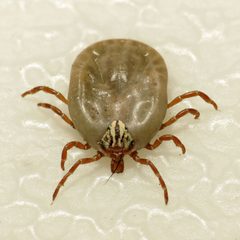
Amblyomma triste is a hard first described by Koch in 1844. It is the primary of parkeri, the causative agent of a spotted fever group rickettsiosis with resembling . The species is the sole tick responsible for human tick-borne in Uruguay and a significant vector in Argentina and Brazil. Though historically considered restricted to South America, specimens have been documented in the United States (Arizona and Texas) and Mexico, where they were long misidentified as the morphologically similar Amblyomma maculatum.
Pronunciation
How to pronounce Amblyomma triste: /æmˈblaɪəmə ˈtrɪsteɪ/
These audio files are automatically generated. While they are not always 100% accurate, they are a good starting point.
Identification
Morphologically similar to Amblyomma maculatum and Amblyomma tigrinum, forming a cryptic . Accurate identification requires molecular analysis; the mitochondrial of A. triste shows 4.2% from A. maculatum. Specimens in North America were historically misidentified as A. maculatum due to this morphological convergence.
Images
Distribution
Native to South America: Venezuela, Argentina, Brazil, Colombia, Peru, and Uruguay. Documented in North America from Cochise and Santa Cruz Counties, Arizona, and Brewster and Jeff Davis Counties, Texas; also detected in import cattle from Mexican states of Coahuila, Durango, and Sonora.
Diet
Obligate blood-feeder on vertebrate . Larvae and nymphs feed on guinea pigs, chickens, rats, rabbits, wild mice, dogs, and capybaras. feed on dogs, capybaras, and rabbits. In natural settings, has been documented parasitizing marsh deer (Blastocerus dichotomus).
Host Associations
- Cavia porcellus - Most suitable for larvae and nymphs in laboratory conditions
- Gallus gallus - Secondary for stages
- Hydrochaeris hydrochaeris - Most suitable for stage; produces more and heavier engorged females than other hosts
- Canis familiaris - for and stages
- Blastocerus dichotomus - Wild documented in Argentina; associated with Ehrlichia chaffeensis transmission cycle
- Rattus norvegicus - Larval and nymphal
- Oryctolagus cuniculus - Larval, nymphal, and
- Calomys callosus - Wild mouse for stages
Life Cycle
Under laboratory conditions at 27°C and 90% relative humidity, the from to averages 155 days. Larval feeding period: 3.8–4.7 days; larval premolt period: 8.9–10.4 days. Nymphal feeding period: 4.2–6.2 days. Male nymph premolt period (15.4 days) is significantly longer than female nymph premolt period (14.7 days). Female nymphs are significantly heavier than male nymphs. Adult sex ratio is 0.9:1 (male:female).
Behavior
Exhibits questing typical of hard ticks, climbing vegetation and extending forelegs to encounter . Repeated of hosts induces acquired resistance; in guinea pigs, this manifests as reduced engorgement weight, prolonged feeding time, decreased nymph recovery rate, and marked cutaneous basophilia at bite sites.
Ecological Role
of zoonotic . Primary vector of parkeri in South America. Documented carrier of Ehrlichia chaffeensis in Argentina, with evidence of active in salivary glands indicating potential for transmission. Links wild mammal (marsh deer, small mammals) to human risk.
Human Relevance
Significant public health . Transmits parkeri, causing spotted fever group rickettsiosis. The sole responsible for human tick-borne in Uruguay; significant vector in Argentina and Brazil. Misidentification as A. maculatum in North America complicates surveillance and risk assessment. Laboratory studies show guinea pigs develop resistance after repeated exposure, with cutaneous basophilia playing a key role in this immune response.
Similar Taxa
- Amblyomma maculatumCryptic with overlapping ; historically confused with A. triste in North America where specimens were misidentified for at least 67 years. of 4.2% in mitochondrial distinguishes them.
- Amblyomma tigrinumThird member of the A. maculatum group; all three species are morphologically similar and share parkeri competence.
Sources and further reading
- BugGuide
- Wikipedia
- GBIF taxonomy match
- iNaturalist taxon
- NCBI Taxonomy
- Catalogue of Life
- A warming world: range expansions of lone star ticks, Amblyomma americanum, and the alpha-gal they carry — Bug of the Week
- A trio of trouble – Black-legged ticks Ixodes spp., American dog tick Dermacentor variabilis, and lone star tick Amblyomma americanum — Bug of the Week
- Alpha-gal and the Lone Star Tick, Amblyomma americanum — Bug of the Week
- Time for ticks: Lone star tick, Amblyomma americanum, Blacklegged ticks, Ixodes spp., and American dog tick, Dermacentor variabilis — Bug of the Week
- A trio of trouble just in time for summer: Blacklegged ticks, Ixodes spp.; American dog tick, Dermacentor variabilis; and lone star tick, Amblyomma americanum — Bug of the Week
- Destination Potomac, Maryland – Spring arrives and with it, ticks: Lone star tick, Amblyomma americanum, and Blacklegged ticks, Ixodes spp. — Bug of the Week
- Distribution and genetic variation of Amblyomma triste (Acari: Ixodidae) in Argentina
- Seasonal dynamics and hosts of Amblyomma triste (Acari: Ixodidae) in Argentina
- Life cycle and host specificity of Amblyomma triste (Acari: Ixodidae) under laboratory conditions
- Factors affecting patterns of Amblyomma triste (Acari: Ixodidae) parasitism in a rodent host
- Simultaneous detection of Ehrlichia chaffeensis in marsh deer (Blastocerus dichotomus) and their parasitic Amblyomma triste ticks inArgentina: a zoonotic pre-emergence scenario?
- Tick host specificity: An analysis based on host phylogeny and tick ecological features using Amblyomma triste and Amblyomma tigrinum immature stages
- Amblyomma triste (Acari: Ixodidae): New North American Collection Records, Including the First From the United States
- Amblyomma triste Koch, 1844 (Acari: Ixodidae): Hosts and seasonality of the vector of Rickettsia parkeri in Uruguay
- First mitochondrial genome of Amblyomma triste Koch, 1844 (Acari: Ixodidae): Evidence for studying species within the A. maculatum group</p >
- Guinea Pigs Develop Cutaneous Basophilia after Repeated Infestations by Nymphs of the Tick Amblyomma triste
- Molecular detection of Ehrlichia chaffeensis in marsh deer (Blastocerus dichotomus) and their parasitic Amblyomma triste ticks in Argentina suggests a local transmission cycle