
Haemaphysalis leporispalustris
Packard, 1869
rabbit tick, grouse tick
Haemaphysalis leporispalustris, commonly known as the rabbit , is a hard tick ( Ixodidae) with one of the widest distributions of any New World tick , ranging from Alaska to Argentina. It is a three- tick specialized on lagomorph hosts (rabbits and hares), with larvae also frequently found on ground-dwelling birds. Despite rarely feeding on humans, it serves as a for several affecting wildlife and domestic animals, including rickettsii, Coxiella burnetii, and Francisella tularensis. A newly recognized human pathogen, Rickettsia lanei, has been associated with this tick species.
Pronunciation
How to pronounce Haemaphysalis leporispalustris: //hɛ.mə.fɪˈseɪ.lɪs ˌlɛ.pɔr.ɪs.pəˈlʌs.trɪs//
These audio files are automatically generated. While they are not always 100% accurate, they are a good starting point.
Identification
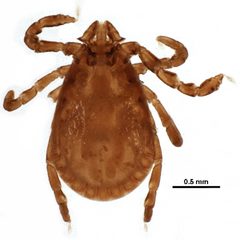
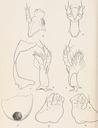
Distinguished from other Haemaphysalis by the rectangular (not hexagonal) basis of the capitulum and palpi that are wider than long. The unornamented separates it from ornamented . Extremely similar to other members; molecular identification may be necessary for definitive determination. Resembles Dermacentor (wood ticks) in general appearance but lacks the scutum patterns common in that genus.
Images
Appearance
measure approximately 1 mm in length. The body lacks . Palpi are wider than long. The is unornamented in both sexes. The basis of the capitulum is rectangular rather than hexagonal. Festoons (wrinkles) are present at the base of the body. The capitulum projects forward prominently from the body. Overall appearance resembles the "wood tick" (Dermacentor ).
Habitat
Occurs in diverse environments across its broad range, from northern forests to tropical regions. Larvae climb vegetation to quest for , preferring curved vegetation 12–15 cm in height with smaller diameter tips. and nymphs are found on host animals, particularly on ears, between ears, or on necks of lagomorphs. Development rates are temperature-dependent, proceeding faster at higher temperatures.
Distribution
Widely distributed in the Americas from Alaska through Canada, the United States, Mexico, and Central America to Argentina. Documented in Venezuela, Bolivia, Brazil, Colombia, Rica, Guatemala, Panama, Paraguay, and Peru. Present in Atlantic rain forest environments in Brazil (Rio de Janeiro and Minas Gerais states). One of the largest distributions for a originating in the New World.
Seasonality
peaks during summer and declines during winter. In temperate regions, the can extend to a year, especially in cold climates. Activity patterns vary by life stage and temperature conditions.
Diet
Obligate blood-feeding . Feeds on rabbits (Sylvilagus spp.), hares (Lepus spp.), and occasionally ground-feeding birds. Rarely feeds on humans. Takes blood meals during each active life stage (larva, nymph, ).
Host Associations
- Sylvilagus spp. (cottontail rabbits) - primary Common ; ticks frequently found on ears, between ears, or on neck
- Lepus spp. (hares/jackrabbits) - primary Includes snowshoe hares; common
- Ground-dwelling birds - (larval stage)Larvae frequently found on ground-feeding birds; includes Arremon semitorquatus, Corythopis delalandi, Fluvicola nengeta, Troglodytes musculus, Volatinia jacarina, Turdus rufiventris in Brazil
- Humans - rare incidental Rarely feeds on humans
Life Cycle
Three- with hemimetabolic development. Stages: , larva, nymph, . Each active stage feeds on a host, drops to ground, , then seeks next host. Host switching may occur between stages, especially if host is not a lagomorph. Complete cycle may take up to one year in cold climates; faster at higher temperatures. of some documented.
Behavior
Highly -specific in host-seeking . Climbs vegetation to quest for hosts, positioning on curved vegetation 12–15 cm high—matching typical rabbit height. Uses carbon dioxide sensing and body temperature detection to locate hosts. Exhibits negative geotaxis (upward movement on vegetation). Upon host contact, either accepts and feeds or rejects and drops to ground to repeat questing. Prefers dry surfaces and darker environments. Becomes still and extends when waiting for host stimuli.
Ecological Role
for multiple bacterial including rickettsii ( agent), Coxiella burnetii (Q fever), Francisella tularensis (), and Rickettsia lanei (newly described human pathogen). maintains R. rickettsii in . Serves as a maintenance for zoonotic agents in wild lagomorph populations. Heavy can cause macrocytic normochromic anemia or death in small mammals.
Human Relevance
Rarely bites humans, so direct medical importance is limited. However, recently identified as the for lanei, a newly recognized human causing spotted fever illness in California. Important veterinary concern for rabbits, hares, and small mammals—heavy cause anemia and mortality. Control in domestic rabbits uses ivermectin; pyrethrin, permethrin, and amitraz are toxic to small mammals and must be avoided.
Similar Taxa
- Haemaphysalis longicornis (Asian longhorned tick)Similar ; distinguished by parthenogenetic in H. longicornis and subtle morphological differences. H. longicornis is an in the U.S. not native to the Americas.
- Dermacentor variabilis (American dog tick)Resembled in general "wood tick" appearance; distinguished by rectangular capitulum basis and lack of patterns in H. leporispalustris.
- Other Haemaphysalis speciesExtremely similar ; often require molecular identification or examination of capitulum shape and palpal proportions for separation.
More Details
Thermal biology
Critical temperature varies with developmental stage and nutritional state in nymphs and . Engorged nymphs have low critical temperature (36–40°C) one day after drop-off, increasing to 46–47°C over 15 days, then decreasing post-. Unfed females maintain 42–43°C for two months, with further decrease during engorgement. Water loss rates correlate with these thermal changes.
Pathogen associations
Documented to carry rickettsii, Coxiella burnetii, Francisella tularensis, Anaplasma bovis, and Rickettsia lanei. Maintains R. rickettsii in the Americas through , serving as a despite rarely biting humans.
Taxonomic note
First described by Packard in 1869. Molecular identification via 16S rRNA and 12S rRNA sequencing may be necessary for definitive identification due to morphological similarity with .
Sources and further reading
- BugGuide
- Wikipedia
- GBIF taxonomy match
- iNaturalist taxon
- NCBI Taxonomy
- Catalogue of Life
- Invasive Tick Has Been Present in New York Longer Than Previously Known, Study Shows
- Be On the Lookout: There's a New Tick in Town
- Potential Range for Asian Longhorned Tick Covers Much of Eastern U.S.
- Lab Study Shows Asian Longhorned Tick Can Spread Rocky Mountain Spotted Fever
- Invasive Tick Persists in New Jersey
- Commonly Used Acaricides Found Effective on Invasive Tick
- Climbing Behavior and Host-Finding of Larval Rabbit Ticks (Haemaphysalis leporispalustris)
- New host records of Haemaphysalis leporispalustris (Acari: Ixodidae) on birds in Brazil
- Changes in Critical Temperature During Nymphal and Adult Development in the Rabbit Tick, Haemaphysalis Leporispalustris (Acari: Ixodides: Ixodidae)
- Reproduction in Ticks (Acari: Ixodoidea). 3. Copulation in Dermacentor occidentalis marx and Haemaphysalis leporispalustris (Packard) (Ixodidae)
- Experimental infection of the rabbit tick, Haemaphysalis leporispalustris, with the bacterium Rickettsia rickettsii, and comparative biology of infected and uninfected tick lineages
- Host Associations and Seasonal Occurrence ofHaemaphysalis leporispalustris,Ixodes brunneus, I. cookei, I. dentatus, andI. texanus(Acari: Ixodidae) in Southeastern Missouri
- Rickettsia lanei, sp. nov. (Rickettsiales: Rickettsiaceae), a Newly Recognized Pathogen of Humans Associated with the Rabbit Tick, Haemaphysalis leporispalustris (Acari: Ixodidae)