
Metellina curtisi
(McCook, 1894)
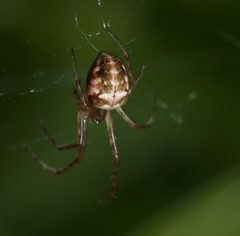
Metellina curtisi is a of long-jawed orb-weaver spider in the Tetragnathidae. It is native to North America, with confirmed records from the United States and Canada. The species belongs to a characterized by elongated and orb-web building . It is one of approximately 12 species in the genus Metellina, which occurs primarily in the Holarctic region.
Pronunciation
How to pronounce Metellina curtisi: /mɛˈtɛl.ɪ.nə ˈkɜː.tɪ.siː/
These audio files are automatically generated. While they are not always 100% accurate, they are a good starting point.
Identification
As a member of Tetragnathidae, Metellina curtisi possesses the 's characteristic elongated (jaws) that project forward, giving the "long-jawed orb weavers." -level identification within Metellina requires examination of genitalia and other subtle morphological features. Males typically have more pronounced elongation of chelicerae and compared to females. Distinction from such as Metellina segmentata and Metellina mengei relies on detailed structural characters of the epigyne in females and palpal organs in males.
Images
Distribution
North America; confirmed records include the United States and Canada (Alberta).
Behavior
As with other Tetragnathidae, Metellina curtisi is known to construct orb webs for prey capture. Members of the Metellina typically build horizontal or slightly inclined orb webs, often positioned in vegetation near water or in shaded . The elongated are used to grasp and manipulate prey while wrapping it in silk.
Ecological Role
As a spider, Metellina curtisi functions as a of small flying and crawling insects. Its orb-web construction contributes to local structure and nutrient cycling through prey capture.
Similar Taxa
- Metellina segmentataOverlapping distribution in North America; distinguished by genitalic and subtle differences in abdominal patterning.
- Tetragnatha speciesSame (Tetragnathidae) with similar elongated body form and long jaws; Tetragnatha typically have more extremely elongated bodies and different web positioning habits.
- Pachygnatha speciesSame but with shorter, stouter and different web-building ; Pachygnatha are often ground-dwelling or vegetation-dwelling without typical orb webs.
More Details
Taxonomic note
The was described by Henry Christopher McCook in 1894. The Metellina was established by Chamberlin & Ivie in 1941, with species previously placed in related genera such as Meta and Metleucauge.
Observation data
iNaturalist records 462 observations of this , indicating it is moderately well-documented by citizen scientists, though detailed biological studies appear limited in the accessible literature.