
Leucauge
White, 1841
Orchard Spiders, Orchard Orbweavers, Long-jawed Orb Weavers
Species Guides
4- Leucauge argyra
- Leucauge argyrobapta(Mabel's orchard orb weaver)
- Leucauge licina(Dominican Spider)
- Leucauge venusta(Orchard Orbweaver)
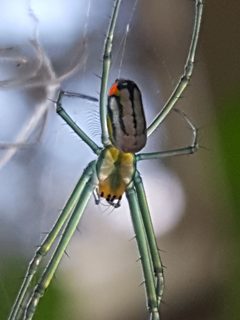
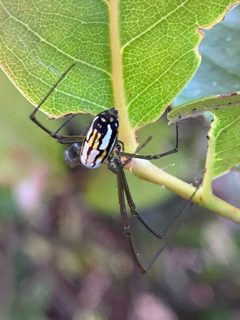
Leucauge is a of long-jawed orb-weaving spiders in the Tetragnathidae, comprising over 170 with pantropical distribution. The genus was established by Adam White in 1841 based on a specimen collected by Charles Darwin. Leucauge spiders are characterized by their distinctive silver, black, yellow, and green coloration, horizontal or slanted orb webs, and two rows of long, slender curved hairs on the femurs of the fourth leg. The genus underwent significant taxonomic revision in 2010 to resolve historical confusion surrounding the type species.
Pronunciation
How to pronounce Leucauge: //luˈkaʊ.ɡiː//
These audio files are automatically generated. While they are not always 100% accurate, they are a good starting point.
Identification
The is relatively easy to identify due to the distinctive body and leg shapes combined with silver, black, and yellow markings in females. The two rows of long, slender curved hairs on the fourth leg femurs are a key diagnostic character. -level identification requires examination of (short and stout versus long and well-developed with rows of large teeth in males) and abdominal shape variations. The horizontal or slanted web orientation distinguishes Leucauge from vertical-orb genera like Mangora. Unlike black widows (Latrodectus), Leucauge are , build orb webs rather than tangled cobwebs, and lack the globular and red hourglass marking.
Images
Habitat
Frequently found in damp places such as marshes and rainforests, but not restricted to damp areas. Also occurs in woodlands, shrubs, bushes, and forest edges. Younger spiders build webs closer to ground level; typically position webs about 1.5 meters high in vegetation.
Distribution
Fully pantropical distribution. In the Americas, ranges from southern Canada (Ontario) through the United States (east to Nebraska and Texas, west to California), Mexico, Central America to Panama, and throughout South America including the Colombian Andes. Also occurs in Africa (from Gambia to Libya), southern Europe (Greece), and Asia (Malaysia, Indonesia, India region). Introduced documented in Australia and Brazil.
Seasonality
most abundant in late spring and early summer. In temperate regions, individuals overwinter as sub-adults in leaf litter and under loose bark. Year-round activity in tropical regions. Web-building occurs both in morning and during daytime.
Host Associations
- Hymenoepimecis castilloi - ectoparasitoidIchneumonid that induces behavioral modification; first record in Colombia
- Hymenoepimecis tedfordi - ectoparasitoidPreviously recorded
- Eruga ca. gutfreundi - ectoparasitoidPreviously recorded
Life Cycle
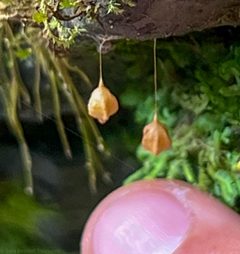
Development includes , spiderling, sub-, and adult stages. occurs as sub-adults in protected locations. Males use silk to loosely bind female legs during mating. Females construct silken egg sacs. In parasitized individuals, the develops through at least three instar stages; second instar larvae associated with modified webs, third instar larvae kill adult spider, and occurs in cocoon hanging from vertical line at web hub.
Behavior
Constructs large orb webs, often reusing frame and anchor lines. Webs are typically slanted or horizontal rather than vertical, with open hub and clear, widely spaced viscid spirals. Spider rests in hub with underside facing upward. Some webs multiple occupants (up to three spiders), each using a portion of the web. When threatened, spiders drop directly to the ground and disappear into leaf litter. Parasitized individuals exhibit dramatically modified , constructing cocoon webs lacking adhesive spirals with multiple reinforced connections to vegetation.
Ecological Role
Predatory spiders that capture flying insects in orb webs. Serve as for polysphinctine ichneumonid . Modified cocoon webs constructed by parasitized spiders may provide protection for developing pupae against scavenging arthropods, climate extremes, and flying insect strikes.
Human Relevance
Generally harmless to humans; not medically significant. Occasionally mistaken for black widows due to red abdominal markings, causing unnecessary concern. Valued by photographers for their colorful appearance and accessible webs. Subject of citizen science observations and biodiversity documentation.
Similar Taxa
- MangoraAlso builds orb webs and some have similar coloration, but Mangora constructs vertical orb webs rather than horizontal ones
- Latrodectus (black widows)Red abdominal markings cause confusion, but widows are , build tangled cobwebs not orb webs, and have globular
- Mecynogea (Basilica Spider)Builds horizontal orb web, but pulls it into a distinctive dome shape unlike the flat or slanted webs of Leucauge
- Linyphiidae (sheetweb weavers)Some resemble Leucauge in coloration and build horizontal webs, but they construct sheet webs rather than orb webs with and spirals
Misconceptions
The "Orchard Orbweaver" for L. venusta is misleading, as the is not particularly common in orchards and prefers woodland . The red abdominal markings of some species (especially L. venusta) frequently lead to misidentification as black widows, despite fundamental differences in web architecture, activity period, and body shape.
More Details
Etymology
The name derives from Greek λευκός (leukos, "white") and αὐγή (augḗ, "dawn"), referring to the habit of building the first web before dawn.
Taxonomic History
Charles Darwin suggested the name and collected the first specimen (L. argyrobapta) in May 1832. The genus became a wastebasket containing approximately 300 loosely related until 2010 research resolved L. argyrobapta as a synonym of L. venusta and enabled major revision. A 2018 paper restored L. argyrobapta as a separate species.
Species Diversity
As of October 2025, the World Spider Catalog recognizes 174 and eight in the .
High-Altitude Record
First documented case of spider- interaction at high altitude (2583 m ASL) in the Colombian Andes involved Leucauge mariana and Hymenoepimecis castilloi.
Sources and further reading
- BugGuide
- Wikipedia
- GBIF taxonomy match
- iNaturalist taxon
- NCBI Taxonomy
- Catalogue of Life
- Bug Eric: Spider Sunday: Orchard Orbweaver
- Bug Eric: January 2013
- Bug Eric: City Nature Challenge 2024 Recap
- Behavioral Modification of Leucauge mariana Induced by an Ichneumonid Spider-Parasitoid, Hymenoepimecis castilloi, in the Colombian Andes.