
Mangora
O. Pickard-Cambridge, 1889
Tuftlegged Orbweaver, Stabilimentum Orb-weaver
Species Guides
6- Mangora fascialata
- Mangora gibberosa(lined orbweaver)
- Mangora maculata(Green-legged Orbweaver)
- Mangora passiva
- Mangora placida(Tuft-legged Orbweaver)
- Mangora spiculata
Mangora is a of small orb-weaving spiders in the Araneidae, commonly known as tuftlegged orbweavers. These spiders are distinguished by their compact bodies, often with prominent abdominal projections or , and their distinctive vertical orb webs that frequently feature white silk decorations called . The genus occurs across North America, Europe, and parts of Asia, with inhabiting diverse from woodlands to grasslands. Mangora spiders are active primarily in late spring and summer, with some species producing multiple per year.
Pronunciation
How to pronounce Mangora: //mæŋˈɡɔːrə//
These audio files are automatically generated. While they are not always 100% accurate, they are a good starting point.
Identification
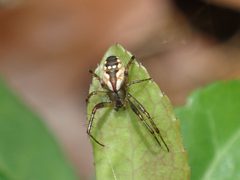
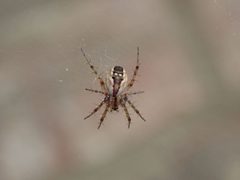
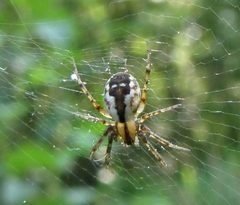
Mangora are small orb-weavers, with females typically measuring 4-8 millimeters in body length. They possess compact, often angular that may bear one or more pairs of or projections, giving some species a spiny or humped appearance. The legs are relatively short and stout, with dense tufts of hairs on the tibiae and —hence the 'tuftlegged orbweaver.' Coloration varies by species but often includes combinations of white, yellow, green, and black, with intricate dorsal patterns. The arrangement is typical of Araneidae, with two rows of four eyes each. Most reliably distinguished from similar small orb-weavers by the vertical orientation of their orb webs (in contrast to the horizontal webs of Leucauge) and the frequent presence of linear or cruciform of dense white silk at the web center.
Images
Habitat
Mangora occupy varied including deciduous and mixed woodlands, forest edges, shrublands, meadows, and riparian corridors. They are found in vegetation ranging from low herbs and grasses to shrubs and the lower branches of trees. Webs are typically constructed in relatively open sites with adequate structural support, often at heights of 0.5-2 meters above ground. Some species show preference for humid microhabitats near water sources.
Distribution
The Mangora has a broad distribution spanning the Holarctic region. In North America, occur across southern Canada, throughout the United States, and into Mexico. European records extend from Scandinavia and the British Isles south to the Mediterranean, with additional in North Africa, the Middle East (including Israel and Lebanon), and across temperate Asia. Specific distribution varies considerably by species, with some having restricted ranges while others are transcontinental.
Seasonality
Mangora are most abundant and active from late spring through summer, with peak activity typically occurring in May-July in temperate regions. Many appear to produce two annually, with adults of the second generation occurring in late summer and early autumn. Juveniles may overwinter in protected situations, resuming development in early spring.
Diet
Mangora spiders are predatory, feeding primarily on small flying insects captured in their orb webs. Prey includes various Diptera (flies), small Hymenoptera ( and bees), and other minute arthropods. The vertical web orientation may influence prey composition, potentially capturing different insect guilds than horizontal orb webs.
Life Cycle
Mangora undergo typical spider development with , spiderling, and stages. Females deposit eggs in flattened, disc-shaped egg sacs constructed of silk, often attached to vegetation near the web. Spiderlings emerge and disperse, initially building small orb webs or inhabiting the maternal web briefly before establishing independent webs. Development proceeds through multiple instars; in temperate regions, late-season individuals may overwinter as subadults or juveniles, completing development the following spring. Some species are multivoltine, producing two or more per year where climate permits.
Behavior
Mangora spiders are , constructing and occupying their webs during daylight hours. A distinctive behavioral trait is the construction of —conspicuous bands or patterns of dense, white (often UV-reflective) silk laid across the orb web, typically at the hub or in zigzag bands. The function of stabilimenta remains debated; hypotheses include prey attraction, deterrence through camouflage or startle effects, web reinforcement, and . When disturbed, Mangora typically drops from the web on a dragline and seeks concealment in nearby vegetation. Web maintenance includes regular repair of damaged spirals and radial threads, with complete web reconstruction occurring at intervals of several days.
Ecological Role
As small orb-weaving , Mangora contribute to regulation of of small flying insects in their . Their webs represent a distinct foraging strategy within the broader spider , with vertical orientation and decoration potentially partitioning prey resources from other web-building spiders. They serve as prey for larger , birds, and other vertebrates. The stabilimentum silk may have secondary ecological effects through enhanced visibility to or other flower-visiting insects.
Human Relevance
Mangora spiders are harmless to humans and provide ecological services through insect pest suppression. Their small size and attractive webs with make them subjects of interest for nature observation and photography. Some , particularly Mangora acalypha, are among the most frequently encountered small orb-weavers in gardens and suburban in their range, contributing to backyard biodiversity. They are occasionally referenced in ecological studies of web architecture evolution and stabilimentum function.
Similar Taxa
- LeucaugeLeucauge ( Tetragnathidae) are similar in small size and often bright coloration, but construct horizontal orb webs rather than vertical ones, and lack the prominent leg tufts and abdominal characteristic of Mangora.
- AraniellaAraniella ( Araneidae) are small orb-weavers with rounded, often greenish , but lack the angular body shape and leg tufts of Mangora; their webs are typically smaller and lack prominent .
- ZygiellaZygiella ( Araneidae) construct vertical orb webs but are distinguished by the characteristic 'missing sector' web architecture with a signaling thread extending from the hub to a retreat, and lack the abdominal projections and dense leg tufts of Mangora.
Sources and further reading
- BugGuide
- Wikipedia
- GBIF taxonomy match
- iNaturalist taxon
- NCBI Taxonomy
- Catalogue of Life
- Bug Eric: Spider Sunday: Orchard Orbweaver
- Bug Eric: Grand Finale
- Bug Eric: 2024
- Bug Eric: January 2013
- Spiders of the generaAraniella, Zygiella, ZillaandMangora(Araneae, Araneidae) from Israel, with notes onMetellinaspecies from Lebanon