
Araniella
Chamberlin & Ivie, 1942
Cucumber Spiders, Sixspotted Orbweaver
Species Guides
2- Araniella displicata(sixspotted orbweaver)
- Araniella proxima
Araniella is a of small orb-weaver spiders in the Araneidae, first described in 1942. The genus includes approximately 20 recognized distributed across the Palearctic and Nearctic regions, with notable species including A. cucurbitina (cucumber green spider) and A. displicata (sixspotted orbweaver). Members are characterized by green coloration due to biliverdin pigments, small body size (4–8 mm), and distinctive abdominal spotting patterns. Several species have been described recently, including A. villanii (2020) named after mathematician Cédric Villani.
Pronunciation
How to pronounce Araniella: /ˌærəˈnɪɛlə/
These audio files are automatically generated. While they are not always 100% accurate, they are a good starting point.
Identification
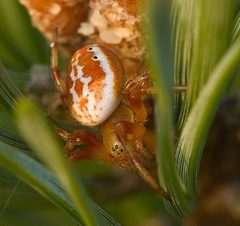
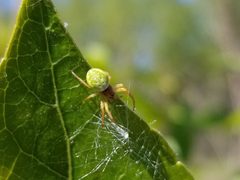
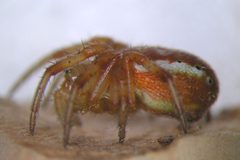
Distinguished from other small orb-weavers by combination of green/yellow coloration, small body size, and paired black abdominal spots. A. displicata specifically identified by three (sometimes four) pairs of black dots on rear half of . Closely related A. cucurbitina and A. opisthographa require examination of epigynal —specifically receptaculum length and distance between receptaculum and copulatory duct—for reliable separation; males distinguished by palpal morphology. A. alpica and A. inconspicua cannot be separated by CO1 due to shared haplotypes, requiring morphological examination of males.
Images
Habitat
Vegetated environments including woodlands, heath and heather fields, gardens, and yards. Webs frequently constructed across edges of single large leaves, positioned 4–6 feet above ground. Horizontal web orientation common, spanning foliage where long-legged flies (Dolichopodidae) and other leaf-skittering insects occur. Sunflowers and similar vegetation with extrafloral attract prey and consequently these spiders.
Distribution
Widespread across Palearctic and Nearctic regions. North American records primarily A. displicata, distributed across virtually entire continent including parts of Alaska. European distribution includes multiple with varying ranges: A. cucurbitina and A. opisthographa widespread; A. alpica in mountainous regions; A. maderiana restricted to Macaronesia. Asian distribution extends through Russia (Europe to Far East), Central Asia, Caucasus, Turkey, Iran, China, Korea, Japan, and Indian subcontinent. Recently described A. villanii ranges from southwestern Iran to eastern Kazakhstan and northern India.
Seasonality
A. displicata overwinters as subadults, reaching adulthood late May to June in temperate North America (earlier in southern climates). Mating occurs shortly after maturity; sacs produced June–July. present from late spring through late summer; juveniles predominate from late summer onward. Other presumably follow similar seasonal patterns in temperate zones, though specific timing varies by latitude.
Life Cycle
Overwinters as subadult. Reaches sexual maturity in late spring to early summer. Mating occurs shortly after maturity. Female constructs sac containing approximately 80 eggs, covered in loose fluffy yellowish silk; deposited in curled leaf that serves as maternal retreat at web perimeter. Spiderlings emerge and develop through subsequent season, reaching subadult stage before winter.
Behavior
Constructs small orb webs relative to body size—typically 3–4 inches in diameter, notably smaller than webs of larger araneid relatives. Web positioned well above ground, frequently oriented horizontally across leaf edges. Spider occupies hub position, hanging beneath horizontal webs or positioned -down in vertical webs. Web placement targets interception of insects that move between leaves, particularly long-legged flies.
Ecological Role
of small flying and leaf-dwelling insects; web placement across vegetation edges exploits movement patterns of prey between foliage patches.
Human Relevance
Occur commonly in gardens and yards where they contribute to insect . Not dangerously venomous to humans or pets despite possessing venom. A. cucurbitina widely known as cucumber green spider in Europe. Subject of taxonomic research including integrative studies combining and molecular data.
Similar Taxa
- AraneusLarger body size and substantially larger webs; lacks distinctive paired black abdominal spot pattern and green biliverdin-based coloration of Araniella
- ZygiellaConstructs orb webs with characteristic missing sector; different abdominal patterning and epigynal
- MangoraDifferent web architecture and patterns; distinct abdominal shape and coloration
More Details
Taxonomic complexity
-level identification within Araniella presents significant challenges. Females of A. cucurbitina and A. opisthographa are morphologically cryptic and frequently misidentified; reliable separation requires morphometric analysis of epigynal structures or examination of male palps. using CO1 fails to separate A. alpica and A. inconspicua due to shared haplotypes, demonstrating limitations of single-gene approaches even in small, morphologically homogeneous .
Recent species descriptions
Three described in 2020 from Caucasus, Middle East and Central Asia: A. villanii (named for mathematician Cédric Villani), A. mithra (named for Indo-Iranian light god Mithra), and A. maasdorpi. A. villanii is notably widespread for a newly described species, occurring across at least ten countries from Iran to Kazakhstan and India, highlighting substantial undescribed biodiversity in well-studied spider groups.
Coloration mechanism
Green coloration results from biliverdin, a bile pigment, deposited in tissues—unusual among spiders and providing effective camouflage against foliage. This biochemical differs from pigmentary coloration in many other green arthropods.
Sources and further reading
- BugGuide
- Wikipedia
- GBIF taxonomy match
- iNaturalist taxon
- NCBI Taxonomy
- Catalogue of Life
- French mathematician and spider aficionado Cédric Villani honoured with a new orb-weaver | Blog
- Bug Eric: Spider Sunday: Sixspotted Orbweaver
- Combining morphology, DNA sequences, and morphometrics: revising closely related species in the orb-weaving spider genus Araniella (Araneae, Araneidae)
- Spiders of the generaAraniella, Zygiella, ZillaandMangora(Araneae, Araneidae) from Israel, with notes onMetellinaspecies from Lebanon