
Leucauge argyra
(Walckenaer, 1841)
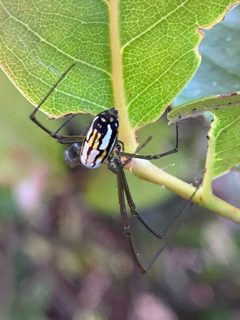
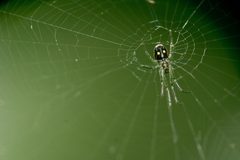
Leucauge argyra is a colonial orb-weaving spider in the Tetragnathidae, found from the United States through Brazil and the Caribbean. It constructs individual orb webs within a shared framework of support lines maintained by the colony. The exhibits size stratification in colonies, with larger occupying higher web positions and smaller juveniles in lower positions. It is notably the of the Hymenoepimecis argyraphaga.
Pronunciation
How to pronounce Leucauge argyra: /ˈljuːkɔːdʒ ˈɑːrɡɪrə/
These audio files are automatically generated. While they are not always 100% accurate, they are a good starting point.
Identification
Distinguished from Leucauge venusta by abdominal pattern: L. argyra has three parallel lines that bend inward midway across the , while L. venusta has inverted V-markings. Similar to Leucauge mariana. Females identifiable by the epigyne with projection, unique within the . webs have upper and occasional lower tangles connected to the hub; webs lack these tangles, with only a narrow upper tangle section across the middle of the orb.
Images
Habitat
Vegetation in forest understory and other where colonial web structures can be established. Uses plants as structural support for web scaffolding.
Distribution
North, Central and South America: United States to Brazil, including the Caribbean. Specific records from Brazil (Amazonas, Bahia, Mato Grosso, Rio Grande do Sul, São Paulo states), St. Thomas, and Magdalena.
Host Associations
- Hymenoepimecis argyraphaga - Rican or Puerto Rican that uses L. argyra as
Life Cycle
Multi-generational colonies observed. Juveniles construct webs with upper and occasional lower tangles; build webs lacking these tangles. details unknown.
Behavior
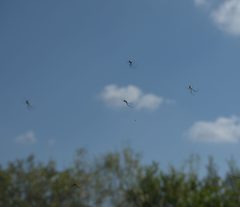
Colonial: maintains individual orb webs within shared scaffolding of support lines constructed and maintained by the group. Exhibits size stratification within colonies, with larger occupying higher web positions and smaller juveniles in lower positions. Drops from web when threatened.
Ecological Role
. Has been observed in a facultative mutualistic relationship with plants, where web presence correlates with reduced herbivory on associated plants. This represents a rare documented case of spider-plant interaction beyond .
Similar Taxa
- Leucauge venustaSimilar appearance but differs in abdominal markings: L. venusta has inverted V-markings rather than three parallel lines that bend inward
- Leucauge marianaExplicitly noted as similar in source material
More Details
Colonial web structure
Colonies maintain a scaffolding of shared support lines while each spider defends its individual orb web territory
Spider-plant mutualism
A study in Seropédica, Brazil found that plants with L. argyra webs showed lower herbivory levels than plants without webs, suggesting an indirect protective effect