
Leucauge venusta
(Walckenaer, 1841)
Orchard Orbweaver, Orchard Spider
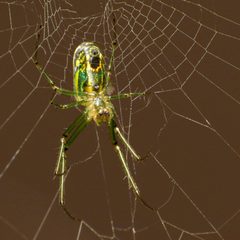
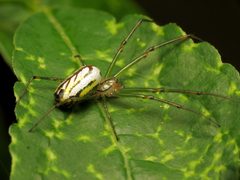
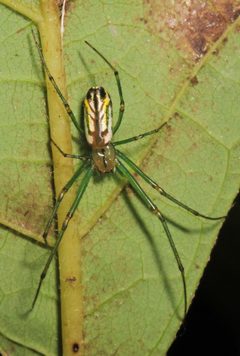
Leucauge venusta, commonly known as the orchard orbweaver, is a small, colorful spider in the Tetragnathidae. It is one of the most common and visually distinctive spiders in eastern North America, recognized by its silvery-white body, green legs, and variable red or orange abdominal markings. The builds horizontal orb webs in woodland and is active primarily in late spring and early summer. Despite its , it is not particularly associated with orchards, preferring forest edges and shrubby vegetation.
Pronunciation
How to pronounce Leucauge venusta: /ljuːˈkɔːdʒi vɛˈnʌsta/
These audio files are automatically generated. While they are not always 100% accurate, they are a good starting point.
Identification
Distinguished from black widows (Latrodectus spp.) by activity, orb web structure, and green legs—widows build tangled webs and are rarely visible during day. Separated from Mangora orbweavers by horizontal (not vertical) web orientation. Distinguished from Basilica Spider (Mecynogea lemniscata) by flat web (not domed). Sheetweb weavers in Linyphiidae may resemble superficially but do not construct orb webs. Similar Leucauge argyrobapta occurs in Florida and is difficult to distinguish visually; L. venusta has broader North American distribution.
Images
Appearance
Small spider with mature females measuring 5.5–7.5 mm and males 3.5–4 mm in body length. silvery-white with brown and black streaks dorsally; underside of spotted with yellow and black. displays variable neon yellow, orange, or red spots posteriorly, sometimes absent. Legs leaf-green, occasionally dark green or orange in some individuals. Underside mostly black with red crescent or rectangular spot visible when hanging in web.
Habitat
Woodland , forest edges, and shrubby vegetation. Builds webs in shrubs and bushes, with juveniles constructing webs closer to ground and spinning webs approximately 1.5 meters high. Not strongly associated with orchards despite .
Distribution
North America from southern Ontario, Canada south to Florida and Panama; west to Nebraska and eastern Texas. Also reported in South Asia. Most abundant in eastern United States.
Seasonality
most abundant late spring and early summer. Overwinters as sub-adults in leaf litter and under loose bark. Activity period may vary by latitude; immatures observed in late May at northern latitudes.
Life Cycle
Overwinters as sub-, hiding in leaf litter and under loose bark. Matures to adult in spring. sacs constructed by female; one source notes external observation of egg sac with spider. Lifespan details beyond cycle not documented.
Behavior
Constructs horizontal orb webs averaging 12 inches in diameter with approximately 30 and 60+ spirals. Hangs upside down in web hub. Shy; drops straight to ground when threatened, disappearing into leaf litter. Shows interspecific , documented aggregating around webs of Nephila clavipes with consequences for web architecture. Males may lose capacity to spin normal orb webs upon maturity.
Ecological Role
Prey for spider-hunting mud dauber (Trypoxylon lactitarse). Subject to kleptoparasitism by Argyrodes spiders. Parasitized by external wasp larva attaching at - junction (specific wasp not identified in sources). Serves as of small flying insects captured in web.
Human Relevance
Frequently encountered in gardens and residential areas. Often mistaken for black widows due to red abdominal markings, causing unnecessary concern. Docile when handled; one observer noted females remain calm once realizing they are not threatened. Subject of citizen science observations and photography due to photogenic appearance.
Similar Taxa
- Leucauge argyrobaptaSimilar in same , occurs in Florida; difficult to distinguish visually, distinguished primarily by geographic range
- Latrodectus spp. (black widows)Red abdominal markings cause confusion; widows build tangled webs, are , and lack green legs
- Mangora spp.Similar appearance but build vertical rather than horizontal orb webs
- Mecynogea lemniscata (Basilica Spider)Builds horizontal orb web but pulls it into distinctive dome shape
- Linyphiidae (sheetweb weavers)Superficially similar appearance but do not construct orb webs
Misconceptions
Commonly mistaken for black widow spiders due to red abdominal marking and hanging posture. Unlike widows, this is , builds orb webs rather than tangled cobwebs, and possesses distinctive green legs. The 'orchard orbweaver' is misleading as the species is not particularly associated with orchards, preferring woodland .
Sources and further reading
- BugGuide
- Wikipedia
- GBIF taxonomy match
- iNaturalist taxon
- NCBI Taxonomy
- Catalogue of Life
- Bug Eric: City Nature Challenge 2024 Recap
- Bug Eric: Spider Sunday: Orchard Orbweaver
- Bug Eric: January 2013
- Bug Eric: New Mexico Dragonfly Blitz - Day 3
- Waxy wanderers flocking flowers: Planthoppers - Flatidae and Acanaloniidae — Bug of the Week
- Orchard Orbweaver, Orchard Spider Leucauge argyrobapta (White), Leucauge venusta (Walckenaer) (Arachnida: Araneae: Tetragnathidae)