
Trypoxylon lactitarse
de Saussure, 1867
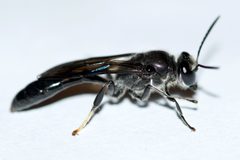
Trypoxylon lactitarse is a solitary square-headed wasp in the Crabronidae, found from Canada to Argentina across the Americas. It nests in pre-existing cavities such as hollow twigs, borings, and trap-nests, constructing linear series of 3-8 mud-partitioned provisioned with paralyzed spiders. males exhibit unusual nest-guarding , defending against and rival males while females hunt. The has been extensively studied using artificial trap-nests due to its readiness to adopt human-made cavities.
Pronunciation
How to pronounce Trypoxylon lactitarse: //tɹɪˈpɒksɨˌlɔn læktɨˈtɑrseɪ//
These audio files are automatically generated. While they are not always 100% accurate, they are a good starting point.
Identification
Trypoxylon lactitarse can be distinguished from other by its long, slender, club-shaped with a blunt tip; a single submarginal in the forewing; and with a distinct notch on the inner margin. As a member of the subgenus Trypargilum, it is medium-sized to large for the . It differs from the eastern North American T. politum (Pipe Organ Mud Dauber), which constructs conspicuous free-standing mud tubes rather than nesting in cavities. -level identification within Trypargilum typically requires examination of collected specimens.
Images
Habitat
Edges of forest fragments and open including Araucaria forest, grassland, and swamp areas. Nests in pre-existing cavities: hollow twigs, borings in dead wood, vacated insect galls, abandoned mud dauber nests, and human-made trap-nests. In southern Brazil, occurs at elevations around 1,120 m in wet, cool climates with hoar frosts; warmest month average temperature below 22°C.
Distribution
North, Central, and South America, ranging from Canada to Argentina. Specific records from: USA (South Carolina), Brazil (Paraná, São Paulo, Goiás, and multiple states including AC, AM, AP, BA, CE, ES, GO, MA, MG, MT, PA, PR, RJ, RO, RS, SC, SP, TO), and throughout Middle America.
Seasonality
Nesting activity occurs during warm months; in southern Brazil most frequent during hot and wet season (September to April). In the southern part of its range, nesting may occur year-round with peaks in certain months. in central Brazil occurs during rainy season (December-March).
Diet
Spiders (Araneae), almost exclusively. Prey includes 53+ from at least 7 , with Araneidae (orb-weavers) strongly (93-97% of prey). Specific recorded prey: Eustala spp. (especially E. cepina, Eustala sp.1, sp.2, sp.3, sp.4, sp.5, sp.6, sp.7, sp.8), Acacesia villalobosi, A. hamata, Alpaida spp. (A. grayi, A. leucogramma, A. scriba, A. veniliae), Araneus spp. (A. corporosus, A. omnicolor, A. sicki, A. blumenau), Wagneriana spp. (W. iguape, W. eupalaestra, W. juquia), Larinia t-notata, Mangora spp., Parawixia audax, Aysha gr. brevimana, Ocrepeira galianoae, plus occasional Mimetidae, Tetragnathidae, and Philodromidae. spiders comprise 56% of prey, females 38%, adult males 6%.
Life Cycle
Females construct nests beginning with a mud layer at the bottom of the cavity, then build a linear series of 3-8 (average 3.3-4.0 depending on cavity diameter) separated by mud partitions. Each cell is provisioned with 3-36 paralyzed spiders; a single is laid on the last spider before the partition is sealed. Larva hatches and consumes the spider cache, then spins a -specific cocoon containing silk, saliva, and soil. Two strategies observed: direct development (emerging same season) or delayed development with winter . occurs inside the cocoon; emerge by chewing exit holes. Development includes three or four larval . No significant sex relative to cell position.
Behavior
Solitary nesting; females work alone to construct and provision nests. Males exhibit distinctive nest-guarding , remaining at the nest entrance to physically block (ants, parasitic flies, cuckoo wasps) and aggressively chase competing males. Males possess a fishhook-like spine on the underside of the first abdominal segment that may anchor them during defense. Males may also assist by taking prey from females, cleaning cavities, and helping build partitions. Prey constancy is high within individual nests despite variation between . Females readily adopt trap-nests, facilitating ecological study.
Ecological Role
of spiders, particularly orb-weaving spiders (Araneidae), linking terrestrial spider to higher . Potential agent of spider . visit flowers and may contribute to pollination. Serves as a bioindicator of environmental change due to sensitivity to fragmentation—nest foundation rates are higher in large forest fragments. to including Chrysididae, Sarcophagidae, Dolichopodidae, and Ichneumonidae.
Human Relevance
Harmless to humans; not aggressive. Valued as a research organism due to readiness to use artificial trap-nests, enabling studies of nesting , prey selection, and reproductive . Provides services through spider and potential . Nest architecture and male guarding make it an interesting subject for natural history observation.
Similar Taxa
- Trypoxylon politumAlso in Trypoxylon but constructs free-standing external mud tubes (resembling pipe organs) rather than nesting in pre-existing cavities; found primarily in eastern North America
- Trypoxylon californicum / T. clavatumSimilar cavity-nesting members of subgenus Trypargilum with comparable , but differ in geographic distribution and specific prey preferences; -level identification requires specimen examination
- Pachodynerus nasidensAlso called 'Keyhole Wasp' and nests in pre-existing cavities, but belongs to Vespidae (potter wasps) rather than Crabronidae; constructs pot-shaped mud rather than linear series with partitions
More Details
Nesting Plasticity
The shows remarkable flexibility in cavity diameter acceptance, successfully nesting in trap-nests of 0.7 cm, 1.0 cm, and 1.3 cm diameter with no significant difference in number or architecture.
Sex Ratio Adjustment
Females exhibit haplodiploid sex determination and can adjust offspring sex ratios, producing more males when food availability or space is limited.
Research Utility
This has become a model organism for studies of solitary , with over 449 nests collected in single studies, enabling detailed analysis of prey selection, use, and reproductive success across fragmented landscapes.
Sources and further reading
- BugGuide
- Wikipedia
- GBIF taxonomy match
- iNaturalist taxon
- NCBI Taxonomy
- Bug Eric: Wasp Wednesday: Trypoxylon
- Bug Eric: Pipe Organ Mud Dauber, Trypoxylon politum, Found in Colorado
- Bug Eric: Mud Masterpieces
- Bug Eric: August 2015
- Spider Prey of Trypoxylon lactitarse Saussure (Hymenoptera: Sphecidae)
- Reproductive success of Trypoxylon (Trypargilum) lactitarse (Hymenoptera: Crabronidae) in a fragmented landscape
- Patterns of prey selection of Trypoxylon (Trypargilum) lactitarse Saussure (Hymenoptera: Crabronidae) in southern Brazil
- Nesting biology of Trypoxylon (Trypargilum) lactitarse Saussure (Hymenoptera, Crabronidae) in trap-nests in Southern Brazil
- Spiders (Araneae) captured by <i>Trypoxylon (Trypargilum) lactitarse</i> (Hymenoptera: Sphecidae) in southeastern Brazil