
Filistatidae
Ausserer, 1867
crevice weavers
Genus Guides
3- Filistatinella
- Filistatoides(crevice weavers)
- Kukulcania(Crevice Weavers)
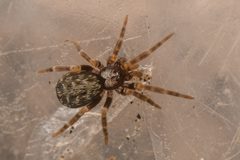
Filistatidae are cribellate spiders commonly known as crevice weavers, characterized by their distinctive silk-producing anatomy and retreat-building . Members of this possess a cribellum—an additional silk-spinning organ—and a calamistrum, a comb of curved hairs on the fourth leg used to card silk into a non-sticky, highly entangling web structure. The family includes that frequently inhabit human structures, as well as species restricted to natural such as arid and semi-arid regions.
Pronunciation
How to pronounce Filistatidae: //ˌfɪlɪˈstætɪˌdiː//
These audio files are automatically generated. While they are not always 100% accurate, they are a good starting point.
Identification
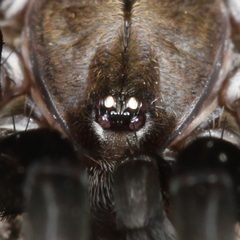
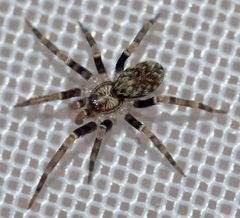
Filistatidae are distinguished from other spider by the presence of a cribellum (a plate-like silk-spinning organ to the ) and a calamistrum (a row of short, stout, curved hairs on the of the fourth leg) used to comb cribellar silk. This separates them from ecribellate spiders and from other cribellate families with different silk-processing . Within Haplogynae, filistatids can be recognized by their sprawling, lacy, non-sticky webs and their habit of constructing tubular retreats in crevices. is pronounced in some : mature females of Kukulcania are velvety black or dark gray with lumpy arrangements, while males are pale with small bodies and extremely long legs.
Images
Habitat
Filistatids occupy diverse environments including arid and semi-arid regions, coastal areas, and settings. in the Kukulcania frequently inhabit the exterior of human structures, building retreats in window frames, under eaves, and in wall crevices. The genus Sahastata is distributed in arid and semi-arid areas from westernmost Sahara to India. Pikelinia arenicola was described from a restinga in Brazil. Pikelinia floydmuraria has been observed in high densities (20–30 individuals per square meter) in building wall crevices in urban Colombia.
Distribution
Filistatidae has a broad distribution spanning multiple continents. The Kukulcania occurs throughout the southern United States, Central and South America, and the Caribbean, with K. hibernalis recorded as non-native on Ascension Island, Saint Barthélemy, Liberia, and the Canary Islands. The genus Sahastata ranges from westernmost Sahara through the Middle East to India. Pikelinia is South American, with described from Colombia, Brazil, and the Galapagos Islands. Pritha occurs in Europe (Italy, Spain, Greece).
Diet
Life Cycle
Observations on Sahastata indicate clutch size, time to maturation, and a strongly female-biased sex ratio: only 20–25% of individuals reaching adulthood are male. Female Kukulcania continue to after reaching sexual maturity, a trait otherwise known only in Mygalomorphae, and may live several years.
Behavior
Filistatids build characteristic sprawling, lacy, non-sticky webs that issue from a tubular retreat. The silk is produced by rapid vibration of the fourth leg against the third leg to card cribellar silk—distinct from the slow rocking motion used by most other cribellate spiders. Females typically remain in or near their retreats, venturing to the web edge to capture prey after dark. Males wander in search of mates. All known filistatids have that cannot move independently. Members of the possess autospasy at the tibia-patella joint, allowing leg loss to escape .
Ecological Role
Human Relevance
Several filistatid are and commonly encountered in human dwellings, particularly Kukulcania hibernalis (Southern House Spider) and K. arizonica in the southern United States. They are frequently misidentified as brown recluse spiders (Loxosceles) or tarantulas due to superficial resemblance, but filistatids possess eight (versus six in Loxosceles) and are not dangerously venomous to humans. Their non-aggressive nature and role in controlling household pests make them generally benign cohabitants.
Similar Taxa
- Sicariidae (recluse spiders)Male Kukulcania are frequently mistaken for brown recluse spiders due to pale coloration and long legs, but differ in having eight grouped atop the (versus six eyes in three pairs across the front in Loxosceles) and extremely long, elbowed .
- Theraphosidae (tarantulas)Female Kukulcania resemble small tarantulas in their dark velvety coloration and lumpy , but are much smaller and possess the cribellum and calamistrum characteristic of cribellate spiders.
- AmaurobiidaeSome amaurobiids build similar retreat-and-web structures in crevices; web architecture alone is unreliable for identification without examination of and arrangement.
- SegestriidaeAriadna and other segestriids construct tubular retreats with issuing webs similar to filistatids; distinguished by different arrangement and lack of cribellum.
More Details
Silk production
Filistatidae are cribellate spiders, possessing both a cribellum ( silk plate) and calamistrum (leg comb). The calamistrum is used to card silk through rapid leg vibration, producing a woolly, highly entangling non-sticky silk distinct from the viscid capture silk of ecribellate orb-weavers and others.
Haplogyne reproduction
As haplogynes, female filistatids possess relatively simple genitalia with a slot-like accessed through the epigastric furrow, lacking the complex of entelegyne spiders. Males use modified as intromittent organs, with palpal complexity generally less elaborate than in entelegynes.
Taxonomic note
The South American Pikelinia was long confused with the Mediterranean genus Filistata but was redefined in 2022 as part of a distinct South American radiation. The contains multiple genera including Filistata, Kukulcania, Pikelinia, Pritha, Sahastata, Filistatinella, and others.
Sources and further reading
- BugGuide
- GBIF taxonomy match
- NCBI Taxonomy
- Catalogue of Life
- Bug Eric: Spider Sunday: Crevice Weavers
- Bug Eric: Spider Sunday: Spider Sex Ed
- Meet the Crevice Weaver: A Newly Discovered Urban Spider from Colombia | Blog
- Description of a new species of Pikelinia (Araneae: Filistatidae) from Brazil, with notes on its ecology
- Cribellar silk-combing and line-adding behaviours of the North American spider Filistatinella domestica Desales-Lara, 2012 (Araneae: Filistatidae)
- The Italian species of Pritha (Araneae, Filistatidae): a critical revision and description of two new species
- The first occurrence records of Kukulcania hibernalis (Hentz, 1842) from Ascension Island and Saint Barthélemy (Araneae: Filistatidae)
- On Sahastata (Araneae: Filistatidae): complementary description of the generotype and two new species from Oman and Morocco