
Segestriidae
Simon, 1893
Tube-dwelling spiders, Tunnel spiders
Genus Guides
3- Ariadna(Tube-web Spiders)
- Citharoceps
- Segestria
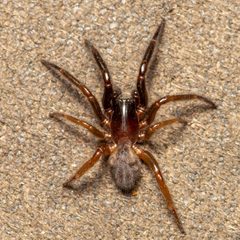
Segestriidae is a of tube-dwelling spiders comprising two large and widespread (Segestria and Ariadna) and two smaller genera (Citharoceps and Gippsicola). Members are easily recognized by having six arranged in a semicircle (rather than the typical eight eyes of most spiders) and the first three pairs of legs arranged forward (rather than two). These morphological features appear to be adaptations for living in silken tubes or burrows. The family has a global distribution across all continents except Antarctica, with greatest diversity in tropical and subtropical regions. The genus Ariadna alone contains 102 of the 127 described in the family.
Pronunciation
How to pronounce Segestriidae: //ˈsɛɡəˌstrɪiˌdeɪ//
These audio files are automatically generated. While they are not always 100% accurate, they are a good starting point.
Identification
Segestriidae can be distinguished from other spider by the combination of six arranged in a semicircle (vs. eight eyes in most spiders) and three pairs of legs directed forward (vs. two pairs in most spiders). These features are diagnostic at the family level. Within the family, can be distinguished by genitalic , leg spination patterns, and other somatic characters. Ariadna, the largest genus, is characterized by particular palp structures in males and distinct genitalia in females. The genus Indoseges from India resembles Ariadna but differs in male first leg spines, shape and position, and female palp spination.
Images
Appearance
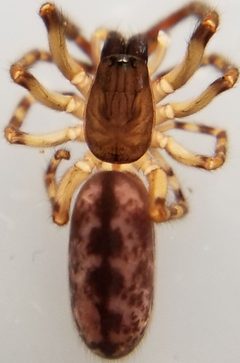
Segestriidae spiders have six arranged in a semicircle, distinguishing them from the eight-eyed majority of spiders. The first three pairs of legs are directed forward, an for tube-dwelling life, compared to the two forward pairs typical of most spiders. The leg structure facilitates movement within silken tubes and burrows. Body form varies among , with Ariadna showing considerable morphological diversity across their range.
Habitat
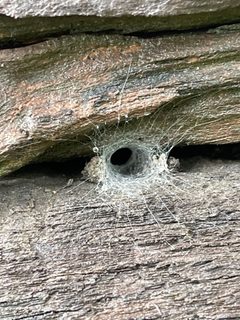
Segestriidae are tube-dwelling spiders that construct silken tubes or burrows in various substrates. They inhabit diverse environments including soil, rock crevices, and human structures. In arid regions such as the Namib Desert, Ariadna construct burrows in gravel plains and surround the entrance with stone rings. The shows remarkable flexibility, with one species (Ariadna phantasma) being halotolerant and inhabiting salt lakes in Western Australia, where it constructs burrows into the lake surface. Some species are found in human dwellings, constructing webs in window frames and eaves.
Distribution
Global distribution on all continents except Antarctica. Greatest diversity occurs in tropical and subtropical regions. The Americas harbor significant diversity, particularly in Brazil, Chile, and Central America, with 31 nominal recognized in the American continent. Australia contains at least 14 described species of Ariadna, with high diversity in South Australia and Victoria. India has documented Segestriidae from Odisha and other regions. The extends into temperate regions, with records from southern and potentially mid-Atlantic United States. Namibian show strong genetic structuring correlated with environmental parameters.
Diet
Segestriidae are sit-and-wait that capture prey from their tube retreats. The specific diet composition has not been documented in the available sources.
Behavior
Segestriidae are tube-dwelling spiders that spend their lives in silken tunnels or burrows, functioning as sit-and-wait . They construct and maintain tubular retreats from which they capture passing prey. In arid environments, Namibian Ariadna surround their burrow entrances with stone rings, a distinctive behavioral trait. The developmental cycle from to has been documented in at least one species (Ariadna mollis), with development taking 24 days, though this reflects the parasitoid rather than the spider's own development. Females of some species may continue molting after reaching adulthood, a trait shared with mygalomorph spiders.
Ecological Role
Segestriidae function as sit-and-wait in their respective . In arid environments such as the Namib Desert, they contribute to biodiversity in gravel plain . Their specialized habitat requirements in some cases (e.g., salt lake ) make them potential indicators of ecosystem health and candidates for conservation attention. The serves as for in the Epipompilus (Pompilidae), with Ariadna mollis documented as host for Epipompilus excelsus in Brazil.
Human Relevance
Some Segestriidae occur in human dwellings, constructing webs on exterior window frames and under eaves, though they are not considered pests. They are not dangerously venomous to healthy humans. The has been subject to taxonomic confusion with other spiders; for example, some Ariadna species have been mistaken for brown recluse spiders or filistatid crevice weavers due to similar web structures. Their tube-dwelling habits and distinctive make them subjects of ecological and behavioral research, particularly in arid-adapted systems.
Similar Taxa
- Filistatidae (crevice weavers)Similar tube-like or funnel-like web structures issuing from holes; both have been confused in field observations. Distinguished by number and arrangement: Segestriidae have six eyes in semicircle, Filistatidae have eight eyes. Filistatidae are cribellate spiders with calamistrum on fourth legs, a feature absent in Segestriidae.
- Agelenidae (funnel-web spiders)Construct funnel-shaped webs with retreat tubes that can resemble Segestriidae webs. Distinguished by arrangement and number: Agelenidae have eight eyes in two rows, Segestriidae have six eyes in semicircle. Agelenidae have two pairs of legs directed forward, Segestriidae have three.
- Brown recluse spiders (Sicariidae)Male Segestriidae have been mistaken for brown recluse spiders due to similar coloration and long legs. Distinguished by number: Segestriidae have six eyes in semicircle, brown recluse have six eyes in three pairs across front of . Male Segestriidae have extremely long, elbowed not seen in recluse spiders.
More Details
Taxonomic diversity
The Ariadna comprises 102 of 127 described Segestriidae . Recent revisions have greatly expanded known diversity, with 23 new species described from South Australia and Victoria alone, and 8 new species from the American continent including Central America, Brazil, and Chile.
Genetic differentiation
Namibian Ariadna show strong genetic structuring correlated with environmental parameters including soil granulometry, temperature, and water availability. Interpopulation sequence divergence ranges from 4.9% to 26.1%, suggesting potential cryptic .
Silk properties
Research indicates that features affect silk protein composition in Namibian arid-adapted Ariadna , with thermal properties of silks varying among .
Sources and further reading
- BugGuide
- GBIF taxonomy match
- iNaturalist taxon
- NCBI Taxonomy
- Catalogue of Life
- Bug Eric: Spider Sunday: Crevice Weavers
- The taxonomy of the American Ariadna Audouin (Araneae: Synspermiata: Segestriidae)
- A ghost in the salt: A new species of halotolerant tube-web spider in the genus Ariadna (Araneae: Segestriidae)
- Description of a new genus and five new species of tube-dwelling spider family Segestriidae (Araneae: Synspermiata) from Odisha, India
- Do habitat features affect the composition of silk proteins by Namibian arid-adaptedAriadnaspiders (Araneae: Segestriidae)?
- The Tube-Web Spiders of the Genus Ariadna (Araneae: Segestriidae) from South Australia and Victoria
- How soil granulometry, temperature, and water predict genetic differentiation in Namibian spiders (Ariadna: Segestriidae) and explain their behavior
- First record of Epipompilus excelsus (Bradley, 1944) (Hymenoptera, Pompilidae) as a koinobiont ectoparasitoid of Ariadna mollis (Holmberg, 1876) (Araneae, Segestriidae)
- Figure 1 from: Villanueva-Bonilla GA, Brescovit AD, dos Santos EF, Vasconcellos-Neto J (2018) First record of Epipompilus excelsus (Bradley, 1944) (Hymenoptera, Pompilidae) as a koinobiont ectoparasitoid of Ariadna mollis (Holmberg, 1876) (Araneae, Segestriidae). Journal of Hymenoptera Research 66: 15-21. https://doi.org/10.3897/jhr.66.28915