
Epipompilus
Kohl, 1884
Species Guides
1Epipompilus is a of spider wasps comprising approximately 52 , with the highest diversity in Australia. The genus exhibits a disjunct Gondwanan distribution across Australasia and the Americas, suggesting ancient origins. Members are small, rarely collected, and exhibit specialized hunting involving searching under bark for spiders. They represent a potentially ancestral behavioral type within Pompilidae, acting as koinobiont ectoparasitoids.
Pronunciation
How to pronounce Epipompilus: /ˌɛpɪˈpɒmpɪləs/
These audio files are automatically generated. While they are not always 100% accurate, they are a good starting point.
Identification
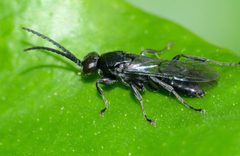
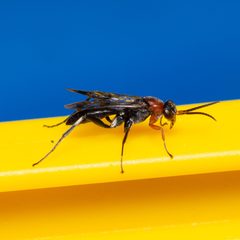
Small-bodied spider wasps with morphological adaptations for crawling under bark and entering crevices. Australian show greater morphological diversity than American species; New Guinea species are notably brilliantly coloured. The is distinguished from other Pompilidae by a combination of primitive structural features and specialized leg suited for substrate-crawling rather than ground-nesting.
Images
Habitat
Associated with trunks of living Eucalyptus trees in Australia; also recorded from semideciduous Atlantic Forest, Amazonian Forest, Brazilian Pantanal, and Edwards Plateau in Texas. characterized by bark-crevice microhabitats suitable for spider hunting.
Distribution
Australasia (Australia, New Zealand, New Guinea) and the Americas (United States from extreme southern regions southward through Mexico, Central America, and South America to Argentina). Tertiary fossils from the northern hemisphere may also belong to this .
Host Associations
- Sparassidae - preyspider
- Ariadna mollis - tube-dwelling spider (Segestriidae), documented of E. excelsus
Life Cycle
Developmental cycle from to takes approximately 24 days in E. excelsus, notably shorter than other Pompilidae . Larval development has been photographed daily from egg to adult emergence.
Behavior
Hunts spiders underneath bark and in crevices without building nests; lays directly on encountered prey. This represents a proposed ancestral behavioral type for spider wasps. Rarely visits flowers; few flower records exist, with one male E. turneri collected on Leptospermum in New South Wales. Exhibits prey carriage mechanism for transporting captured spiders.
Ecological Role
of spiders, acting as koinobiont ectoparasitoid. of spider in bark-crevice microhabitats.
Human Relevance
Subject of ongoing conservation research; E. namadji was described from Namadgi National Park following 2019–2020 Australian bushfires that destroyed approximately 80% of the park, prompting survey efforts by Australian National Insect Collection at CSIRO.
Similar Taxa
- Other Pompilidae generaEpipompilus differs in exhibiting koinobiont ectoparasitoid with shorter developmental period and ancestral behavioral type involving direct -laying on encountered prey without nest construction
More Details
Biogeographic significance
The disjunct Gondwanan distribution pattern is shared with other relict such as Nothofagus and Araucaria, supporting hypotheses of ancient vicariance.
Taxonomic note
Wikipedia lists as Pepsinae, while iNaturalist lists Ctenocerinae; this discrepancy reflects ongoing taxonomic refinement in Pompilidae classification.
Sources and further reading
- BugGuide
- Wikipedia
- GBIF taxonomy match
- iNaturalist taxon
- NCBI Taxonomy
- Catalogue of Life
- Insecta, Hymenoptera, Vespoidea, Pompilidae, Epipompilus aztecus (Cresson, 1869): first record in South America
- First host record of Epipompilus (Hymenoptera: Pompilidae) from Brazil and discussion of prey carriage mechanism
- Distribution of Epipompilus aztecus (Cresson, 1869) (Hymenoptera, Pompilidae) with a new record from Texas, United States
- New distribution record of Epipompilus aztecus (Cresson, 1869) (Hymenoptera: Pompilidae) in the Brazilian Pantanal
- First record of Epipompilus excelsus (Bradley, 1944) (Hymenoptera, Pompilidae) as a koinobiont ectoparasitoid of Ariadna mollis (Holmberg, 1876) (Araneae, Segestriidae)
- Additions to the Known Distribution ofEpipompilus aztecus(Cresson, 1869) andE. excelsus(Bradley, 1944) (Hymenoptera: Pompilidae)
- Figure 1 from: Villanueva-Bonilla GA, Brescovit AD, dos Santos EF, Vasconcellos-Neto J (2018) First record of Epipompilus excelsus (Bradley, 1944) (Hymenoptera, Pompilidae) as a koinobiont ectoparasitoid of Ariadna mollis (Holmberg, 1876) (Araneae, Segestriidae). Journal of Hymenoptera Research 66: 15-21. https://doi.org/10.3897/jhr.66.28915