
Segestria
Latreille, 1804
Species Guides
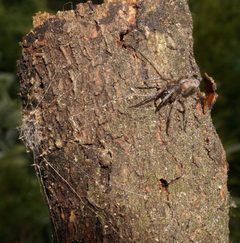
1- Segestria pacifica(tube web spider)
Segestria is a of spiders in the Segestriidae. These spiders are characterized by their elongated, cylindrical bodies and six arranged in a distinctive semicircular pattern. The genus has a primarily Eurasian distribution, with some extending to the Americas, North Africa, Madagascar, and New Zealand. Segestria species are known for building tubular retreats in cracks and crevices, from which they hunt prey using silk triplines.
Pronunciation
How to pronounce Segestria: //sɛˈɡɛstriə//
These audio files are automatically generated. While they are not always 100% accurate, they are a good starting point.
Identification
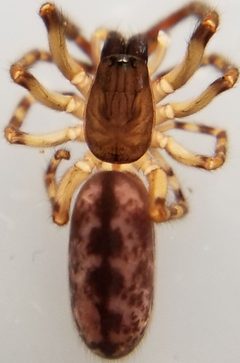
Distinguished from other spiders by the combination of six in three pairs (rather than eight) and the elongated, cylindrical body form. The anteriorly directed legs and tubular retreat-building are additional diagnostic features. Differs from the related Ariadna (also Segestriidae) in eye arrangement details and geographic distribution. The eye pattern alone separates Segestria from all other spider except Dysderidae, which have a different body shape and six eyes in a different arrangement.
Images
Appearance
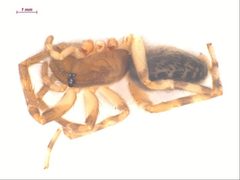
Body elongated and cylindrical, with a somewhat flattened . Six arranged in a semicircle of three pairs anteriorly, rather than the eight eyes typical of most spiders. large and project forward. Legs long and slender, with the first three pairs directed forward and the fourth pair backward. Coloration generally dark brown to black, often with faint patterning. reduced, with only the pair functional; cribellum absent.
Habitat
Found in rocky , walls, tree bark, and other situations providing cracks and crevices suitable for tubular retreat construction. Often occurs in human-modified environments such as stone walls, old buildings, and bridges. Requires sheltered microhabitats that allow construction of silk-lined tunnels.
Distribution
Primarily Palearctic, with the majority of in Europe and Asia. Disjunct in North America (introduced or native), North Africa (two species), Madagascar (S. madagascarensis), and New Zealand (one species).
Diet
Active hunters that use silk triplines radiating from the retreat entrance to detect prey. Prey includes various insects and other small arthropods that blunder into the triplines; the spider rushes out to capture them.
Life Cycle
involves sacs placed within the female's retreat. Development includes egg, spiderling, and stages. Spiderlings likely disperse by ballooning or wandering, though specific details are poorly documented for most .
Behavior
Constructs tubular silk-lined retreats in crevices, with several silk triplines extending across the substrate to detect vibrations. Spends most of time inside the retreat, emerging rapidly when prey contacts a tripline. Non-aggressive toward humans; bites rare and not considered medically significant.
Ecological Role
of small arthropods in rocky and crevice . May contribute to control of insect in urban and natural settings. Serves as prey for larger arthropods, birds, and other vertebrates.
Human Relevance
Occasionally found in homes and buildings, particularly older structures with stone or brick walls. Not considered a pest . Bites are rare and cause only minor local . Some species have been transported internationally via human commerce.
Similar Taxa
- AriadnaAlso in Segestriidae with similar tubular retreat construction; differs in arrangement details and primarily tropical distribution
- DysderaAlso has six , but eyes are arranged differently and body is more compact with enlarged for preying on woodlice
More Details
Taxonomic note
The name Segestria has also been used for a genus of lichenized fungi ( Porinaceae, Ascomycota), but this usage is now generally considered a synonym of Segestria (fungus) or treated under other names. The spider genus Segestria Latreille, 1804 has priority and is the accepted usage in zoological .