
Dysdera
Latreille, 1804
woodlouse hunter, sowbug killer, slater-eating spider, woodlouse spider, pillbug hunter
Species Guides
1- Dysdera crocata(Woodlouse Spider)
Dysdera is a of spiders in the Dysderidae, first described by Pierre André Latreille in 1804. The genus originated from Central Asia to Central Europe and has since spread globally through human commerce. Members are specialized of woodlice (terrestrial isopods), using enlarged and long fangs to pierce their armored prey. The genus exhibits remarkable adaptive radiation, particularly on oceanic islands—most notably the Canary Islands, where 48 occur. Dysdera crocata, the hunter, is the only widespread species outside its native range and the sole representative in North America.
Pronunciation
How to pronounce Dysdera: //dɪsˈdɛrə//
These audio files are automatically generated. While they are not always 100% accurate, they are a good starting point.
Identification
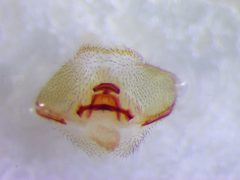
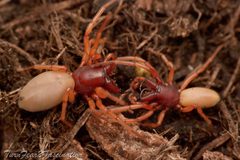
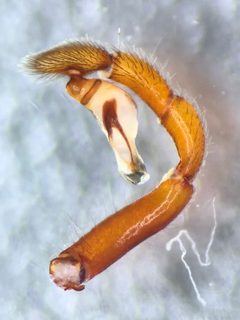
Dysdera possess six arranged in a compact semi-circle or oval at the front of the , distinguishing them from most spiders which have eight. They have disproportionately large with long fangs adapted for penetrating woodlice armor. The cephalothorax and legs are typically reddish-brown to orange; the ranges from beige to gray, sometimes shiny yellow-brown. Females measure 9–15 mm, males 9–10 mm. The second pair of legs backward, an unusual orientation. Dysdera lacks the eight eyes in two rows and broad cephalothorax of the superficially similar Trachelas (Corinnidae); Trachelas also has shorter jaws and climbs more readily.
Images
Habitat
Ground-dwelling spiders inhabiting humid forests, natural shelters under stones, logs, bark, leaf litter, and organic debris. In urban environments, found in mulched gardens, beneath bricks and boards, and occasionally indoors near baseboards. Constructs silken retreats in crevices of partially decayed wood or rock indents for molting, , and protection from . Canary Island occupy diverse elevations, with some limited to highest elevations on arid eastern islands.
Distribution
Native to Central Asia through Central Europe and the Mediterranean region. Introduced globally through human commerce; established in North and South America, South Africa, Australia, and New Zealand. In North America, D. crocata occurs from New England to Georgia and west to California. Five persist in Central Europe post-glaciation: D. crocata, D. ninnii, D. dubrovninnii, D. hungarica, and D. longirostris. The Canary Islands harbor exceptional diversity with 48 species, representing one of the most outstanding examples of island radiation among spiders. Additional species occur in North Africa, the Iberian Peninsula, Ethiopia, Iran (14 species described in 2022), and Central Asia.
Seasonality
hunters active year-round in suitable climates. Mating primarily occurs in April. In temperate regions, may be found throughout the year; specimens overwinter. Canary Island show varying phenologies by elevation and microhabitat.
Diet
Specialized of terrestrial isopods (woodlice, sowbugs, pillbugs). Dysdera crocata is the only in the known to prey on other spiders. Can subdue competitors including and other spiders. Some species excrete that neutralize chemical defenses of alternative prey, allowing consumption of silverfish, , millipedes, and small burying beetles when woodlice are scarce.
Life Cycle
Extended development: approximately 18 months from to maturity. Females produce a egg sac containing up to 70 eggs, constructed with minimal silk strands. Males play no role in parental care; females guard eggs and young. Lifespan after maturity: 2–3 years. Mating occurs in spring; females create silk pouches for egg protection. Spiderlings emerge in summer and may overwinter as immatures.
Behavior
; in silken retreats. Does not construct prey-capture webs. Uses enlarged fangs to turn woodlice onto their backs to access soft surface. When threatened, may display menacingly. Not known to balloon; likely occurs through rafting or transport on floating islands, explaining of oceanic archipelagos. Some Canary Island show reduced dispersal ability, contributing to speciation.
Ecological Role
Important agent of woodlice in forests, gardens, and urban . Prey specialization on isopods may influence nutrient cycling in leaf litter . As for their size, they suppress competitor populations including and other spiders. Island radiations provide model systems for studying speciation and adaptive evolution.
Human Relevance
D. crocata frequently enters homes, causing alarm due to formidable appearance. Bites are rare; when they occur, cause brief localized pain and occasional transient dermatitis from mechanical injury by large fangs, not medically significant venom. Subject of recurring social media hoaxes falsely claiming lethal danger. Valued for controlling woodlice in gardens. Popular in arachnoculture for educational display due to distinctive and manageable care requirements.
Similar Taxa
- Trachelas tranquillus (Broad-faced Sac Spider)Nearly identical coloration (reddish , pale ) but has eight in two rows across broad cephalothorax, shorter jaws, and superior climbing ability; often found higher on walls.
- Herpyllus ecclesiasticus (Eastern Parson Spider)Similar prowling and indoor occurrence, but has distinct black-and-white pattern recalling clerical garb, eight , and visible from above.
Misconceptions
Repeatedly subject to viral social media hoaxes falsely identifying D. crocata as a 'new deadly spider' causing human fatalities. The has been established in North America for decades, is not recently introduced, and its venom is not dangerous to healthy humans. Large are frequently misinterpreted as indicating dangerous venom rather than specialized prey-handling adaptations.
More Details
Island Radiation
The Canary Islands Dysdera radiation represents one of the most spectacular examples of adaptive radiation in spiders, with 48 derived from an estimated 2–4 events. Most species descended from a single ancestor, with independent origin only confirmed for D. lancerotensis. This diversity parallels only Tetragnatha on Hawaii among spider island radiations.
Conservation Significance
Cave-dwelling Dysdera , such as D. caeca in Morocco's Aziza Cave, represent troglobitic fauna vulnerable to disturbance. The serves as an indicator for subterranean health in karst regions.
Sources and further reading
- BugGuide
- Wikipedia
- GBIF taxonomy match
- iNaturalist taxon
- NCBI Taxonomy
- Catalogue of Life
- Don't Believe Everything You Read About Spiders--Or Anything Else for that Matter! | Bug Squad
- Bug Eric: Woodlouse Hunter
- Bug Eric: August 2018
- Bug Eric: Spider Sunday: A Common "Indoor" Spider
- A biodiversity hotspot in North Africa
- Bug Eric: November 2012
- Figure 2 from: Macías-Hernández N, López SC, Roca-Cusachs M, Oromí P, Arnedo MA (2016) A geographical distribution database of the genus Dysdera in the Canary Islands (Araneae, Dysderidae). ZooKeys 625: 11-23. https://doi.org/10.3897/zookeys.625.9847
- Supplementary material 1 from: Macías-Hernández N, López SC, Roca-Cusachs M, Oromí P, Arnedo MA (2016) A geographical distribution database of the genus Dysdera in the Canary Islands (Araneae, Dysderidae). ZooKeys 625: 11-23. https://doi.org/10.3897/zookeys.625.9847
- Supplementary material 2 from: Macías-Hernández N, López SC, Roca-Cusachs M, Oromí P, Arnedo MA (2016) A geographical distribution database of the genus Dysdera in the Canary Islands (Araneae, Dysderidae). ZooKeys 625: 11-23. https://doi.org/10.3897/zookeys.625.9847
- Notes on the spider genus Dysdera Latreille, 1804 (Araneae: Dysderidae) in Central Asia
- A survey of the spider genus Dysdera Latreille, 1804 (Araneae, Dysderidae) in Iran, with fourteen new species and notes on two fossil genera