
Eratigena atrica
(C.L. Koch, 1843)
Giant House Spider
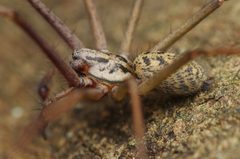
Eratigena atrica is a large funnel-weaving spider native to continental Europe and introduced to North America. It is among the largest spiders of Central and Northern Europe, with mature females reaching 11–16 mm body length and males 10–14 mm. The is closely related to E. duellica and E. saeva, forming a morphologically similar species group distinguishable only by palp and epigyne features. E. atrica shows no evidence of hybridization with these relatives.
Pronunciation
How to pronounce Eratigena atrica: //ˌɛr.əˈtɪ.dʒə.nə əˈtraɪ.kə//
These audio files are automatically generated. While they are not always 100% accurate, they are a good starting point.
Identification
Distinguished from co-occurring Eratigena (E. duellica, E. saeva) by palp in males and epigyne structure in females; these relatives are morphologically identical in overall appearance and . Males have legs approximately three times body length, females twice body length. Overall coloration is brownish-grey with paler abdominal patches forming -facing chevrons toward the rear.
Images
Habitat
Human habitation and environs; also thrives under stones and logs, in tree cavities, and beneath overhanging earth banks far from immediate human influences.
Distribution
Native to continental Europe; widespread across Europe and northern Asia (excluding China). Introduced to North America, with established in Canada (British Columbia) and USA (Pacific Northwest). In Britain, self-sustaining populations occur in Newcastle-upon-Tyne area and Perth/Dundee region of eastern Scotland, likely from accidental importation via ports.
Seasonality
mature August–September; males emerge slightly before females. Spiderlings emerge in fall (contrasting with E. agrestis, which emerges in spring).
Life Cycle
sacs laid in spring, each containing approximately 60–80 eggs. Both sexes overwinter as half-grown juveniles, mature the following August–September. Mating occurs in the female's web; males may cohabit briefly before dying. Females overwinter with stored sperm and commence laying egg sacs in spring. Some females survive for a third winter. Males live approximately 18 months; females typically two years or more.
Behavior
Makes sudden apparent appearances during late summer and autumn when mature. Constructs funnel-shaped webs.
Human Relevance
Frequently encountered in human dwellings, earning the "Giant House Spider." Often mistaken for more dangerous due to large size and rapid movements.
Similar Taxa
- Eratigena agrestisCo-occurs in Pacific Northwest; distinguished by spring of spiderlings versus fall emergence in E. atrica
- Eratigena duellicaMorphologically identical in overall appearance and ; distinguished by palp and epigyne features only
- Eratigena saevaMorphologically identical in overall appearance and ; distinguished by palp and epigyne features only; E. atrica shows no evidence of hybridization with this unlike potential hybridization between E. duellica and E. saeva
Sources and further reading
- BugGuide
- GBIF taxonomy match
- iNaturalist taxon
- NCBI Taxonomy
- Catalogue of Life
- Bug Eric: Missing Sector Orbweaver, Zygiella x-notata
- Life-history data for the funnel weavers Eratigena agrestis and Eratigena atrica (Araneae: Agelenidae) in the Pacific Northwest of North America
- The genome sequence of the house spider, Eratigena atrica (C.L.Koch, 1843) (Araneae: Agelenidae).